Eridge Park venison stew

The retort of hunters’ guns sounded throughout our stay at Forgewood campsite on Eridge Park. Wandering through the forest, we startled a small deer. At the sound and sight of us galumphing over splintering wood, the deer fled in one flash of his white tail, back toward the hunters. When we returned to the campsite, we asked if they sold any venison shot on the estate. They did. And so I devised this stew for the campfire.
Venison stew cooked over the campfire
Serves 4

Ingredients
4 venison steaks, fat trimmed and cubed
1 onion, diced
1 large or 2 small carrots, diced
2 cloves of garlic, peeled
Olive oil
Knob of butter
Couple of tablespoons of plain flour
Salt and black pepper
3 cloves
1 stick cinnamon
3 or 4 cardamon pods
1 bay leaf
Two slivers of orange peel

Method
Marinate the venison in oil, salt, pepper, bay leaf, onion and carrot for about an hour.
I cooked this stew in a large, lidded billy can over a wood fire, but it could be done in any lidded pan on a gas stove. I heated a pan over the fire and put in the marinated meat. Once the meat was browned all over, I added some water, the spices and orange peel, put the lid on and left it cooking for half an hour or so.
venison stew and cath
Meanwhile I made a thickener with flour and soft butter, mushing it with the back of a fork until completely incorporated. I mixed this thickener with a bit of the liquid from the pan and then stirred it all into the stew. I cooked the stew some more, regularly stirring it and checking it had enough liquid. Once the meat was tender, I crushed the garlic against the side of the pan and stirred it in. Once seasoned the stew was served with fried gnocchi and a watercress, raisin and pine nut salad.

How to cook pancakes on a campfire

I cooked a big batch of small, fat American-style pancakes for breakfast in the woods. I used a muurikka, a large skillet on legs that sits over a hot campfire. The muurikka was new so it required seasoning with a hunk of pork fat. It is a large pan, so I could cook nearly all pancakes and bacon for five people at once: result.

The weighing-out of the “dry” ingredients is best done at home and then, once at camp, you can add the “wet” ingredients. Remember to pack a whisk, a large bowl and something to measure the milk.

Dry ingredients

250g plain flour
1 tsp baking powder
1/2 tsp salt
1 tsp caster sugar

Wet ingredients, to be added before you cook

2 eggs
300ml milk (this generally equates to a large mug-full)
Butter for frying

Method

Put all the dry ingredients into a large mixing bowl and whisk in the eggs. Gradually add the milk, whisking all the time until you have a smooth batter. Batters should always be left to rest awhile, so you have time to set the campfire and heat up the muurikka (or whatever pan you are using). The pancakes should be cooked rather quickly so a small hot fire is ideal.

Once you have a rested batter and a hot pan, melt a knob of butter and add one large spoonful of batter to the pan per pancake. Once the pancakes start to bubble, it is time to flip and cook the other side. For each batch, melt another knob of butter before cooking more pancakes. Serve hot and with any of the following fillings:

Maple syrup and streaky bacon
Fried eggs and bacon
Fresh fruit
Fried bananas
Caramelized apples
Caramelized oranges

Cath’s campfire roast dinner: Lamb shoulder with aubergine and flat bread

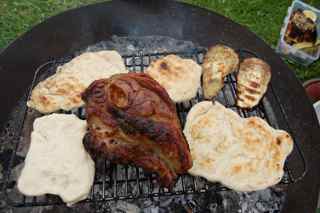
On a windy field in the Cotswolds, I roasted some lamb shoulder over a low campfire. The field was around the back of Abbey Home Farm with a view of the surrounding land, upon which the lamb in question had been organically reared.

I have cooked lamb shoulder steaks on an open fire before. They are an ideal cut for the campfire, with a goodly amount of fat, so they are less liable to dry out. I reckoned a larger joint might work.
Math set the fire and balanced a grill, keeping the meat well out of the flames, but close enough so that it would cook. I rubbed the joint with salt, pepper and olive oil and placed it on the grill. After turning it a couple of times, it was browned and sealed. To speed up the cooking and keep moisture in, I then wrapped it in tin foil. I can’t give cooking times, because it depends on the ferocity of the fire. A joint like this, with a substantial bone in it and side of fat, doesn’t require exact timings.
Cath prepares flatbreads for the campfire
Once it was nearly cooked, I removed the joint from the foil and exposed it to the fire again, to crisp up the outside. I am considering taking a meat thermometer on my next camping trip, Math thinks this is a utensil too far, but for cooking larger joints of meat on the fire I’m going to put it down as a necessity. I am quite good at telling when meat is cooked by pressing it and judging how bouncy it is, but the bigger the joint, the harder that is to do.
Once the lamb was ready, I set it aside to rest for fifteen minutes. Then I flapped some thin slices of aubergine down on the grill. Lightly charred aubergine has a smoky flavour that fits campfire cooking. For substance, I nudged some homemade flat bread dough onto the grill, the plan being to serve the lamb with the aubergine wrapped in garlicky, soft, warm bread. Here’s my recipe for making flat breads on a campfire.

Cath’s campfire flat breads
This takes a bit of prep at home, where I weigh out the dry ingredients and store them in a sealed plastic bag. I also take a little extra flour in case my dough turns out a little too wet.
Dry ingredients:
500g strong white bread flour
1 1/2 tsp dried yeast
1 1/2 tsp salt
What to add at camp:
300ml warm water
1 clove garlic, finely sliced
4 or so tablespoons of olive oil

Make the dough as soon as the fire is lit. You want it to rise before you cook it. In a mixing bowl, put the dry ingredients and mix the water in with your hand. You can knead the dough in the bowl. Do this for at least five minutes, ten if you can. You want a smooth dough, not too wet or dry. Add some more flour or water to achieve this. Leave it in the bowl covered with a damp tea towel by the side of the fire, so that the dough rises.
Leave it for at least forty minutes, longer if you can. Finely slice the garlic clove and mix it into the olive oil. Once you are ready to cook the breads, shape them by pulling off tangerine-sized lumps of dough, roll it into a ball in your hand and then flatten it as thin as you can, dip it into the garlic flavoured oil and throw it on the grill. Once the underside is browning and bubbling up a little, flip the bread over to cook the other side. Serve immediately.

Sliced aubergine grilled over the campfire
2 aubergines
Olive oil
1 clove garlic
Salt and black pepper

This is so simple. Aubergines thrive when cooked over a fire, getting just the right smoky crisp texture. Simply slice the aubergine 1/2 cm thick, brush with quite a lot of oil, but not so it is dripping. Cook over your fire until it is charring, flipping once. Crush a clove of garlic and put in a serving bowl with salt and pepper. When each slice is done on both sides, put it in your serving bowl with the salt, pepper and crushed garlic. Mix thoroughly, you can eat hot, warm or cold.

Abbey Home Farm


View Campsites, campfires, UK in a larger map

Foraging and campfire cooking at Wowo

We spent a sunny weekend at WOWO, the campsite of Waspbourne Manor Farm in East Sussex. During our visit, the people running the campsite generously cooked up a wild garlic soup to share with the campers, and this inspired me to cook up some ideas of my own.

Sausage and wild garlic stew cooking on the campfire

A large patch of wild garlic leaves grows in the shady areas under the trees by the Tipi trail. You can smell the garlic as you approach; it grows in such abundance that we were allowed to gather as much as we wanted. It is the leaves that you cook with, treating them as you would spinach or as a strong salad leaf.

wild garlic leaves at WOWO campsite
Wild garlic leaves at WOWO campsite

I took the toddlers and a carrier bag and collected enough for two ‘made up on the spot’ recipes. As Matthew set the fire, I washed and chopped a good handful of wild garlic leaves and some flat-leaf parsley. I then mashed it up with a fork along with a pinch of sea salt, a knob of butter and some lemon juice.

Cath and kids picking wild garlic leaves at wowo campsite

Once the fire was going I toasted some slices of home-made bread that I sprayed with olive oil. Once they were toasted on both sides, I rubbed in the wild garlic leaf mixture and ate it without ceremony; Wild Garlic bread.

Sausage stew with wild garlic leaves for 4

The main course was a sausage stew with wilted garlic leaves. I had some Italian style sausages from Tablehurst Farm and decided to stew them rather than grill them over the campfire. They are meatier than British bangers and so stew well without falling to bits. I had a loaf of bread I made at home; I sprayed it with olive oil and toasted it over the fire. The garlic leaves give a fresh garlicky taste, not harsh at all and barely need cooking.

Ingredients
8 decent Italian or Toulouse sausages
1 tin of chopped tomatoes
1 sprig of rosemary
1 onion, chopped
Olive oil
Salt and black pepper
2 red peppers
2 handfuls of freshly picked wild garlic leaves, washed

Method
Roast the red peppers on the campfire until they are blackened, then skin and chop them. Meanwhile, heat the oil and gently cook the onion, then add the sausages and rosemary and fry for a minute or two before adding the tomatoes. Season with salt and pepper and simmer covered until the sausages are cooked through. You may need to add some water if your stew looks like it may stick. Don’t forget to add the peppers when they are done. Take the stew off the heat and stir in the leaves, they will wilt very quickly. One last taste for seasoning and serve with toasted bread, pasta or new potatoes.
Tags: foraging, sausages, stew, one-pot meals,

Tablehurst farm

WOWO campsite

View Campsites, campfires, UK in a larger map

Just Pitched Dinners

Camping requires a lot of planning and prep. Don’t leave the first meal to chance. After all that packing, travelling, unloading, and pitching, you deserve to eat something good in front of the perfectly pitched tent.
just-pitched-dinners
The trip to the supermarket to load up on pre-packaged picnic stuff just doesn’t do it for me anymore, hauling mounds of plastic pasty wrappers to the bins is not only embarassing, but a major hassle. Some sites make you take your rubbish home, this really gets you thinking: one way to leave no trace is to take your food with you in proper reusable containers.
After the exertions of the day you need something filling, nutritious, easy and lovely. The key is to get a one-pot meal that contains everything you need: carbs, protein, vegetables with maybe some bread to spin it out. Good containers to transport your meal with tight-fitting lids are needed. Once cleaned, they can be used again during your trip to keep other foods fresh.
It’s beer o’clock and someone in your party is likely to be shouting “Where’s me dinner?” Take it with you, heat it up, problem solved.

Cath’s Just Pitched Dinners
Spanish meatballs
Veggie chilli
Spanish tortilla
Chicken pie

Just Pitched Veggie chilli

I love veggie chilli, I serve it at home with wholemeal soft flour tortillas, pickled jalapenos and guacamole. What you take to camp is really what you can manage. Like many stews, chilli benefits from a day’s rest before eating so is perfect to heat up on a one ring stove. This recipe is more tasty than spicy. The same flavourings can be used for a beef or chicken chilli: substitute the beans for the meat, which you fry off before adding the other ingredients.

Ingredients
250g dried black turtle beans, soaked for 24 hours, or 2 x 240g tins, drained
240g tin of chopped tomatoes
1 large or 2 small carrots, diced
1 onion, chopped
1 stick of celery, diced
1 red pepper, roasted, skinned and chopped
1 clove garlic, peeled
1 bay leaf
2 dried kashmiri chillis
1 tsp chilli powder
1 star anise, crushed
1 tsp ground cumin
1 tsp ground coriander
2 cloves, crushed
1 tsp cinnamon
1 tsp ground caraway seeds
1 handful raisins
1 handful flaked almonds
1 tbs cocoa powder
1 handful fresh coriander, chopped
Salt
Juice of 1 lime

Method

The beans
If using dried beans, once they have been soaked for 24 hours, put them in a large pan with enough water to cover them plus about 5cm. Add the onion, carrot, celery, garlic, chillis and bay leaf. Bring to the boil, put the lid on and simmer for 1 1/2 to 2 hours until they are soft and edible. Keep an eye on them, if the water runs out top it up otherwise the beans will stick and burn.
If you are using tinned beans, then drain them. Fry the carrot, onion, garlic, celery in a little onion, then add the beans and chillis and cover with 1 to 2cm of water. Cook for 15 to 20 minutes until they are soft and edible, don’t let them burn.

The spices and finishing off
Grind the whole spices. Add them to your pot along with the other already ground spices. Add the tin of tomatoes and cook for 10 minutes. Add the cocoa, raisins, almonds and red pepper, cook through. Once the dish is fragrant and tasty, then you can add the salt, lime and fresh coriander. You may want a spicier dish in which case add a little more dried chilli powder and cook it through.
You can serve it now, or it will heat up easily, you may need to add some water when reheating to stop the beans sticking. Serve with soft flour tortillas, yogurt and guacamole.

Just Pitched Chicken Pie

Serves 4

I made two little pies with asparagus and chicken for our tea when we went to Glastonbury. As I burnt the first load of pastry, which I had bought, I had to then whip up another batch. So we had one pie with shop-bought and one with home-made, the home-made won the taste test. If you have time and the inclination then make your own.

This is perfect if you have leftover meat from a roast dinner: you can add more vegetables if you have less meat or top it up with some fried bacon. I like to layer pies, ensuring everyone gets a bit of everything.

If the peas or asparagus are late season ones i.e. bigger than new season, then steam them for a couple of minutes before adding to the pie. New season vegetables are sufficiently tender to go in uncooked.

I use a 26cm oblong enamel pie dish, the old fashioned kind, which is white with a blue rim.

Ingredients

Pastry
1 portion rich short crust pastry, 500g packet shop bought or home-made, instructions below
225g plain flour
110g butter, straight from the fridge, cubed
2 egg yolks mixed with 2 tbs very cold water
A pinch of salt

Pie filling
450g chicken or approximately 2 breasts and 2 thighs of a small chicken, cooked, boned and sliced into generous pieces
2 leeks, cut once lengthways, washed then very finely sliced into half-moon shapes
1 tbs olive oil
1 clove garlic, chopped
50g butter
500ml liquid, a mixture of milk and chicken stock
75g plain flour
Salt and pepper
2 tbs parsley, chopped
100g/handful of seasonal green vegetables, fresh peas or young asparagus, cut into 2cm lengths are ideal
Rind of a lemon
1 egg, beaten

Method
Heat the oven to 200°C

How to make the pastry
If you are making the pastry, get going with it first. Sieve the flour, add a pinch of salt and rub the cold butter into the flour until you have a breadcrumb-like mixture. Add the egg yolks and water and mix with a knife, then bring the dough together with your hand. Add a little more water if the pastry doesn’t come together. A shortcrust pastry is best, so don’t make it soggy, it will turn out hard.
Cool in the fridge for 30 minutes wrapped in cling film.

Making the pie
Roll out 2/3 of the pastry and line the pie dish. Don’t make it too thick, as you will run out of pastry. A pie with too much pastry and not enough filling is a bad thing. Shortcrust pastry is – as its name suggests – very short and sometimes hard to handle. If yours breaks then you can patch it up in the pie dish, no one will know, just make the top look good. Trim the edge of the pastry all round the dish. Prick the base of the pastry lightly with a fork, so it doesn’t rise, cover with greaseproof paper and fill with baking beans. Blind bake for ten minutes.

While the pastry case is cooking, gently heat the oil and fry the leeks and garlic with a pinch of salt until they are soft and bright green – don’t rush this, leeks can go papery very easily. Make the white sauce by melting the butter in a small saucepan, remove from the heat and add the flour. Beat well with a wooden spoon, so you have one ball of mixture in the pan. Cook very gently for five to eight minutes; you want to cook the flour, but not burn it. Take it off the heat. Add the liquid bit by bit, mixing well after each spoonful. Once the liquid is incorporated, then cook gently until the sauce thickens, season and add the parsley. You want quite a thick white sauce so it holds together in your pie.

Once the pastry case is cooked, take it out, remove the paper and baking beans. Layer the pie filling, seasoning well with salt and pepper: leeks first, chicken, lemon rind, peas or asparagus and lastly white sauce.

Brush the edges of the pastry with the beaten egg and roll out the remaining pastry and cover the pie, pinch the edges to seal the pie and trim the excess. Brush the top with beaten egg and cut two slits in the top for the steam to escape. Cook in the oven for 25 to 30 minutes, the meat needs to be fully heated through, so if you put in cold meat you will need the full 30 minutes.

If your pastry top is burning, cover it with greaseproof paper. If the meat was still hot when you put it in, as soon as the pastry is cooked on top, your pie is ready. Take out and cool, cover when cold and take it camping with you in a cool box.

Just Pitched Spanish meatballs

Serves 4

Prepare this at home and take it with you in two pots: one containing the sauce, and the other holding the meatballs.
Once at camp, all you need is a one-ring cooker, (or two-ring if you are cooking rice or potatoes), a large, lidded saucepan and wooden spoon. Once pitched, all you need to do is warm the sauce and add the meatballs until they are cooked through.
Serve on the first night outside your tent with Rioja.

Ingredients

For the meatballs
500g minced pork
Grated zest of a lemon
1 dried bay leaf, crushed
1 tbs sherry
Salt and pepper
½ onion grated
¼ tsp smoked paprika
1 egg
1 handful breadcrumbs

For the sauce
1 small onion, finely sliced
½ green pepper, finely sliced
1 clove garlic, chopped
Olive oil
¼ tsp smoked paprika
1 small glass sherry
1 pt chicken or vegetable stock (fresh or from cube)
Salt and pepper
½ tin tomatoes
2 tbs parsley, chopped

Method
Put all the ingredients for the meatballs in a bowl and mix together with your hands for five minutes.
Make the mixture into walnut-sized balls between your palms. Keep them in the fridge until you are ready to cook them.
Heat a ridged cast-iron grill pan, for example Le Creuset and when it is very hot, cook the meatballs. If you use a normal frying pan, add a splash of olive oil to cook in.

Brown the meatballs on all sides, do them in two or three batches if necessary. An overloaded pan won’t give you the browned crispy edges you need for this dish. Don’t wriggle the meatballs around, wait until they are brown on one side and then move them over to brown on another side. Do this with a fish slice and slide it under the meatball along the ridge-line of the pan.

What you want is a meatball that is browned and sealed all over but not cooked through. You cook it through once it is in the sauce, thereby keeping it moist but intact. If you are taking the meatballs and sauce separately to reheat at camp, then put the meatballs in a container, and seal it once they have cooled.

Now get on with the sauce.

Heat the oil in a pan and slowly fry the green pepper, onion and garlic. Once soft, add the sherry and apply a higher heat for a few minutes to cook off the alcohol. Add the stock, tomatoes, paprika, parsley and salt and pepper. Bring to the boil and then cook gently for ten minutes or so.

At camp, heat the sauce up, add the meatballs and cook gently until they are cooked through: the meat needs to be piping hot. Keep an eye on the consistency of the sauce, not too gloopy and not too thin. Check the seasoning and serve with some carbs. Crusty bread will do perfectly.

Just Pitched Spanish tortilla

Serves 4

I have been making this tortilla for years, it is a real store cupboard recipe. Waxy potatoes are a must, floury ones like King Edwards will fall apart and leave you with just oniony mashed potatoes. Older new potatoes are ideal, as they are waxy, but less work than new potatoes because they are bigger. Slice them lengthways as thinly as you can, or use a mandoline.
Serve with salad and a mild cheese like Ossau Irraty or Manchego and membrillo.

Ingredients
500g onion, thinly sliced
750g waxy potatoes, scrubbed (not peeled) and sliced thinly, 3mm thickness
3 eggs, beaten
Olive oil
Salt and pepper
2 tbs fresh oregano, chopped

Method
Boil the potatoes for seven minutes in salted water. They should be just cooked, but not falling apart. While they are cooking, gently fry the onions in oil and a pinch of salt until they are soft, sweet and browning.

Drain the potatoes and put them back into the dry pan over a low heat for a couple of minutes. This is so they dry out as wet potatoes will cause you trouble. Don’t take your eyes off of them or they will burn. Mix in the cooked onions and stir in the beaten eggs and pepper, do this gently so you don’t break up the potatoes.

Heat the oil in a decent non-stick frying pan. Once the oil is hot, add the potato, onion and egg mixture, squashing it down into the pan a little. Turn the heat to medium and wait for the eggs to cook. Use a spatula or fish slice to look under the tortilla.

Once it is browning, you are ready to turn it over. Loosen the tortilla all the way round with a blunt knife. Turn the heat off, place a large plate over the pan and a rolled up tea-towel over that. Turn the pan upside down, the tortilla should come out cleanly. Wipe the pan down with kitchen towel and heat another tablespoon of oil. Once hot, slide in the tortilla to cook the other side. Once both sides are cooked, serve onto a plate, season with salt and oregano. Wait for it to cool. You can serve it at room temperature or cold.

Variations
Add 1/2 red pepper, thinly sliced and cooked with the onions.
Add a clove of garlic to cook with the onions.
Add a couple of slices of Serrano ham, shredded.
Add chives or parsley instead of oregano

Five-a-day barbecue

For a carnivore, a barbeque can easily become too meaty: a sausage, a lamb chop, a chicken drumstick, oh and one of those minute steaks too – it all adds up. Ketchup does not count as one of the five-a-day. Here are my recommendations for vegetable dishes to cook on the barbecue to break up the monotony of sausages.weber-bbq-on-beach

Asparagus
New season asparagus brushed with olive oil and quickly grilled over the barbeque is perfect. At its best from late May through to June. Season with salt and pepper.

Banana chillis stuffed with halloumi

Corn on the cob
For this old favourite, the fresher the corn the better. As soon as corn is picked it begins to deteriorate, the texture goes chalky and the sweetness starts to go. If the cobs are in their husks, wet the husks so they don’t catch fire. If the cob does not have the protective husk, brush the kernels lightly with oil and cook, turning frequently. Serve the cobs with butter that has been mixed with finely chopped red chillli, chopped parsley and sea salt.

Peppers and anchovies
Halve red and yellow peppers, brush the skin lightly with olive oil and fill each half with a couple of roughly chopped anchovies, a few capers, black pepper and some oil out of the anchovy jar. Grill over the barbeque until the peppers soften and start to char. Serve with torn basil leaves.

Tangy tomato relish to go with vegetable kebabs and/or red meat

Sweetcorn relish

Vegetable kebabs