The Art of Camping: The History and Practice of Sleeping Under the Stars is out now in Penguin paperback.
http://www.facebook.com/artofcamping
Reviews
Does for camping what Roger Deakin did for wild swimming. (Independent )
A delightful combination of history and memoir with a generous dollop of guidance thrown on top . . . read this gem of a book. (Economist )
An elegant ode to the joys of camping. All sorts of tips on campsite etiquette, lore, equipment, and best practice, and his advice is convincing and honest. He is a lovely writer and his history is enlivened with tremendous flashes of wit. (Daily Telegraph)Teaming witty anecdotes with a potted history of what sleeping under the stars means sociologically, De Abaitua makes learning how to create a tented home away from home fun. (Elle)De Abaitua will soon have you believing in this consistently engaging and enjoyable book. It’s a fine writer indeed who can seem authoritative, approachable and just great fun. (Metro)
“The Art of Camping is the perfect chiarascuro of personal observation, wit and insight, with a detailed – but never over-egged – history of a stream athwart the main current of urbanised life. The entire hidden under-the-groundsheet history of camping provides such a fascinating perspective from which to look back on the follies of the permanently settled, while, in and of itself, it turned out to be a vital strand in the liberation movements of the 20th century.” Will Self.
Could there be another way of life? Can I survive with less stuff? Should I run for the hills?
These are all good questions that people have asked before, throughout history, and which have inspired people to set up camp. But now camping is part of the drive for self-sufficiency, a reaction against mass tourism, a chance to connect with the land, to experience a community, to leave no trace . . .
From packing to pitching, with hikes into the deep history of the subject and encounters with the great campers and camping movements of the past, the Art of Camping is a witty and philosophical blend of ‘how to’, history and personal anecdotes – a must for every camper.
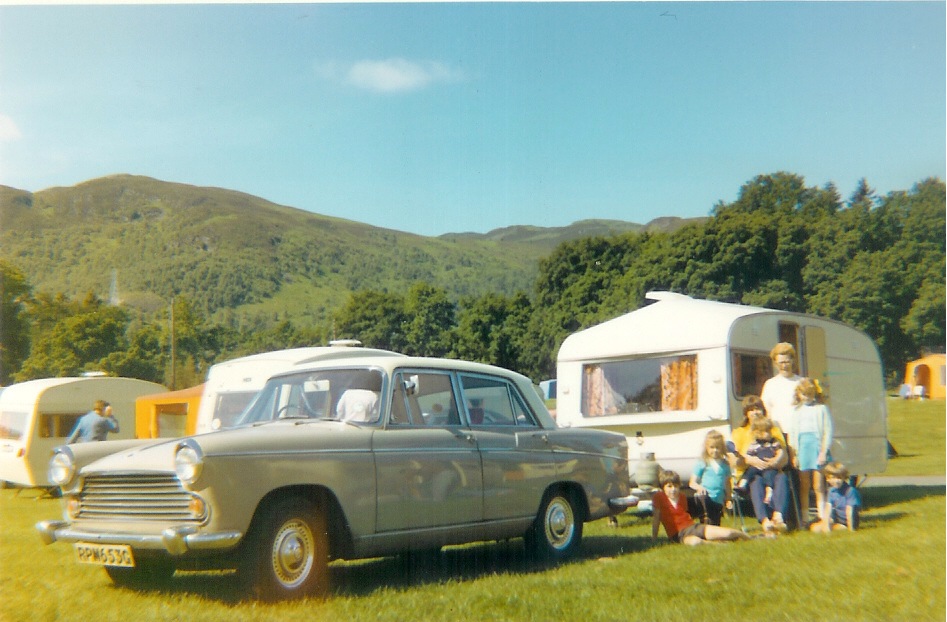
My parents gave up camping after my father Eddie, a policeman, was injured during the Toxteth riots. Convalescing, he didn’t fancy wrangling the enormous frame tent onto the roof rack and was finally in a financial position to buy a modest caravan.
My grandparents had owned a caravan. I have a vague memory of being allowed to sleep in it while the rest of my family slept in the awning: I was the youngest, after all.
On our first trip in Eddie’s new caravan, it fell to me to perform the tasks that might have aggravated his injury: to drag the caravan onto its immaculate cut-grass pitch, to put down the four legs with a wheel wrench, to fetch the water and empty the waste. My parents were cautious types: they liked the assurance and peace of mind that came from Caravan Club sites and Caravan Club insurance. My mother’s great fear, often voiced, was that they would one day find themselves accidentally driving down the Champs Elysees with the caravan, like one of those anxiety dreams in which you find yourself naked on a train.
As a committed camper, I’ve taken a different path from the rest of my family. My sister has a caravan, my brother had a caravan while he was in the UK. They would meet for caravan holidays and I would occasionally camp with my wife and children somewhere nearby: I like a campfire, and while caravanners and campers can get on, campfires and caravans most definitely do not.
The difference between campers and caravanners can be summed up in one detail from a Mass Observation report in 1970: when campers were asked ‘No Matter How Much You Like It, You Have to Admit Camping Can Be Pretty Miserable Some of the Time’, seventy-two per cent of them agreed with the statement. When the same question was put to caravanners, only fifty-five per cent agreed. Caravanning spares its followers the worst of the indignities and discomforts suffered by campers.
While researching my history of camping The Art of Camping: The History and Practice of Sleeping Under the Stars, I came across a few details about the early history of caravanning that I couldn’t use in the book but can share now.
I was surprised to discover that caravanning was referred to as ‘land yachting’ in the Edwardian era and that writer H Rider Haggard, author of She and King Solomon’s Mines, was one-time chair of the Caravan Club. In the summer of 1907 Lady Arthur Grosvenor, sister-in-law to the Duke of Westminster, travelled through Oxfordshire disguised as a gypsy and calling herself Syeira Lee. She was bound for Ascot, of course. It was part of the bohemian vogue for all things gypsy, with artists of the time such as Augustus John affecting the dash of the ‘Romany Rye’.Rider Haggard took against the new fangled motor caravan and protested strongly against the innovation, saying:
‘Nowadays people are going a good deal too fast and are trying to cram into one day what they should do in a week. Motors are making life intolerable. I believe that the world is going far too rapidly and that we shall have to pay for it. Caravaning tends to counteract the evils of the day; it gives people time to think and brings them into contact with nature.’
Another early advocate of caravanning Bertram Smith toured Britain in 1907 and wrote Caravan Days, his homage to his pursuit. Bertram Smith always slept on a veranda in the open air, summer and winter alike. As a young man in Liverpool (the home town of my parents), he toured the Cheshire lanes by night and at weekend. His caravan was drawn by two horse, Sam and Simon, and his driver and handy man was called Herbert, and he slept nearby in an Alpine tent of about seven foot square. Bertram Smith had been a keen camper and was perceptive about the differences between it and caravanning:
‘Caravanning is sometimes attacked for its complexity and elaboration, compared with camping-out. But it is of a different order altogether. By all means if you are going to live in a tent and I am myself a keen lover of canvas cut down your necessities and simplify to the last degree. But the special charm of a caravan is in complexity and completeness, the whole fun of it is to bring with you a dwelling fitted out in every detail, even to shoe-horns and paper-knives.’
I contribute to Radio 4’s excellent programme on camping food, along with the Guyrope Gourmet himself, Josh Sutton, and presented by Fire And Knives founder Tim Hayward. I think it will be available on iPlayer for a while.
Being brief readings from Matthew’s De Abaitua’s book The Art of Camping: The History and Practice of Sleeping Under the Stars (Hamish Hamilton) mixed with campfire tracks by the legendary Richard Norris (The Time and Space Machine, Beyond the Wizard’s Sleeve).
Voice: Matthew De Abaitua
Mix: Richard Norris
Recorded and mixed in Lewes, East Sussex.
4. The Fire in My Head by Voice of the Seven Woods from the album Voice of the Seven Woods. Reading from ‘In Yosemite with John Muir’ by Theodore Roosevelt from his An Autobiography (1913), and quoted in The Art of Camping.
5.Farmland, Freeland by The Advisory Circle from the album Other Channels. Reading from Letter to the Editor of Forest and Stream by Nessmuk, quoted in The Art of Camping.
6. Campfire by Grizzly Bear from the album Horn of Plenty. ‘How to Light a Fire Without a Match’ adapted from Ernest Thompson Seton’s Two Little Savages for The Art of Camping.
10. Ancient Campfire by Biosphere from the album Shenzhou. Reading ‘The Camping Years’ from Leslie Paul’s Angry Young Man, quoted in The Art of Camping.
Readers who are interested in discovering more about the history of camping should like our Art of Camping Facebook group. Photographs of the eccentric camping movements covered in the book will appear here and it will be place for new material on camping history as we discover it.
http://www.facebook.com/artofcamping
My essay on the River Mersey is included in the forthcoming paperback of Caught By The River’s collection of words on water, along with writers such as Roger Deakin, Chris Yates, Jarvis Cocker, Bill Drummond, Irvine Welsh and Jon Savage. The essay covers the time I worked as a security guard at Liverpool docks.
“The Mersey is an industrious river. Too wide and cold for pleasure boating, its toil is visible in the treacherous contrary current. At the Runcorn gap, its course is bounded by Runcorn Railway Bridge, a bracing engineering marvel of wrought iron lattice girders. The arch sweeps overhead like rollercoaster track. The engineering of man and nature compliment one another. Under dour daylight, the Mersey runs muddy and rusty. At dusk, it turns belly-up, showing a pallid steel hide. Neither nature nor industry are built to the scale of a man. To stand under a giant bridge that passes over a great river is to be doubly dwarfed.”
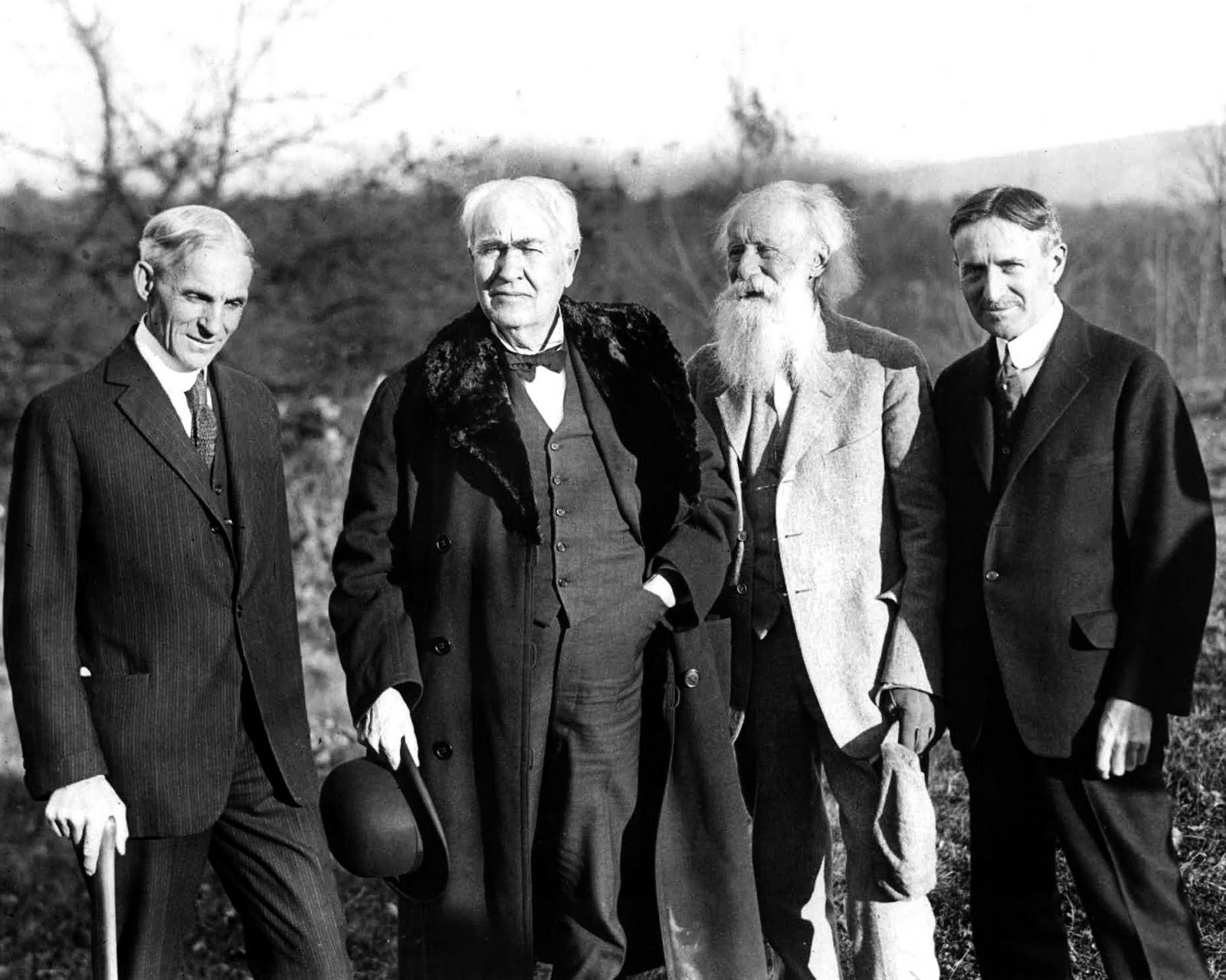
Henry Ford, Thomas Edison, John Burroughs and Harvey Firestone
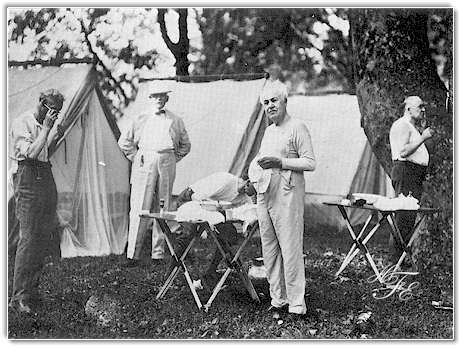
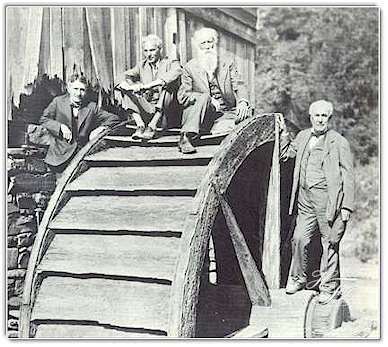
The most famous autocamper was Henry Ford. Every summer Ford undertook a camping tour with his friend Harvey Firestone, of Firestone tyres, and his mentor, Thomas Edison, the bringer of electric light. The fourth member of the party was the antithesis of the modern industrialist, the ageing writer John Burroughs, disciple of Walt Whitman and friend of Theodore Roosevelt.
Burroughs was a critic of the era of mass production, of which Ford’s cars and Edison’s light bulbs were potent symbols, but he had been courted by Ford, and his presence on the trips was a symbol of two American centuries meeting around the campfire.
Henry Ford was a farm boy who couldn’t read a blueprint. He was nervous and energetic, emotionally immature, and puritan in matters of intoxication. A genius with his hands rather than his head, he did not read many books, but he did read the works of John Burroughs, due to his interest in birdspotting. In December 1912, Ford wrote to Burroughs telling him that few persons in the world had given him as much pleasure as he had. In return, he wanted to do something for Burroughs. He wanted to give him a car. He assured Burroughs that it was not a publicity stunt, and the car could be there by January.
Burroughs had misgivings. He was seventy-five years old, an advanced aged for a learner driver. Friends persuaded him to accept the gift and the old man spent the winter attempting to master it, with comically haphazard results. Behind the wheel, he was easily distracted by rare birds or plants, and would take his eyes off the road to follow its flight, his white bushy head rattling as the car bumped over the farm track. Driving scared him. He was not the master of the car. This technology was an unbroken horse with a will of its own.
The gift achieved Ford’s intended aim, which was to meet his hero. In June, Burroughs travelled to Detroit to visit Henry Ford. The two men got on. After a tour of the Ford factory, Burroughs described the manufacturing process with the eyes of a nature writer; it was a “wilderness of men and machinery covering over forty acres. The Ford cars grow before your eyes, and every day a thousand of them issue from the rear.” After returning home to Roxbury, Burroughs went to park his car in the barn but “it run wild”, bursting through the side of the building and rattling on to a drop of fifteen feet. The forward axle went out over the edge but the wheels caught enough purchase to prevent the car landing at the foot of the steep hill. He regarded the accident with shame. The old fool should not have dabbled with technology. Four vagabonds on a water wheel: Harvey Firestone Henry Ford John Burroughs and Thomas Edison
Ford’s courting of Burroughs continued. In September, Henry Ford undertook a pilgrimage in Burroughs’ company to Concord to visit Thoreau’s pond at Walden and the house of Ralph Waldo Emerson, the central figure of The Philosophers’ Camp of 1850. The camping trips that Ford, Burroughs, Thomas Edison and Harvey Firestone undertook echoed the transcendentalist gathering in their assertion that camp is a fitting place to thrash out solutions to the issues of the day. Only at camp, removed from the demands and pressures of daily life, could great men discern the greater good.
Ford and Burroughs’ visited Thomas Edison’s home in Fort Meyer in Florida. Edison was a decade younger than Burroughs, and sixteen years older than Ford, or as Burroughs put it, “Mr Edison and Mr Ford are as young as I am, but no younger.” The public images of all three men relied upon their physical vigour. Burroughs was uncommonly fit for a man in his seventies. When dallying at a cliff edge, it was suggested to him that he show caution and step back. In defiance, the old man sprang onto this hands, his feet in the air, to prove there was no danger. In his early fifties, Henry Ford could run like a deer, and prided himself upon his high kicks and leaps. Edison had many famous pronouncements concerning diet and sleep, claiming that he subsisted on four or five hours rest a night and ate a sparing diet of toast and hot milk. Their camping trips saw the suspension of Edison’s frugal regime; as Burroughs’ diary of his first visit to Florida relates, “We begin the day so late here… Edison sleeps ten to twelve hours in the twenty-four; says he can store up enough sleep to last him two years.”
Edison suggested that the men and their wives should take a break from Fort Meyer and go down to the Everglades and revert back to nature. “We will get away from fictitious civilisation,” said Edison to a reporter, “and we expect to be happy and learn much.” In early March, the party slipped away for two days camping, with two guides and a cook. The trip was a success. More ambitious camping trips were to follow, billed by The Washington Times as “Edison and Ford to go back to nature”.
Taken from The Art of Camping: The History and Practice of Sleeping Under the Stars by Matthew De Abaitua and published by Penguin
Colonel T Coleman Du Pont was an arms dealer, an elected senator and, in the words of President Taft, “as slippery as an eel and crooked as a ram’s horn.” He was also the inventor of the “Camping Car”.
T Coleman Du Pont had a 1911 Stoddard-Dayton “Camping Car” built to his specifications so that he could live in it for long stretches with all the comforts of home. The interior accommodated a six foot hair mattress, the exterior had racks and packs for supplies, lockers for carrying stoves and a long box on each running board in which the tent was kept.
The tent was made of balloon waterproof silk and supported by six tent poles, each six feet high. When the car tent was pitched, it consisted of three compartments, with the interior of the car acting as a bedroom, abutted by two boxy tent rooms. T Coleman Du Pont’s camping car also came with electric light, powered by one of Thomas Edison’s storage batteries constantly charged by a dynamo powered by the engine.
T Coleman Du Pont required a camping car to monitor the progress of a road he wanted built across Delaware, a one million and three hundred thousand dollar, ninety-six mile long monument to himself. The construction workers also camped, even through the snow, when they were mainly preoccupied with keeping warm, playing cards, drinking and fighting.
‘Picnic Point’ in ‘Three Men in a Boat’ by Jerome K Jerome
A trio of liverish young men and their dog float up the Thames in a camping skiff. They finally pitch their tent at a spot called Picnic Point, near Runnymede, a very pleasant nook under a great elm tree. Yanking the hooped canvas over the boat almost defeats them, but the effort of camping is rewarded; they wake to a soft morning, the river in sunlight, and a view of timeless Englishness.
Mesquite country, Southwest Texas in ‘Freedom’ by Jonathan Franzen
Walter Berglund rejects the corporate way, and takes his young lover Lalitha camping. It’s been a hell of ride for Walter. This camp, filled with birdsong and empty of people, is a blissful interval between crisis and tragedy. Jonathan Franzen recently wrote of his own experiences camping alone on Selkirk Island (reputedly Crusoe’s island) to commemorate his friend and writer, David Foster Wallace.
Jackson’s Island, ‘The Adventures of Huckleberry Finn’ by Mark Twain
The densely wooded Jackson’s Island stands in the middle of the Mississippi River. Huck sets up camp here for three nights. He picks strawberries and green summer grapes, lands catfish and roasts them over a campfire. Islands are lonesome places; Huck smokes, counts the stars, and inspires generations of boys to follow him outdoors.
Swallowdale valley in ‘Swallowdale’ by Arthur Ransome
With their raft shipwrecked, the Swallows climb over a waterfall and discover the perfect valley campsite. With steep sheltering sides, a stream running through it, a pool for the washing up and a secret cave, the craggy landscape of Arthur Ransome’s Swallowdale offers handholds for the imagination of children and adults alike.