10 tips for camping with kids

In my time, I have taken three different babies to festivals, to well-equipped campsites and bare fields, and I took them by planes, trains and automobiles. And buses. Here’s how:

cath-and-math-with-two-baby-backpacks
Two baby backpacks with rain cover and rain suit

1. Sleeping
Where will they sleep? Tiny babies who can’t roll over go in Samsonite pop-up cots and then their larger bubble cot, which accommodates them until they are 18 months old. Vaude and Little Life also make good travel cots to use from birth to about two years old.

Keeping children warm at night is crucial. Each of my babies slept in a double-layered sleeping bag with zip-on sleeves. Doubling or tripling the number of children in one room also keeps them warm – like gerbils. I take small sheepskin rugs to go under the cot for extra insulation. For older children, thermarest trail mats suffice. They do not require as much puff as a standard blow-up bed.
Tents are hot places in the day, making afternoon naps a problem; I often wheeled the baby around in the buggy, letting them nod off as and when. A sun shade for the buggy is essential.
The worst part of camping with babies is traipsing around a tent in the middle of the night in your long johns looking for clean nappies, wipes or bottles. Try to keep the tent tidy and these essential items close to hand. Glow sticks make good night lights for toddlers and will give you enough light to change them by without startling them. Head torches are not just for pot-holers: a small head torch means you can keep both hands free if you need to change or rock an infant back to sleep again.

2. Eating
Breast milk is by far the most convenient food for a baby on holiday. There are no storage or hygiene issues to take care of.
Cleaning bottles and keeping enough milk is particularly troublesome at festivals; when I went to Glastonbury, I planned ahead and breastfed my youngest daughter, only knocking it on the head (breastfeeding not the baby) when I returned.

One top tip is to freeze the milk before you leave and then put it in a coolbag. The frozen bottles act as ice packs, keeping your other provisions cool.
At other times, I have nagged stall-holders for hot water to wash baby bottles with, and Math has even bought a glass of milk from them when required. For older, weaned babies make sure you arrive at camp with a couple of meals already prepped. Give them something to munch on while you pitch camp. They have no patience when it comes to their bellies, and will not wait while you struggle with the tent, so it’s up to you to have foresight.
[ad#Google Adsense-solid bar]
3. Weather
It will rain and your baby will want to crawl out of the tent to play in the puddles; waterproof suits (Muddy Puddles and Bush Baby make these) and waterproof booties (Bush Baby, Togz and Barts all make these) are good protection. If it is sunny the usual sun-cream, hats, full body coverage applies. Wellies for everyone.

4. Playing
Babies love the outdoors: they love the sounds of birdies singing, moo cows mooing and the wind blowing through the trees. They are quite interested in sticks they find on the ground and they like pulling grass up in their chubby little hands. Let them; dirt and the fresh air is why you took them camping.

5. Pitching
It’s hard to pitch a tent and look after the baby at the same time, especially if your tent requires two pairs of hands to erect. Arriving late at night is always pretty tough. Try your utmost to get there in daylight hours. Do a dry run and practise pitching any new tents before you travel, even if it means pitching it in the local park.

More >>> 6-10 Tips for Camping with Kids

Seven Things Every Camper Should Own

I contributed to The Guardian’s G2 camping trip with a brief list of essential camping gear. The Guardian writers camped not far from where I live, at Wowo, which Cath and I visited earlier in the year. I provided a list of seven items, one of which was salad, inspired by Cath’s five-a-day barbecue to stave off camper scurvy; another is a campfire tripod, made for me by a local blacksmith, Terry Tynehurst in Glynde.

cooking tripod

The Art of Camping paperback

The Art of Camping: The History and Practice of Sleeping Under the Stars is out now in Penguin paperback.

http://www.facebook.com/artofcamping
The Art of Camping paperback cover

Reviews
Does for camping what Roger Deakin did for wild swimming. (Independent )
A delightful combination of history and memoir with a generous dollop of guidance thrown on top . . . read this gem of a book. (Economist )
An elegant ode to the joys of camping. All sorts of tips on campsite etiquette, lore, equipment, and best practice, and his advice is convincing and honest. He is a lovely writer and his history is enlivened with tremendous flashes of wit. (Daily Telegraph)Teaming witty anecdotes with a potted history of what sleeping under the stars means sociologically, De Abaitua makes learning how to create a tented home away from home fun. (Elle)De Abaitua will soon have you believing in this consistently engaging and enjoyable book. It’s a fine writer indeed who can seem authoritative, approachable and just great fun. (Metro)

“The Art of Camping is the perfect chiarascuro of personal observation, wit and insight, with a detailed – but never over-egged – history of a stream athwart the main current of urbanised life. The entire hidden under-the-groundsheet history of camping provides such a fascinating perspective from which to look back on the follies of the permanently settled, while, in and of itself, it turned out to be a vital strand in the liberation movements of the 20th century.” Will Self.

Could there be another way of life? Can I survive with less stuff? Should I run for the hills?

These are all good questions that people have asked before, throughout history, and which have inspired people to set up camp. But now camping is part of the drive for self-sufficiency, a reaction against mass tourism, a chance to connect with the land, to experience a community, to leave no trace . . .


From packing to pitching, with hikes into the deep history of the subject and encounters with the great campers and camping movements of the past, the Art of Camping is a witty and philosophical blend of ‘how to’, history and personal anecdotes – a must for every camper.

Sleeping bag for a child

We needed a new sleeping bag for our eldest child Alice. We camp in the UK between the outer edge of spring and the chillier end of autumn, and so we plumped for a two-season red Starlight cocoon bag from Go Outdoors. Having outgrown her Vango bag, she enjoyed hunkering down in the extra space of the bag.

Walking along Doone Valley in Devon
Children walking in Doone Valley next to Cloud Farm

We took the new sleeping bag and the rest of our kit back to Cloud Farm in Dorset on the Bank Holiday in August. It was our third visit to the site. They don’t accept reservations and so seemed our best bet on the busiest camping day of the season. The site itself is beginning to look frayed at the edges: the shop not as well-stocked, a set of toilets locked up. But its main advantages outweigh the odd careworn feature: Cloud Farm permit campfires, the pitches line up alongside a shallow river, and the wild of the Doone Valley and the moors is right there. Over the weekend, the children barely left the water, paddling around and daring one another to bound over stepping stones. And finally they were old enough to walk a couple of miles from the site deep into Boone Valley. The footpath into the wild moors leads directly from the site, taking in an impressive variety of butterflies.

At night, we set a campfire to keep away any midges. Alice hunkered down into her new sleeping bag. The sleeping bag has a long heritage. In 1853, Lieutenant Creswell, the first officer ever to cover the north west passage, describes pitching a bet that combined a layer of macintosh with a piece of buffalo robe and a blanket sown up in the form of a bag.
The French douaniers, who watched the mountain passes of the Pyrenean frontier, used sleeping bags with wool inside. When not in use, they were folded up and buckled with five buckles into a knapsack weighing seven pounds – about twice the weight of Alice’s sleeping bag. The douaniers slept out at night in these bags. When traveling on a donkey across the Cevennes, the writer Robert Louis Stevenson adopted this way of camping too, eschewing the tent in favour of a sleeping bag that was six feet square and took a mule to carry it. And since I am the one who lugs the gear in our family, I am much happier with the one and half kilo Starlight cocoon bag than Stevenson’s wool-lined happy sack.

Can we unpack the camping gear?

We packed away our tent and gear last August after the End of the Road festival. It seemed an appropriate point at which to end. I spoke to a hundred people in rain-soaked glade wearing the braces and hard-wearing trousers that saw me through two summers of performing at festivals.

Matthew De Abaitua talking about The Art of Camping at The End of the Road Festival

And then the long winter set in and it’s mid-April and only now does it show signs of shifting. For first-time campers, it’s time to check out tents from Argos and their selection of camping equipment from torches to sleeping bags. A few times we’ve swung down to Argos to pick up head torches for the kids or a replacement camping kettle. Given the bad habits of the recent British climate, I’d be inclined to pack warm: that means a sleeping bag which is comfortable at temperatures below freezing, a silk sleeping bag liner, a good Thermarest sleeping mat, hat and gloves.

Last summer was pretty rotten for the camping season. It was July before the rain abated. At our annual group camp in the woods, half the people cried off at the last minute, citing gales. I am guessing that the late Spring is causing carnage with campsite bookings in the UK. Like many families at the moment, we can’t afford to fly anywhere and even paying for a ferry trip abroad is daunting. In the past, we’ve always braved the British climate with good cheer. What seems to have changed is its unremitting nature: that when cold and rain sets in, they persist without relief.

This will be the first summer for a long time that I won’t be traveling around performing at festivals, and instead I’m hoping to get the family out to somewhere wild: perhaps Calgary beach on the Isle of Mull, or the forests of the Czech Republic. But no firm plans yet. Also, I’m much fitter now than I was even last year, and can consider something more strenuous; treating myself to a solitary highland wild camp. I have another novel to complete first but at the first sign of prolonged sunshine, I know I won’t be able to stop myself from hauling the tent out again.

Tarp

I have wanted a tarp for a while now to create a sheltered area outside of the tent under which I could cook or loiter during a long rainy day. The Terra Nova Tarp Shelter is not cheap but it is extremely light and shimmers to the touch in a pleasingly quasi-organic fashion. The good people of Idealo.co.uk were kind enough to send me one to test out and you can find similar products on their site here. The Terra Nova Tarp Shelter is here.

The tarp comes without guy ropes or poles. Fortunately I had a some lying around, left over from my previous aborted attempt to turn a spare groundsheet into a tarp. I set to improvising the best way to set the tarp up, eventually arriving at this set up attached to my tent.

Tarp attached to Vaude Badawi II tent

If camping near a tree, I would have used a high branch instead of the exterior of our tent. There is a loop in the middle of the tarp that – if strung up to a tree – would make it drape in a triangle shape, ideal for sleeping under during a wild camp.

When the rain came, I cooked under the tarp and made a few notes on how to improve the pitching of it next time out. I’ll need more guy ropes, for a start. The tarp is full of possibility, a shelter against the sun, the wind and the rain. That’s why I’ve always hankered after one. I feel that I am only at the very beginning of mastering my tarp skills.

Update

The following weekend we camped at Forgewood in Kent in the pitch known as Nick’s Nook. This gave me the chance to pitch the tarp without poles and tethered to the surrounding trees. It makes such pleasing shapes.

How to put up a tarp in a wood

Du Pont’s Camping Auto

Colonel T Coleman Du Pont was an arms dealer, an elected senator and, in the words of President Taft, “as slippery as an eel and crooked as a ram’s horn.” He was also the inventor of the “Camping Car”.
Coleman Du Pont's camping auto

T Coleman Du Pont had a 1911 Stoddard-Dayton “Camping Car” built to his specifications so that he could live in it for long stretches with all the comforts of home. The interior accommodated a six foot hair mattress, the exterior had racks and packs for supplies, lockers for carrying stoves and a long box on each running board in which the tent was kept.

The tent was made of balloon waterproof silk and supported by six tent poles, each six feet high. When the car tent was pitched, it consisted of three compartments, with the interior of the car acting as a bedroom, abutted by two boxy tent rooms. T Coleman Du Pont’s camping car also came with electric light, powered by one of Thomas Edison’s storage batteries constantly charged by a dynamo powered by the engine.
Coleman Du Pont's camping auto car
T Coleman Du Pont required a camping car to monitor the progress of a road he wanted built across Delaware, a one million and three hundred thousand dollar, ninety-six mile long monument to himself. The construction workers also camped, even through the snow, when they were mainly preoccupied with keeping warm, playing cards, drinking and fighting.

Trangia gas burner

Cooking our last meal of the camping season at a festival in West Dean, the gas on our crappy cooker ran out. We couldn’t get a replacement canister and so had to eat vile claggy pasta cooked in lukewarm water. Enough, I thought. Enough of this stove; The Camping Gaz Camp Bistro.

camping gaz camp bistro: a piece of shitIt comes in a plastic briefcase that falls apart, it collects grease and gunk and because it has no shelter from the wind, it burns through fuel at an indecent rate. We do most of our cooking over the campfire so I had picked this up for the odd morning brew. But campfires are not always practical and quickly I began to resent the awfulness of this piece of kit.

I have always owned a Trangia but found the meths burner pretty unpleasant to use. Looking around for decent camping cookers, they all looked pretty rubbish. And then I spotted the Trangia gas burner.
Trangia gas burner
It’s a bit pricey but it fitted inside my existing Trangia which protects it from the wind. The burner gives off a brisk, intense heat. After a weekend using it to cook on the midge-infested grounds of Wales, I am a convert. Sometimes I wonder why it takes me so long to get around to the bloody obvious.

On sandals and socks

I was lying in my tent in the middle of a cold night when I received an urgent call from nature. I often camp in remote spots, seeking a connection with the land and respite from creditors. The call was urgent, and so I clambered over my sleeping wife, out of the inner tent and into the cold chamber under the flysheet.

I was wearing a thermal vest, long johns and thick hiking socks. To go outside, I would need footwear. In the corner of the tent, my boots – which require some lacing – and next to them, a pair of sandals. I gazed down at my stockinged feet, back at the sandals, and then at my sleeping wife:

Could I do it? Could I wear sandals and socks?

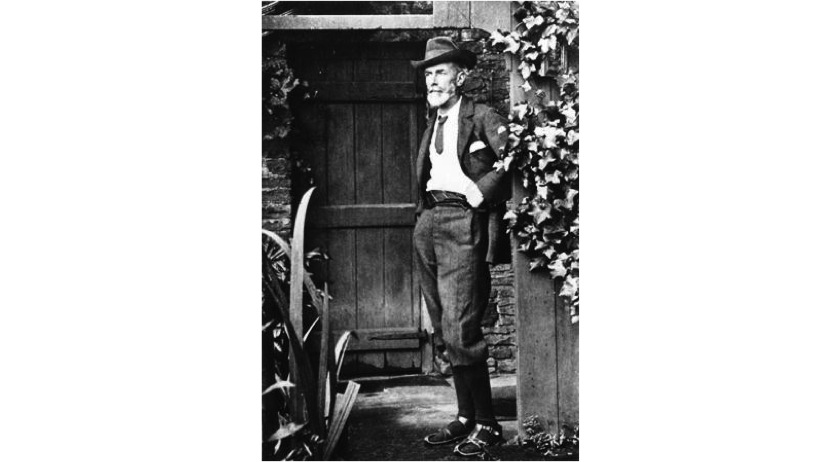
Edward Carpenter modelling his sandals with socks

Sandals and socks are reviled because they are a philosophical cop-out. The sock we associate with the shoe, with keeping one foot in the compromises and confinements of city life. The sandal yearns for the simple life, the toes wriggling free and tickled by spears of dewy meadow grass. To put a sock between the foot and the sandal is an ugly compromise.


Although Edward Carpenter could cast off the repressive expectations of Victorian society, he could never quite take off his socks

The shoe is a “leather prison” for the toes. So declared Edward Carpenter, a free-thinking socialist of the late Victorian period who was responsible for introducing the sandal into bohemian culture. A friend sent Carpenter two pairs of Kashmiri sandals from India, and he set about copying the design and distributing them to contemporary free-thinkers, in partnership with George Adams who he set up as sandal maker-in-chief.

Carpenter was gay, overtly so. His discretely circulated pamphlets did much to prepare the ground for what a same sex comradeship might be in the modern world. Born in Hove and educated at Cambridge, he set up home in Millthorpe in the countryside beyond industrial Sheffield, attracted both by the radical potential of the labour movement and by the sexual potential of the labourers. He met one such labourer, George Merrill, on a train. The two men enjoyed an open relationship, and Millthorpe became a site of pilgrimage for seekers of the simple life.


How would the spectacle of me in socks and sandals affect my wife?  The marriage would survive, but it is likely that her libido would not

Although Edward Carpenter could cast off the repressive expectations of Victorian society, he could never quite take off his socks. Photographs of the lean bearded “Saint in Sandals” show him wearing them with socks pulled up to the knee. Freedom was more important that the restrictions of style: he dispensed with waistcoats, underlinen and ties and wore instead a minimal outfit of woolly shirt, coat and pants. His sandals cost 10s 6d, less for children, and were a symbol of belonging to the progressive cause.

All these thoughts assailed me on that cold night in my tent. How would the spectacle of me in socks and sandals affect my wife? I wasn’t worried about the damage that it might do to our marriage. Our marriage has solid economic underpinnings, and there are children involved. The marriage would survive, but it is likely that her libido would not. I checked that she was soundly asleep, and then carefully slipped on the sandal.


Archeological analysis of fibres found on Roman sandals suggest that when the soldiers were in colder climes, such as Britain, the sandal was worn with socks

The sensation was obscene. The thickness of the sock caused the strap of the sandal to tighten indecently around the foot. The sandal was a Birkenstock, a German family company who made contoured shoes contemporaneous with Edward Carpenter’s sandal business. The German people are associated with the sandal and the sock combination, a Teutonic assertion of pragmatism over aesthetics. One wonders if they even remove their white ankle socks during intercourse.Birkenstocks did not get into sandals until 1965 during the American revival of the simple life or hippy movement.


The sandal was mankind’s first article of footwear. In the age of Homer, both sexes wore a wooden sole fastened to the foot by thongs. The Mogollon Indian in Southwest America plaited their sandals from the leaves of the Yucca tree. In Roman times, the sandalium worn by women was a sole with a piece of leather covering the toes and was worn mainly indoors. The soldiers of the Emperor wore the caliga, a heavy and high-laced boot that was open at the toe. Archeological analysis of fibres found on Roman sandals suggest that when the soldiers were in colder climes, such as Britain, the sandal was worn with socks.


Today the British army issue sandals that are man-made with velcro fastenings. Far more appealing than these are the Northwest Frontier Chaplis worn by the Indian army during campaigns in the 1930s; with two thick leather straps crossing a tongue, only the merest peep of the toes is visible, thereby sparing passersby the sight of your ten blind blunt-headed worms.
In my sandals and socks, I went out into the night to heed the call of nature. It was the moment before the moment before dawn, and the land seethed with anticipation. Carpenter and his sandals stand for the lost mystical socialism of Albion; a place where the working man and the high-minded type could join together to exceed the bounds of the acceptable and push away the deadening influence of mindless consumerism. This mystical socialism did not survive the Second World War. Sandal-wearing cranks were seen as an impediment to the credibility of socialism. George Orwell famously railed against “every fruit-juice drinker, nudist, sandal-wearer, sex-maniac… in England.”
In his essay On Sandals and Simplicity, GK Chesterton also took the sandal-wearers to task. He complained that advocates of the simple life would make us simple in the things that do not matter – diet, costume, etiquette – and complex in the things that do – philosophy and spirituality. The mystical socialist believed in plain living and high thinking. Chesterton, the scruffiest man in England, corpulent and windblown, sought the opposite: high living and plain thinking.
In my socks and sandals, I walked across the meadow to the witchy silhouettes of the copse, where I satisfied the masculine urge to urinate against the vertical. The black tops of the trees thrashed around in a bohemian dance. Grainy bands of indigo lay over the land. I felt the spirit of vitality move within me, the urge to cast off all clothing and to run amok as a natural animal. The wind goaded the tree tops into complete self abandonment. Would I join them?
No. Donning the sock and sandal was a transgression that threatened my very being! What next: speedos in the office? Trainers? The age of mysticism is past. I tromped back across the meadow, removed my sandals and cast them into the undergrowth. Never again would I be tempted by the comfortable compromise of the sock and sandal. From that night onward, my toes would serve out a life sentence in brogue and Brasher boot.

Download a camping packing list

I never used to be the kind of woman who made lists.
Cath with a camping blanket

But trying to prep for a camping trip while being mithered by small children has changed me.

The only way I can be certain that some crucial item is not forgotten has been to put together an Excel spreadsheet of our required gear.

Having gone to this effort, Matthew suggested other campers might find it useful. If only as the basis for their own packing list. Ours is designed for two adults and three small children and by no means do we take every item on it every time we camp.

The spreadsheet has tabs divided into pantry, bedrooms, living room, clothes, bathroom, First Aid and Other Stuff.

Not that our tent has a pantry.

Packing list on Google Docs

Download camping packing list

Caths camping gear packing list