Ready camp at Sandringham

I’ve been camping in earnest with my family for the past twelve years, almost entirely in the UK, yet this was to be our first camp at a Camping and Caravanning Club site. My camping taste runs to the wilder sites. Places where we can set a campfire or pitch in the heart of the woods. Camping and Caravanning Club sites are more established and run in accordance with the heritage of camping in this country: organised sites, no fires, immaculate lawns and quite involved etiquette involving showers and toilets.

But I’m open to softening my camping practice. These days, Cath and I both work. We live in London, and have to travel through the East London rush hour after the schools let out. Self-sufficient family camping takes prep. It takes time. And we don’t always have time. For me, this is where glamping or the Camping and Caravanning Club’s new offer of Ready Camp tents comes in: for the people who want to test out camping without buying the kit, or who can’t face all the hefting and carrying.
So, on a Friday night, I drove the family through Bank Holiday London traffic to the Norfolk coast and out to the Sandringham Camping and Caravanning site, a large clearing in the woods of the Queen’s estate, to try out their new Ready Camp. We took our sleeping bags, some pillows, towels and toothbrushes, clothes and a barbecue. For once, I was spared the rigmarole of loading the tent, camping chairs, crockery and beds into the car.

Ready Camp is pitched all ready and waiting for you. The tent is a large canvas safari tent made by Les Toiles Cabanon: the thick canvas means it stays cool and dark in a hot morning, and the poles are sturdy and metal. This gorgeous tent is pitched on decking, with an awning under which you can sit on your stoop, drinking beer, if you wish, or you can haul out the dining table and chairs that are provided to eat in the open. The covered balcony is a real bonus, even in the rain.
ready camp, sandringham
The kitchen is a two ring hob, microwave, and large trug for you to load the dishes in and take out to the washing area to clean, as there is no sink in the tent.
There were two bedrooms in our tent. One double bed for Cath and I, a canvas partition, then bunk beds for the children. Very comfortable, cool and dark. I wondered if my family might turn soft if they were exposed to any more of this glamping.

Last year, we camped in the Red Squirrel site in the Glencoe valley. Mid-March, snow on the mountains, deer sipping from the river next to the tent.

water in tent
When I struck camp, I discovered we’d been sleeping in a couple of inches of rainwater

The Dad of the only other family camping there was ex-military. I mention this so that you understand that I relish the intensity that comes with a wild camp. And so my caveats with Ready Camp come from this perspective:

Our camp at Red Squirrel in Glencoe.

In Sandringham the Ready Camp tents were pitched among the caravans. I’ve said this before in my book The Art of Camping. Camping and caravanning are like football and cricket, two very different activities that just happened to be played on grass. Part of the allure of glamping is that it is an easy way to get closer to nature. Caravan culture has diverged from that of campers. Diverged quite profoundly. The rest of my family holiday in caravans so I know what I’m talking about.

Ready Camp represents baby steps for the Camping and Caravanning Club as they attempt to reconcile their heritage with the emergent culture of glamping. It may be that they find a mainstream sweet spot for their offering. We had a great time there, the kids playing in the playground, and easy drives to the bracing Norfolk beaches and well-heeled villages. After all, the Abel & Cole veg box and daffodils in a water jug shabby chic of glamping is not for everyone. But I think they will need to find a way of roughing up their glamping pitches a little bit, either permitting fire pits or pointing them in the direction of the woods rather than the awnings of their neighbours.

We stayed at Ready Camp in Sandringham. Prices vary according to time of year and from site to site. We camped on the second Bank Holiday weekend of May and our stay would have cost £335 for three nights, or £264 for a midweek stay. Prices per night at Sandringham vary from £25 in low season up to £85 in high season. Our stay was courtesy of the Camping and Caravanning Club.

Glamping – at its most stateliest

You like the idea of camping, but your prefer a bit of posh? You want to go glamping. Still not posh enough? How about a glampsite within the grounds of one of the many stately homes that punctuate the country?
Luxury glamping bedroom in a Yurt
While there’s not usually a problem finding a normal campsite near any of our national treasures – and actually there are quite a few campsites set in the estates of historic homes: Longleat in Wiltshire, Stanford Hall in Leicestershire, Eastnor Castle in Herefordshire start the list rolling – actually staying under canvas within the grounds is a different matter altogether.
But glamping? That’s a whole different concept. Our stately homes may consider themselves too posh for camping, but the opportunities to glamp in their grounds are growing…

Some of our most to-notch country properties are offering posh camping (for example, in yurts) in their grounds. Here are just a few examples.

Kirklinton – for fun, food and faeries

Kirklinton Hall near Carlisle purchased its first yurt in time for the 2014 season. Locally, of course, because, as Kirklinton’s Alice Doyne puts it: “What we do at here is all about sustainable living and that includes sustainable holidaying.”

But, she adds: “That does not mean missing out on the Best Things in life. Our Motto is Fun, Food, Faeries – and Pigs!

“A yurt in the Orchard is the obvious answer. Zero impact camping but without the spartan drawbacks of a tent.” Hence, there’s full headroom, plus proper beds and furniture, a wooden floor with warm rugs, a wood-burning stove, sink and small cooker etc. And a proper lavatory in the adjacent buildings.
As Alice concludes: “In fact, it’s so cosy we’re tempted to move out of our draughty old 17th century house and live in the Yurt full time!

Also on offer is the chance to stay in the grounds in four-person tents, with the woodlands, swimming in the river and the Faerie Glen among the many attractions.
www.kirklintonhall.co.uk

Ghostly greetings at Layer Marney Tower

Some 120 acres of parkland and a Tudor building dating back over 500 years are what greets you at Layer Marney near Colchester in Essex.

While Layer Marney is claimed to be one of the UK’s most haunted houses, there’s also an exclusive glamping area with six placings, named after each of Henry VIII’s wives – Henry, as well as daughter Queen Elizabeth I, were visitors to Layer Marney.

“We decided to take a different approach four or five years ago,” explains Layer Marney’s current owner, Sheila Charrington. “It’s all about having a lot of fun. We attract two types: families with children of around ten years and couples who want to meet up with their friends for what we would call chilled weekends.”

Layer Marney’s glampers also have access to a large barn – perfect for family reunions, wedding receptions and the like.

The tents, likened to those used on the African plains by explorers in Queen Victoria’s time, come complete with everything up to a kitchen sink. You supply your own electricity – via a static bicycle!

Look out also for the Discovery Tent, equipped with telescope, field phones, a library of reference books, microscope etc.

Also popular here are the hot tubs – the perfect for way to relax after a day of activity.
www.layermarneytower.co.uk

Mannington Hall is a retreat from the coast

Ten miles from the North Norfolk coast, Mannington Hall – set in an Area of Outstanding Natural Beauty – is host to the Amber’s Bell Tents campsite, but you’ll also be able to make the most of all kinds of attractions within the grounds themselves – wildlife watching, over 50 species of trees, landscaped lakes etc – while the gardens are home to over 1,000 varieties of rose (see also www.manningtongardens.co.uk). There’s also the Greedy Goose tearoom, offering everything up to bespoke hampers and custom-made picnics.

Alternatively, drop by the honesty shop, pick up some nets and jam jars, and go pond dipping.

As for the bell tents, they’re some 5m in diameter nearly 4m high, with the cotton canvas experience extending to log burner, eco-friendly cotton bedding, lanterns, a fire bowl outside for cooking or just getting the campfire ambience. Suitable for up to four people in comfort, six maximum, and the rest of the site here offers showers, toilets etc, while the aforementioned honesty shop stocks everything up to firewood and candles. You can light your own camp fire, too, if you want.
www.ambersbelltents.co.uk

Bohemian Boconnoc is beautiful

Boconnoc glamping

It’s a Cornish dream here, with your chance to glamp it up in an ancient woodland setting.

The yurts here are not permanent fixtures. Instead, they’re ordered in specifically for each booking, via Hooe’s Yurts
.
The Boconnoc estate dates all the way back to Domesday while, apart from the house itself, there is both a church and an obelisk. It’s all tucked away down some two miles of private roads.

Owner Clare Fortescue says: “Once you arrive it as though you are somewhere timeless and the only sounds that can be heard are birdsong and the river running through the valley. Glamping at Boconnoc is set amongst sweeping parkland and we want guests to feel as though they have escaped from the busy world and arrived in their own private haven.
“Wake up to the sun rising through the ancient woodland, wander along the streams that meander through the valleys and enjoy champagne or some Cornish cider by the lake in the evening light.”

www.boconnoc.com

Warwick Castle – those summer, summer nights

Warwick Castle will have its very own glamping site this summer, with three super-luxury “King’s tents” among the latest offerings.

Yurt at Warwick Castle

Bookings her also give you two-day admission to the castle itself, also including evening entertainment, for example Have-a-go Archery and Jester’s School. There are also Communal Games Tents, while breakfasts in the Great Banqueting Hall tent are part of the glamping package (it’s extra for other meals).

A five-minute walk away from the castle, the Glamping Village actually hosts over 40 exclusively designed tents. Those top-of-the-pile King’s Tents include four-poster beds, thrones, oak storage chest, a large table with chessboard, even a suit of armour!

Warwick Castle itself celebrates its 1,100th birthday this year, and hosts all kinds of events throughout the year.
www.warwick-castle.com

Mettingham’s positively medieval moments
You’ll enjoy castle views from the medieval tents at Suffolk’s Mettingham Castle Lodge, where the glamping experience centres on medieval-style tents. Camp fires and barbecues are allowed here, too.

Choose between 10m x 10m Somerton (three people maximum) and 8m x 8m Dussindale (two adults, one child maximum) tents, each with wood-burning stove, outdoor table etc.

You can also wander through the 14 acres of grounds here and meet various animals.
www.pitchup.com

What to take

As glamping is the luxurious version of camping, you’ll be able to pack lighter, or use the extra space in your suitcase to bring more of your summer wardrobe. One consideration many neglect is insuring your belongings in the case of theft or damage. Check your other insurance policies to see if you’ll be covered – if not there are specialist camping insurance policies to give you extra peace of mind.

Find out more
Historic Houses Association
Featherdown Country Retreats
Pitchup

10 tips for camping with kids

In my time, I have taken three different babies to festivals, to well-equipped campsites and bare fields, and I took them by planes, trains and automobiles. And buses. Here’s how:

cath-and-math-with-two-baby-backpacks
Two baby backpacks with rain cover and rain suit

1. Sleeping
Where will they sleep? Tiny babies who can’t roll over go in Samsonite pop-up cots and then their larger bubble cot, which accommodates them until they are 18 months old. Vaude and Little Life also make good travel cots to use from birth to about two years old.

Keeping children warm at night is crucial. Each of my babies slept in a double-layered sleeping bag with zip-on sleeves. Doubling or tripling the number of children in one room also keeps them warm – like gerbils. I take small sheepskin rugs to go under the cot for extra insulation. For older children, thermarest trail mats suffice. They do not require as much puff as a standard blow-up bed.
Tents are hot places in the day, making afternoon naps a problem; I often wheeled the baby around in the buggy, letting them nod off as and when. A sun shade for the buggy is essential.
The worst part of camping with babies is traipsing around a tent in the middle of the night in your long johns looking for clean nappies, wipes or bottles. Try to keep the tent tidy and these essential items close to hand. Glow sticks make good night lights for toddlers and will give you enough light to change them by without startling them. Head torches are not just for pot-holers: a small head torch means you can keep both hands free if you need to change or rock an infant back to sleep again.

2. Eating
Breast milk is by far the most convenient food for a baby on holiday. There are no storage or hygiene issues to take care of.
Cleaning bottles and keeping enough milk is particularly troublesome at festivals; when I went to Glastonbury, I planned ahead and breastfed my youngest daughter, only knocking it on the head (breastfeeding not the baby) when I returned.

One top tip is to freeze the milk before you leave and then put it in a coolbag. The frozen bottles act as ice packs, keeping your other provisions cool.
At other times, I have nagged stall-holders for hot water to wash baby bottles with, and Math has even bought a glass of milk from them when required. For older, weaned babies make sure you arrive at camp with a couple of meals already prepped. Give them something to munch on while you pitch camp. They have no patience when it comes to their bellies, and will not wait while you struggle with the tent, so it’s up to you to have foresight.
[ad#Google Adsense-solid bar]
3. Weather
It will rain and your baby will want to crawl out of the tent to play in the puddles; waterproof suits (Muddy Puddles and Bush Baby make these) and waterproof booties (Bush Baby, Togz and Barts all make these) are good protection. If it is sunny the usual sun-cream, hats, full body coverage applies. Wellies for everyone.

4. Playing
Babies love the outdoors: they love the sounds of birdies singing, moo cows mooing and the wind blowing through the trees. They are quite interested in sticks they find on the ground and they like pulling grass up in their chubby little hands. Let them; dirt and the fresh air is why you took them camping.

5. Pitching
It’s hard to pitch a tent and look after the baby at the same time, especially if your tent requires two pairs of hands to erect. Arriving late at night is always pretty tough. Try your utmost to get there in daylight hours. Do a dry run and practise pitching any new tents before you travel, even if it means pitching it in the local park.

More >>> 6-10 Tips for Camping with Kids

Seven Things Every Camper Should Own

I contributed to The Guardian’s G2 camping trip with a brief list of essential camping gear. The Guardian writers camped not far from where I live, at Wowo, which Cath and I visited earlier in the year. I provided a list of seven items, one of which was salad, inspired by Cath’s five-a-day barbecue to stave off camper scurvy; another is a campfire tripod, made for me by a local blacksmith, Terry Tynehurst in Glynde.

cooking tripod

UK Campsites with campfires map

Looking for the best campsites in the UK? I’ve plotted a selection of recommendations from our own experiences on one big Google UK camping map, including campsites in England, Scotland and Wales. The flame symbol denotes UK campsites that allow campfires.

The Art of Camping paperback

The Art of Camping: The History and Practice of Sleeping Under the Stars is out now in Penguin paperback.

http://www.facebook.com/artofcamping
The Art of Camping paperback cover

Reviews
Does for camping what Roger Deakin did for wild swimming. (Independent )
A delightful combination of history and memoir with a generous dollop of guidance thrown on top . . . read this gem of a book. (Economist )
An elegant ode to the joys of camping. All sorts of tips on campsite etiquette, lore, equipment, and best practice, and his advice is convincing and honest. He is a lovely writer and his history is enlivened with tremendous flashes of wit. (Daily Telegraph)Teaming witty anecdotes with a potted history of what sleeping under the stars means sociologically, De Abaitua makes learning how to create a tented home away from home fun. (Elle)De Abaitua will soon have you believing in this consistently engaging and enjoyable book. It’s a fine writer indeed who can seem authoritative, approachable and just great fun. (Metro)

“The Art of Camping is the perfect chiarascuro of personal observation, wit and insight, with a detailed – but never over-egged – history of a stream athwart the main current of urbanised life. The entire hidden under-the-groundsheet history of camping provides such a fascinating perspective from which to look back on the follies of the permanently settled, while, in and of itself, it turned out to be a vital strand in the liberation movements of the 20th century.” Will Self.

Could there be another way of life? Can I survive with less stuff? Should I run for the hills?

These are all good questions that people have asked before, throughout history, and which have inspired people to set up camp. But now camping is part of the drive for self-sufficiency, a reaction against mass tourism, a chance to connect with the land, to experience a community, to leave no trace . . .


From packing to pitching, with hikes into the deep history of the subject and encounters with the great campers and camping movements of the past, the Art of Camping is a witty and philosophical blend of ‘how to’, history and personal anecdotes – a must for every camper.

Top Turkish holidays in Dalaman

Found along the South West coast of Turkey, Dalaman has been attracting visitors since the ancient days. When you arrive, it is easy to see why. It’s a stunning Mediterranean resort and exemplifies perfectly why Turkey is fast becoming one of the best holiday destinations in the world.

In the ancient world, Dalaman was a regular hang out for gods like Apollo and Pegasus and while these may be myths it is easy to see why the gods might have chosen this place. These days it is also visited by around two million people a year, so the gods are far from alone!

The beaches are understandably the main draw – it’s also known as the Turquoise coast which should give you some idea as to what it is that appeals. Long stretches of beach, beautiful coves and bays make it a naturally stunning location. The resorts of Icmeler and Olu Deniz are always in demand and come complete with all the other facilities you would expect at a top resort.

Sarigerme is a relatively new resort but looks set to establish itself as one of the best in years to come.

If you are looking for a spot of history to enjoy then it doesn’t get much better than Ephesus. In its day, this was the second biggest city in the Roman Empire behind Rome itself. Today it is only ruins but still gives you some idea how majestic it must have been in its pomp.

Also well worth a visit is Marmaris – a town full of hustle and bustle. Pick up a bargain at the bazaar (be prepared to haggle) and see what goods are on offer Dalaman holidays from Thomas Cookon any given day.

Like most of the other resorts along Turkey’s Aegean Sea, the warm waters are ideal for swimming and having a go at other watersports. Every age is catered for, as is every budget so no matter what you are looking for, Dalaman is a great spot for a holiday.

Dalaman holidays with Thomas Cook let you take the very best from the region and enjoy a unique holiday in this unique and exquisite destination. If Turkey holidays are on your radar for your next holiday, then Dalaman should be at or near the top of your list.

Why not check it out for your next getaway?

Guest post from Thomas Cook

Sleeping bag for a child

We needed a new sleeping bag for our eldest child Alice. We camp in the UK between the outer edge of spring and the chillier end of autumn, and so we plumped for a two-season red Starlight cocoon bag from Go Outdoors. Having outgrown her Vango bag, she enjoyed hunkering down in the extra space of the bag.

Walking along Doone Valley in Devon
Children walking in Doone Valley next to Cloud Farm

We took the new sleeping bag and the rest of our kit back to Cloud Farm in Dorset on the Bank Holiday in August. It was our third visit to the site. They don’t accept reservations and so seemed our best bet on the busiest camping day of the season. The site itself is beginning to look frayed at the edges: the shop not as well-stocked, a set of toilets locked up. But its main advantages outweigh the odd careworn feature: Cloud Farm permit campfires, the pitches line up alongside a shallow river, and the wild of the Doone Valley and the moors is right there. Over the weekend, the children barely left the water, paddling around and daring one another to bound over stepping stones. And finally they were old enough to walk a couple of miles from the site deep into Boone Valley. The footpath into the wild moors leads directly from the site, taking in an impressive variety of butterflies.

At night, we set a campfire to keep away any midges. Alice hunkered down into her new sleeping bag. The sleeping bag has a long heritage. In 1853, Lieutenant Creswell, the first officer ever to cover the north west passage, describes pitching a bet that combined a layer of macintosh with a piece of buffalo robe and a blanket sown up in the form of a bag.
The French douaniers, who watched the mountain passes of the Pyrenean frontier, used sleeping bags with wool inside. When not in use, they were folded up and buckled with five buckles into a knapsack weighing seven pounds – about twice the weight of Alice’s sleeping bag. The douaniers slept out at night in these bags. When traveling on a donkey across the Cevennes, the writer Robert Louis Stevenson adopted this way of camping too, eschewing the tent in favour of a sleeping bag that was six feet square and took a mule to carry it. And since I am the one who lugs the gear in our family, I am much happier with the one and half kilo Starlight cocoon bag than Stevenson’s wool-lined happy sack.

On Caravans

My parents gave up camping after my father Eddie, a policeman, was injured during the Toxteth riots. Convalescing, he didn’t fancy wrangling the enormous frame tent onto the roof rack and was finally in a financial position to buy a modest caravan.
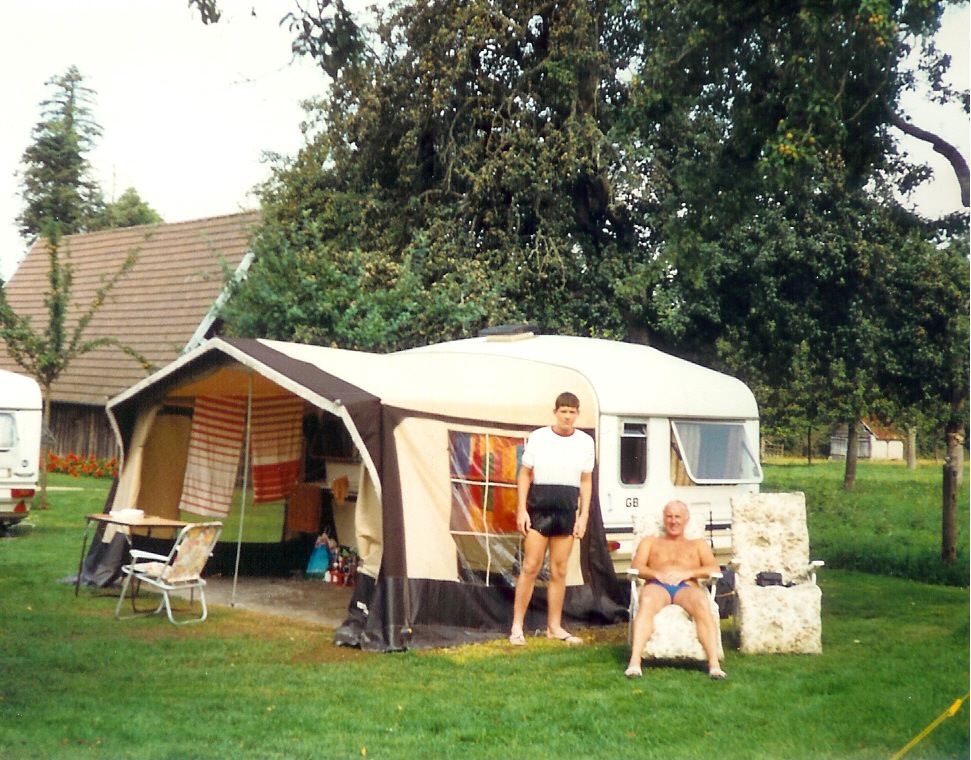
Matthew De Abaitua, Eddie Humphreys and caravan
My grandparents had owned a caravan. I have a vague memory of being allowed to sleep in it while the rest of my family slept in the awning: I was the youngest, after all.
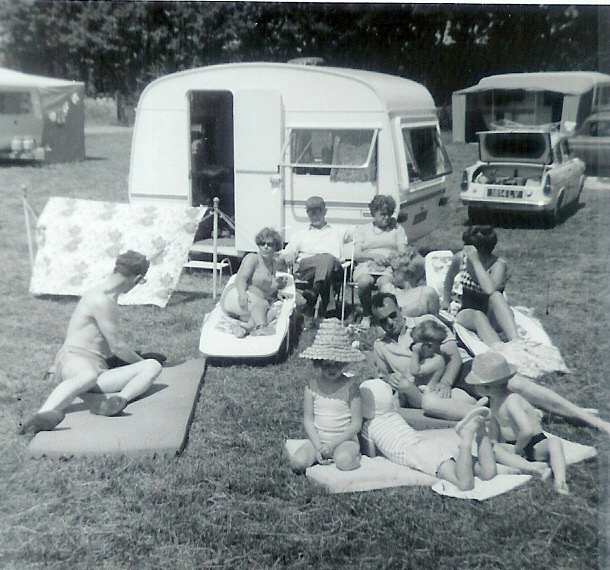
vintage caravan
On our first trip in Eddie’s new caravan, it fell to me to perform the tasks that might have aggravated his injury: to drag the caravan onto its immaculate cut-grass pitch, to put down the four legs with a wheel wrench, to fetch the water and empty the waste. My parents were cautious types: they liked the assurance and peace of mind that came from Caravan Club sites and Caravan Club insurance. My mother’s great fear, often voiced, was that they would one day find themselves accidentally driving down the Champs Elysees with the caravan, like one of those anxiety dreams in which you find yourself naked on a train.
As a committed camper, I’ve taken a different path from the rest of my family. My sister has a caravan, my brother had a caravan while he was in the UK. They would meet for caravan holidays and I would occasionally camp with my wife and children somewhere nearby: I like a campfire, and while caravanners and campers can get on, campfires and caravans most definitely do not.
The difference between campers and caravanners can be summed up in one detail from a Mass Observation report in 1970: when campers were asked ‘No Matter How Much You Like It, You Have to Admit Camping Can Be Pretty Miserable Some of the Time’, seventy-two per cent of them agreed with the statement. When the same question was put to caravanners, only fifty-five per cent agreed. Caravanning spares its followers the worst of the indignities and discomforts suffered by campers.
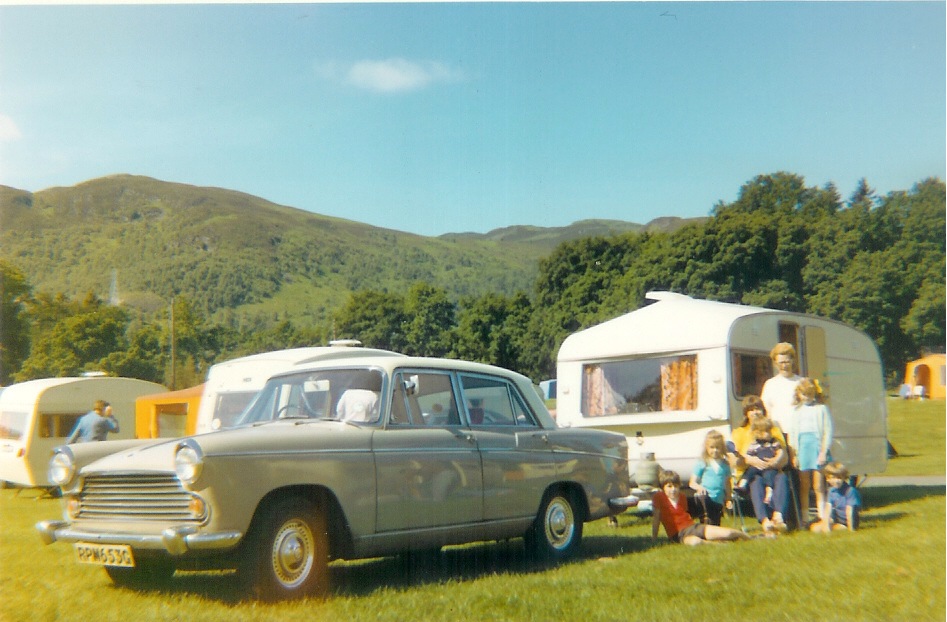
vintage caravan
While researching my history of camping The Art of Camping: The History and Practice of Sleeping Under the Stars, I came across a few details about the early history of caravanning that I couldn’t use in the book but can share now.
I was surprised to discover that caravanning was referred to as ‘land yachting’ in the Edwardian era and that writer H Rider Haggard, author of She and King Solomon’s Mines, was one-time chair of the Caravan Club. In the summer of 1907 Lady Arthur Grosvenor, sister-in-law to the Duke of Westminster, travelled through Oxfordshire disguised as a gypsy and calling herself Syeira Lee. She was bound for Ascot, of course. It was part of the bohemian vogue for all things gypsy, with artists of the time such as Augustus John affecting the dash of the ‘Romany Rye’.Rider Haggard took against the new fangled motor caravan and protested strongly against the innovation, saying:

‘Nowadays people are going a good deal too fast and are trying to cram into one day what they should do in a week. Motors are making life intolerable. I believe that the world is going far too rapidly and that we shall have to pay for it. Caravaning tends to counteract the evils of the day; it gives people time to think and brings them into contact with nature.’

Another early advocate of caravanning Bertram Smith toured Britain in 1907 and wrote Caravan Days, his homage to his pursuit. Bertram Smith always slept on a veranda in the open air, summer and winter alike. As a young man in Liverpool (the home town of my parents), he toured the Cheshire lanes by night and at weekend. His caravan was drawn by two horse, Sam and Simon, and his driver and handy man was called Herbert, and he slept nearby in an Alpine tent of about seven foot square. Bertram Smith had been a keen camper and was perceptive about the differences between it and caravanning:

‘Caravanning is sometimes attacked for its complexity and elaboration, compared with camping-out. But it is of a different order altogether. By all means if you are going to live in a tent and I am myself a keen lover of canvas cut down your necessities and simplify to the last degree. But the special charm of a caravan is in complexity and completeness, the whole fun of it is to bring with you a dwelling fitted out in every detail, even to shoe-horns and paper-knives.’

Can we unpack the camping gear?

We packed away our tent and gear last August after the End of the Road festival. It seemed an appropriate point at which to end. I spoke to a hundred people in rain-soaked glade wearing the braces and hard-wearing trousers that saw me through two summers of performing at festivals.

Matthew De Abaitua talking about The Art of Camping at The End of the Road Festival

And then the long winter set in and it’s mid-April and only now does it show signs of shifting. For first-time campers, it’s time to check out tents from Argos and their selection of camping equipment from torches to sleeping bags. A few times we’ve swung down to Argos to pick up head torches for the kids or a replacement camping kettle. Given the bad habits of the recent British climate, I’d be inclined to pack warm: that means a sleeping bag which is comfortable at temperatures below freezing, a silk sleeping bag liner, a good Thermarest sleeping mat, hat and gloves.

Last summer was pretty rotten for the camping season. It was July before the rain abated. At our annual group camp in the woods, half the people cried off at the last minute, citing gales. I am guessing that the late Spring is causing carnage with campsite bookings in the UK. Like many families at the moment, we can’t afford to fly anywhere and even paying for a ferry trip abroad is daunting. In the past, we’ve always braved the British climate with good cheer. What seems to have changed is its unremitting nature: that when cold and rain sets in, they persist without relief.

This will be the first summer for a long time that I won’t be traveling around performing at festivals, and instead I’m hoping to get the family out to somewhere wild: perhaps Calgary beach on the Isle of Mull, or the forests of the Czech Republic. But no firm plans yet. Also, I’m much fitter now than I was even last year, and can consider something more strenuous; treating myself to a solitary highland wild camp. I have another novel to complete first but at the first sign of prolonged sunshine, I know I won’t be able to stop myself from hauling the tent out again.