Category: Camping gear

Simply Hike
Every summer I add something to our camping gear, and take something away. Old camping gear wears out, or was never quite up to the job in the first place. I had a chat with Simply Hike and they asked me if I would try out their online shop during my annual renewal of my Camping equipment.

I consulted with Cath as to what was required – a second large Billy Can, a new water carrier, a batch of very large hiking socks – and went to work on Simply Hike. I whizzed around the site and filled up the virtual shopping basket in no time. The site is well-designed and resolute; the gear videos are useful, the range is extensive enough to even include the extra-large socks that I require, and now all that remains is the true test of any online store: delivery.
[Update: Everything arrived at my door fine and on-time]

Is it too early to camp?
Is it Spring yet?  The sun has broken through a long and cold winter and campers are asking themselves, is it time for us to take the tent out of storage? Last year Cath and I camped with our family thirteen times. I intend to match that this year, but to do so we’ll have to start early. That means reading sleeping bag reviews to ensure our kit can take the Spring temperature drop so that we will not be shivering in our tents, and making new gear for the season.
[ad#Google Adsense-solid bar]
Cath has been hard at work on the long dark nights sowing fleecy covers for hot water bottles, and making camping blankets for the children. I spent the winter entirely holed up in my study writing The Art of Camping. I will be giving talks and readings from the book at various festivals this summer, including Camp Bestival, Port Eliot, Glastonbury and a few others are in the pipeline. Hope to see you there. Slowly we are coming out of hibernation.
Our tent, the Vaude Badawi II
At campsites and festivals, we get inquiries about our tent, the Vaude Badawi II. When it appeared in the background on the BBC camping documentary Britain Goes Camping, Mumsnet lit up with curiosity.
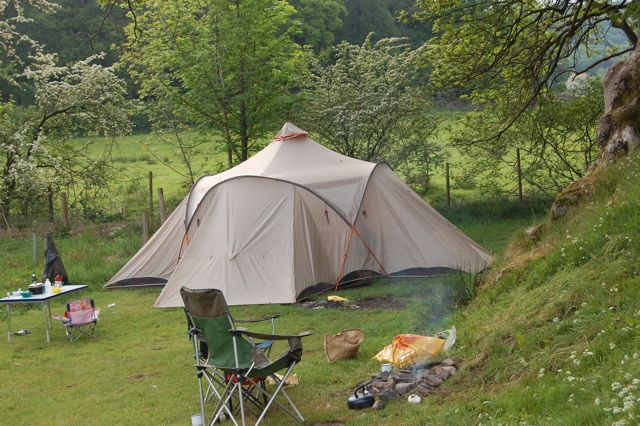
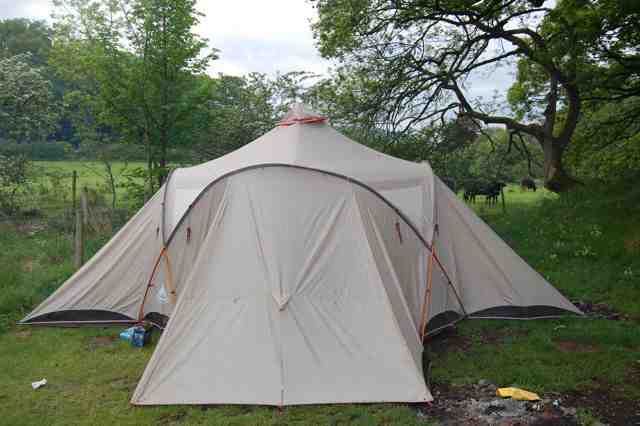
The sand-coloured Vaude Badawi II is a pyramid rising to a ventilated apex, with three bedrooms sloping off the sides. The designer Tommi Langowski was inspired by the old pyramid tents used by expeditions. He improved this classic design by removing the central pole and replacing it with an ingenious four-legged spider pole that provides supportive ribbing for the roof. As a result, the living heart of the tent is roomy, high and uninterrupted.
[ad#Google Adsense-solid bar]
Unlike the big family tunnel tents, the bedrooms are low-ceilinged and modest which makes them much warmer if you are camping out of summer season. Sleeping in the inner tent is like being in a small two-men tent. Step out into the living area and there is plenty of well-ventilated living space. The groundsheet and fly sheet are not stitched together, leaving a gap of about two inches between the grass and the bottom of the fly sheet. As long as you peg the fly sheet so that rain runs straight off the tent and into the ground, the interior remains dry. I prefer not having an integral groundsheet: the tent is less likely to rip and the air circulates freely so that even on a scorching morning, the interior remains cool.

The Vaude Badawi II weighs just shy of twenty kilos and we use it to sleep three children and two adults. Over two years, we have taken it out about twenty-six times, to tiny campsites and festivals. The only flaw is the little rain hat that balances upon the apex of the tent, which is effective but almost impossible to pitch tidily or with any dignity.
Vaude’s website, as of 2011, lists just the Badawi and the Badawi Long as current tents, but the Badawi II is still available.
Camping gear – Camping cookware
If your campsite allows campfires, then the fire is the heart of your camping cookware. All you need is a grill, propped up with some bricks or hung on a chain from a tripod. A campfire is also a ravenous bin, burning up food waste and cardboard packaging.

If you are camping at a festival, don’t bother with cooking your own food. There is nowhere to wash up and you will miss all the fun while you are frying bacon.
I always prepare two “just pitched” meals and some breakfast rolls: after pitching the tent, sorting out the bedrooms and lighting the fire, I don’t want to do a big shop or cook, I want to crack open a beer, warm something on a campfire and watch the children leap about.
Grill
We have ditched the barbecue but kept the grill, propping it up with bricks or stones, and using it to cook over the campfire.
Trangia
The methylated spirit stove (Trangia) packs down small and comes with saucepans, a frying pan and a tiny kettle. But it can only cook one thing at a time. A two ring propane stove lets you extend your culinary options, but will take up more space.
Crockery and cutlery
Because you can’t always use your fingers. And pack a wooden spoon or two for stirring, a nylon sieve, and a fish slice. And tongs, for turning hot meat.
Kettle
A whistling kettle with a handle that folds flat.
Corkscrew and can opener
Not just the old rusty ones in the kitchen drawer but ones that actually work.
Skewers
Wooden or metal ones for kebabs.
Meat thermometer
If I’m cooking a joint of meat or a bird over a campfire, I like it perfectly done, and because you are not using a domestic oven, with its reliable temperature, a thermometer spares the campfire cook all that uncertain prodding and poking.

Paring knife
Look for a very sharp paring knife with a protective cover. A bread knife, wrapped in a tea towel to protect the serrated blade, is also required; if someone could invent a camping bread knife with a cover, I’d be very grateful.
Plates, bowls, melamine mugs and a chopping board
We experimented with folding plastic mugs and plates, which I was adept at assembling but which completely defeated Math. I replaced them with melamine equivalents that should last us until the end of time.
Potato peeler and vegetable brush
For scrubbing and peeling spuds. I have an abrasive glove that I use to clean my spuds.
Opinel knife
A sharp knife is always useful. A sharp knife that folds back into its handle is essential. Hence the design classic that is the French Opinel knife. Used for cutting vegetables, whittling kindling, removing things from bike chains, opening packets etc
Serving and mixing bowl
You can eat salad while camping, it is allowed.
Lock-and-lock containers
Any sealable plastic containers are useful for storing leftovers.
Tin foil
To cook a large joint of meat on the campfire, you will have to wrap it in tinfoil once it has been browned.
Camping Gear – Food and drink
Prepare at least one meal for when you arrive, something you can easily heat up once you’ve pitched the tent. You can try some of my recipes for Just Pitched Dinners.

Basic cooking ingredients
Olive oil, salt and pepper, butter and some tinned food. Amounts really depend on what you have to store it all in. Tea bags, coffee, sugar, of course.
Carbs and protein
I pack plenty of pasta, rice, couscous and even my campfire bread mix. Then some easy-to-store proteins like beans, chickpeas, halloumi cheese, tinned tuna, houmous, saucisson and anchovies.
Sauces etc.
My camp kitchen also includes tinned tomatoes and coconut milk, onions, carrots, garlic, chillies and fresh tomatoes. Prepared spices, flavourings and dressings such as salsa romesco, mustard, french dressing, garlic and ginger paste, garam masala and chermoula. I also stuff fresh herbs into one of my lock-and-lock containers.
Snacks
Something that is calorific and won’t melt in the sun.
Collapsible washing bowl
In which you can wash the dishes and the baby.
Booze
Ice is hard to come by at campsites, so you want a tipple that doesn’t require it, such as whisky or red wine. My friend swears by mead. Remember the trip to the toilet is further than the short hop across the landing, so don’t go overboard. The warming effect of alcohol quickly wears off, and leaves you colder afterwards.
Hot chocolate
The effort involved in making hot chocolate at night ensures it will be the finest experience you and chocolate will ever share. Don’t skimp on the cocoa and melt real chocolate drops in the milk for added pleasure.
Cool bag or box
Boxes take up space, but keep food safe from wildlife and leaks. Many sites let you chill ice blocks in their freezers, sometimes for free, sometimes for a price.
Frozen milk
Put milk cartons in the freezer for a few days before you go. Pop them in your cool bag and not only will they chill the rest of the bag’s contents, they will also thaw in time for you to drink.
Water carrier
A collapsible one with a tap. You want water to hand for drinking, cooking and light washing.
Water flasks
Bottled water is over. Refillable flasks are where it’s at, and you’ll need them as being outdoors all the time will make you much thirstier than usual. Make sure the kids have their own flasks.
Camping Gear – Hygiene
Just because you are sleeping under the stars, there is no need to let some basic standards of cleanliness slip.

Toiletries
Unless space is no problem, stick to the bare minimum. I have, in the past, taken a special wash that is suitable for clothes, dishes, skin and hair. Makes you wonder if this whole washing-up liquid, body gel, shampoo divide is entirely arbitrary. Our friend Tintin travels with nothing more than a toothbrush. You can buy camping towels that take up far less space than the bulky ones in your bathroom. They come in pink or blue. Some anti-bacterial hand gel is particularly useful at festivals. Some of you will want contraceptives, others will be packing nappies (for small children, I pack six nappies a day for each child).
Toilet paper
Three rolls.
Bin bags
For rubbish and for quarantining wet or dirty clothes in.
Toothbrush and toothpaste
Arguably, the most essential piece of camping gear. Even more than the tent. You can always borrow a tent.
First Aid kit
For bumps and scrapes. You want plasters, bandages and something to disinfect wounds. It’s also worth investing in a burns kit, which we’ve required on a number of occasions, not least the time a hot marshmallow stuck to the side of a child’s face. Also, a few precautionary sachets of paracetamol and ibuprofen in solution for children and adults.
Insect repellent
Citronella candles are particularly evil. There is something satisfying about the sizzle of a fat moth in a naked flame. Take something to repel the insects, and a cream or antihistamine to treat the bites or stings. An antihistamine is a miracle cure when the toddler goes face-first into a verge of nettles.
Washing line
For drying washing, rain-soaked clothes and tea towels. Don’t forget to take some pegs as it is quite hard tying undies to a line.
Solar powered shower
Sounds fancier that it is. Basically this is a black bag you fill with cold water and once the sun has warmed it up, you take it into the woods, strip off, hang it from a tree and let gravity do the rest. It’s not a power shower but is good enough to refresh you mid-festival. Festival showers struggle with water pressure and what may seem like an uninhibited playful exercise in communal cleansing quickly turns into three cold naked people huddled under a dripping tap.
Sun hats and sun cream
Because it is always a scorcher when you are camping.
Washing up kit
So that’s tea towels, washing up liquid, a washing up brush, some kitchen roll and even a surface cleaner, as you attempt to maintain a basic level of hygiene.
Camping gear – Sleeping bags and camping lanterns
How to get through the night while camping. It will also be colder than you expect.

Thermal underwear
Wear long-legged and long-armed thermals under your jeans and jumper for sitting out in the evening, and under your pyjamas when you go to bed.
Bed and bedding
The minimum is a decent sleeping bag and self-inflating mattress per person. You can use a thick jumper as a pillow. For family campers, the only chance you have of a decent nights’ sleep is if the kids are warm and comfortable, so an extra blanket and a snuggly toy are essential for them. Augment the powers of an ordinary sleeping bag with a silk liner. When packed, a silk lining takes up about the same amount of space as a pack of cards and the warmth they retain is really worth it. Also if gets really cold you can pull the silk lining over your face and breathe through it. Silk liners are easier to wash, too, as the insulating properties of a sleeping bag are diminished by each pass through the washing machine.
If we camp out of season, in early March or October, then I pack the various sheepskin rugs around the house and put them on top of the mattresses to provide an extra level of insulation. Inflating an air mattress is a tedious job, and I think children can make do with thin self-inflating mattress or a bed roll. Out of season, a big air bed fills up with cold air that leaches heat out of your body, and I am on the verge of abandoning it altogether and returning to the thin, self-inflating Thermarest.
Torch
A torch is necessary for adults, but a torch for each of the kids adds to the sense of night time adventure. We used to keep a small lantern on at night but it quickly burnt through batteries. Instead, pack a handful of fluorescent snappy lights to allay any night-time fears, and a small cheap battery-powered lantern. Math has a hefty Maglite torch, a hangover from his days as a security guard on Liverpool docks, and I have a pencil-thin one that fits in my purse. Avoid the large lanterns, some of which burn so brightly as to extinguish all atmosphere. Candles in fireproof paper lanterns, weighed down with pebbles, make a pleasant alternative when you sit outside chatting of an evening. Naked flames and tents do not mix. The one time I saw a tent engulfed by flame, the whole structure went up in a single ‘poof’.
Continue reading Camping gear – Sleeping bags and camping lanterns
Camping Gear – Tent and the basics
Camping shops sell a wide range of camping gear and camping accessories, only a few of which are essential. If you pack camping carpet you need to ask yourself if you have the right hobby. We pack as light as possible because it makes pitching and striking from campgrounds easier and quicker: maximum utility, minimum weight.

Tent
Before rushing out to buy the biggest tent in the shop, bear in mind that some of the more interesting campsites are quite small and will refuse entry or charge more for an enormo-tent. At festivals, a big tent can be a massive problem, as it will be far too heavy to lug from the car park and you won’t necessarily have a large enough pitch for it. Nearly all the family tents on sale play to the delusion that you are buying a house, in which square footage is important and weight irrelevant. You are not buying a house. You are camping because you want to be outdoors, not because you want to cover the outdoors in a giant bag. A well-designed family tent should have headroom in the living area, but low ceilings in the bedrooms to trap heat.
Tarp
A sheet of tarpaulin strung from a tree means you can cook in drizzly weather, and offers breezy shade when the sun is out.
Waterproofs
All-in-one suits and wellies for toddlers, all-in-one suits for babies, and waterproof jackets for everyone else. If you don’t want to wear waterproof trousers, then change into shorts. Walking boots or wellies are essential, especially at festivals, where the mud can be biblical.
Picnic rug
If you don’t want to bother with a table and chairs, take a plastic-backed picnic rug.
Table and chairs
We used to camp without a table and chairs, using a rug instead. After five years of eating off the ground, Math’s longing for a chair was so intense I was concerned that he would resort to theft. I found flat pieces of reinforced plastic that slid unobtrusively into my rucksack and could be folded into small stools, about six inches high, but the spectacle of him squatting on them only added to Math’s indignity and sense of failure as a man. Once we switched to camping with a car, he bought himself the biggest chair in the shop.
Cooking Matches
Long matches to light fires, stoves and barbecues. A cigarette lighter is not always suitable.
Ordnance Survey map of the area
Math is a great believer in the importance of orientating ourselves upon this earth.
Clothes
Don’t forget to take a big warm jumper; whatever the season, it gets cold at night. At bedtime, stuff the jumper into a pillowcase and rest your head upon it.
Continue reading Camping Gear – Tent and the basics