I contributed to The Guardian’s G2 camping trip with a brief list of essential camping gear. The Guardian writers camped not far from where I live, at Wowo, which Cath and I visited earlier in the year. I provided a list of seven items, one of which was salad, inspired by Cath’s five-a-day barbecue to stave off camper scurvy; another is a campfire tripod, made for me by a local blacksmith, Terry Tynehurst in Glynde.
I was lying in my tent in the middle of a cold night when I received an urgent call from nature. I often camp in remote spots, seeking a connection with the land and respite from creditors. The call was urgent, and so I clambered over my sleeping wife, out of the inner tent and into the cold chamber under the flysheet.
I was wearing a thermal vest, long johns and thick hiking socks. To go outside, I would need footwear. In the corner of the tent, my boots – which require some lacing – and next to them, a pair of sandals. I gazed down at my stockinged feet, back at the sandals, and then at my sleeping wife:
Could I do it? Could I wear sandals and socks?
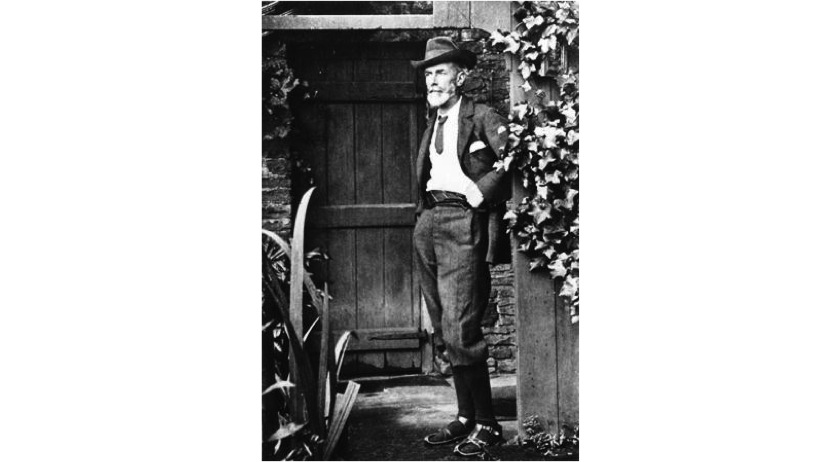
Edward Carpenter modelling his sandals with socks
Sandals and socks are reviled because they are a philosophical cop-out. The sock we associate with the shoe, with keeping one foot in the compromises and confinements of city life. The sandal yearns for the simple life, the toes wriggling free and tickled by spears of dewy meadow grass. To put a sock between the foot and the sandal is an ugly compromise.
Although Edward Carpenter could cast off the repressive expectations of Victorian society, he could never quite take off his socks
The shoe is a “leather prison” for the toes. So declared Edward Carpenter, a free-thinking socialist of the late Victorian period who was responsible for introducing the sandal into bohemian culture. A friend sent Carpenter two pairs of Kashmiri sandals from India, and he set about copying the design and distributing them to contemporary free-thinkers, in partnership with George Adams who he set up as sandal maker-in-chief.
Carpenter was gay, overtly so. His discretely circulated pamphlets did much to prepare the ground for what a same sex comradeship might be in the modern world. Born in Hove and educated at Cambridge, he set up home in Millthorpe in the countryside beyond industrial Sheffield, attracted both by the radical potential of the labour movement and by the sexual potential of the labourers. He met one such labourer, George Merrill, on a train. The two men enjoyed an open relationship, and Millthorpe became a site of pilgrimage for seekers of the simple life.
How would the spectacle of me in socks and sandals affect my wife? The marriage would survive, but it is likely that her libido would not
Although Edward Carpenter could cast off the repressive expectations of Victorian society, he could never quite take off his socks. Photographs of the lean bearded “Saint in Sandals” show him wearing them with socks pulled up to the knee. Freedom was more important that the restrictions of style: he dispensed with waistcoats, underlinen and ties and wore instead a minimal outfit of woolly shirt, coat and pants. His sandals cost 10s 6d, less for children, and were a symbol of belonging to the progressive cause.
All these thoughts assailed me on that cold night in my tent. How would the spectacle of me in socks and sandals affect my wife? I wasn’t worried about the damage that it might do to our marriage. Our marriage has solid economic underpinnings, and there are children involved. The marriage would survive, but it is likely that her libido would not. I checked that she was soundly asleep, and then carefully slipped on the sandal.
Archeological analysis of fibres found on Roman sandals suggest that when the soldiers were in colder climes, such as Britain, the sandal was worn with socks
The sensation was obscene. The thickness of the sock caused the strap of the sandal to tighten indecently around the foot. The sandal was a Birkenstock, a German family company who made contoured shoes contemporaneous with Edward Carpenter’s sandal business. The German people are associated with the sandal and the sock combination, a Teutonic assertion of pragmatism over aesthetics. One wonders if they even remove their white ankle socks during intercourse.Birkenstocks did not get into sandals until 1965 during the American revival of the simple life or hippy movement.
The sandal was mankind’s first article of footwear. In the age of Homer, both sexes wore a wooden sole fastened to the foot by thongs. The Mogollon Indian in Southwest America plaited their sandals from the leaves of the Yucca tree. In Roman times, the sandalium worn by women was a sole with a piece of leather covering the toes and was worn mainly indoors. The soldiers of the Emperor wore the caliga, a heavy and high-laced boot that was open at the toe. Archeological analysis of fibres found on Roman sandals suggest that when the soldiers were in colder climes, such as Britain, the sandal was worn with socks.
Today the British army issue sandals that are man-made with velcro fastenings. Far more appealing than these are the Northwest Frontier Chaplis worn by the Indian army during campaigns in the 1930s; with two thick leather straps crossing a tongue, only the merest peep of the toes is visible, thereby sparing passersby the sight of your ten blind blunt-headed worms.
In my sandals and socks, I went out into the night to heed the call of nature. It was the moment before the moment before dawn, and the land seethed with anticipation. Carpenter and his sandals stand for the lost mystical socialism of Albion; a place where the working man and the high-minded type could join together to exceed the bounds of the acceptable and push away the deadening influence of mindless consumerism. This mystical socialism did not survive the Second World War. Sandal-wearing cranks were seen as an impediment to the credibility of socialism. George Orwell famously railed against “every fruit-juice drinker, nudist, sandal-wearer, sex-maniac… in England.”
In his essay On Sandals and Simplicity, GK Chesterton also took the sandal-wearers to task. He complained that advocates of the simple life would make us simple in the things that do not matter – diet, costume, etiquette – and complex in the things that do – philosophy and spirituality. The mystical socialist believed in plain living and high thinking. Chesterton, the scruffiest man in England, corpulent and windblown, sought the opposite: high living and plain thinking.
In my socks and sandals, I walked across the meadow to the witchy silhouettes of the copse, where I satisfied the masculine urge to urinate against the vertical. The black tops of the trees thrashed around in a bohemian dance. Grainy bands of indigo lay over the land. I felt the spirit of vitality move within me, the urge to cast off all clothing and to run amok as a natural animal. The wind goaded the tree tops into complete self abandonment. Would I join them?
No. Donning the sock and sandal was a transgression that threatened my very being! What next: speedos in the office? Trainers? The age of mysticism is past. I tromped back across the meadow, removed my sandals and cast them into the undergrowth. Never again would I be tempted by the comfortable compromise of the sock and sandal. From that night onward, my toes would serve out a life sentence in brogue and Brasher boot.
If your campsite allows campfires, then the fire is the heart of your camping cookware. All you need is a grill, propped up with some bricks or hung on a chain from a tripod. A campfire is also a ravenous bin, burning up food waste and cardboard packaging.
Trangia, grill and campfire, small gas stove and camping kettle
If you are camping at a festival, don’t bother with cooking your own food. There is nowhere to wash up and you will miss all the fun while you are frying bacon.
I always prepare two “just pitched” meals and some breakfast rolls: after pitching the tent, sorting out the bedrooms and lighting the fire, I don’t want to do a big shop or cook, I want to crack open a beer, warm something on a campfire and watch the children leap about.
Grill
We have ditched the barbecue but kept the grill, propping it up with bricks or stones, and using it to cook over the campfire.
Trangia
The methylated spirit stove (Trangia) packs down small and comes with saucepans, a frying pan and a tiny kettle. But it can only cook one thing at a time. A two ring propane stove lets you extend your culinary options, but will take up more space.
Crockery and cutlery
Because you can’t always use your fingers. And pack a wooden spoon or two for stirring, a nylon sieve, and a fish slice. And tongs, for turning hot meat.
Kettle
A whistling kettle with a handle that folds flat.
Corkscrew and can opener
Not just the old rusty ones in the kitchen drawer but ones that actually work.
Skewers
Wooden or metal ones for kebabs.
Meat thermometer
If I’m cooking a joint of meat or a bird over a campfire, I like it perfectly done, and because you are not using a domestic oven, with its reliable temperature, a thermometer spares the campfire cook all that uncertain prodding and poking.
Using the grill, the tin foil, with lock-and-lock containers and mixing bowl
Paring knife
Look for a very sharp paring knife with a protective cover. A bread knife, wrapped in a tea towel to protect the serrated blade, is also required; if someone could invent a camping bread knife with a cover, I’d be very grateful.
Plates, bowls, melamine mugs and a chopping board We experimented with folding plastic mugs and plates, which I was adept at assembling but which completely defeated Math. I replaced them with melamine equivalents that should last us until the end of time.
Potato peeler and vegetable brush
For scrubbing and peeling spuds. I have an abrasive glove that I use to clean my spuds.
Opinel knife
A sharp knife is always useful. A sharp knife that folds back into its handle is essential. Hence the design classic that is the French Opinel knife. Used for cutting vegetables, whittling kindling, removing things from bike chains, opening packets etc
Serving and mixing bowl
You can eat salad while camping, it is allowed.
Lock-and-lock containers
Any sealable plastic containers are useful for storing leftovers.
Tin foil
To cook a large joint of meat on the campfire, you will have to wrap it in tinfoil once it has been browned.
Prepare at least one meal for when you arrive, something you can easily heat up once you’ve pitched the tent. You can try some of my recipes for Just Pitched Dinners.
Cath demonstrates the camping water bag
Basic cooking ingredients Olive oil, salt and pepper, butter and some tinned food. Amounts really depend on what you have to store it all in. Tea bags, coffee, sugar, of course.
Carbs and protein
I pack plenty of pasta, rice, couscous and even my campfire bread mix. Then some easy-to-store proteins like beans, chickpeas, halloumi cheese, tinned tuna, houmous, saucisson and anchovies.
Sauces etc.
My camp kitchen also includes tinned tomatoes and coconut milk, onions, carrots, garlic, chillies and fresh tomatoes. Prepared spices, flavourings and dressings such as salsa romesco, mustard, french dressing, garlic and ginger paste, garam masala and chermoula. I also stuff fresh herbs into one of my lock-and-lock containers.
Snacks
Something that is calorific and won’t melt in the sun.
Collapsible washing bowl In which you can wash the dishes and the baby.
Booze
Ice is hard to come by at campsites, so you want a tipple that doesn’t require it, such as whisky or red wine. My friend swears by mead. Remember the trip to the toilet is further than the short hop across the landing, so don’t go overboard. The warming effect of alcohol quickly wears off, and leaves you colder afterwards.
Hot chocolate The effort involved in making hot chocolate at night ensures it will be the finest experience you and chocolate will ever share. Don’t skimp on the cocoa and melt real chocolate drops in the milk for added pleasure.
Cool bag or box
Boxes take up space, but keep food safe from wildlife and leaks. Many sites let you chill ice blocks in their freezers, sometimes for free, sometimes for a price.
Frozen milk
Put milk cartons in the freezer for a few days before you go. Pop them in your cool bag and not only will they chill the rest of the bag’s contents, they will also thaw in time for you to drink.
Water carrier A collapsible one with a tap. You want water to hand for drinking, cooking and light washing.
Water flasks
Bottled water is over. Refillable flasks are where it’s at, and you’ll need them as being outdoors all the time will make you much thirstier than usual. Make sure the kids have their own flasks.
Camping shops sell a wide range of camping gear and camping accessories, only a few of which are essential. If you pack camping carpet you need to ask yourself if you have the right hobby. We pack as light as possible because it makes pitching and striking from campgrounds easier and quicker: maximum utility, minimum weight.
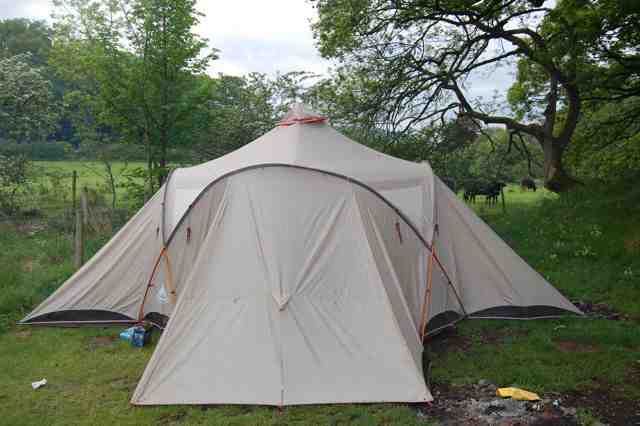
Vaude badawi tent in Lake District
Tent
Before rushing out to buy the biggest tent in the shop, bear in mind that some of the more interesting campsites are quite small and will refuse entry or charge more for an enormo-tent. At festivals, a big tent can be a massive problem, as it will be far too heavy to lug from the car park and you won’t necessarily have a large enough pitch for it. Nearly all the family tents on sale play to the delusion that you are buying a house, in which square footage is important and weight irrelevant. You are not buying a house. You are camping because you want to be outdoors, not because you want to cover the outdoors in a giant bag. A well-designed family tent should have headroom in the living area, but low ceilings in the bedrooms to trap heat.
Tarp
A sheet of tarpaulin strung from a tree means you can cook in drizzly weather, and offers breezy shade when the sun is out.
Waterproofs
All-in-one suits and wellies for toddlers, all-in-one suits for babies, and waterproof jackets for everyone else. If you don’t want to wear waterproof trousers, then change into shorts. Walking boots or wellies are essential, especially at festivals, where the mud can be biblical.
Picnic rug
If you don’t want to bother with a table and chairs, take a plastic-backed picnic rug.
Table and chairs
We used to camp without a table and chairs, using a rug instead. After five years of eating off the ground, Math’s longing for a chair was so intense I was concerned that he would resort to theft. I found flat pieces of reinforced plastic that slid unobtrusively into my rucksack and could be folded into small stools, about six inches high, but the spectacle of him squatting on them only added to Math’s indignity and sense of failure as a man. Once we switched to camping with a car, he bought himself the biggest chair in the shop.
Cooking Matches
Long matches to light fires, stoves and barbecues. A cigarette lighter is not always suitable.
Ordnance Survey map of the area
Math is a great believer in the importance of orientating ourselves upon this earth.
Clothes
Don’t forget to take a big warm jumper; whatever the season, it gets cold at night. At bedtime, stuff the jumper into a pillowcase and rest your head upon it. Continue reading Camping Gear – Tent and the basics