I contributed to The Guardian’s G2 camping trip with a brief list of essential camping gear. The Guardian writers camped not far from where I live, at Wowo, which Cath and I visited earlier in the year. I provided a list of seven items, one of which was salad, inspired by Cath’s five-a-day barbecue to stave off camper scurvy; another is a campfire tripod, made for me by a local blacksmith, Terry Tynehurst in Glynde.
Looking for the best campsites in the UK? I’ve plotted a selection of recommendations from our own experiences on one big Google UK camping map, including campsites in England, Scotland and Wales. The flame symbol denotes UK campsites that allow campfires.
The Art of Camping: The History and Practice of Sleeping Under the Stars is out now in Penguin paperback.
http://www.facebook.com/artofcamping
Reviews
Does for camping what Roger Deakin did for wild swimming. (Independent )
A delightful combination of history and memoir with a generous dollop of guidance thrown on top . . . read this gem of a book. (Economist )
An elegant ode to the joys of camping. All sorts of tips on campsite etiquette, lore, equipment, and best practice, and his advice is convincing and honest. He is a lovely writer and his history is enlivened with tremendous flashes of wit. (Daily Telegraph)Teaming witty anecdotes with a potted history of what sleeping under the stars means sociologically, De Abaitua makes learning how to create a tented home away from home fun. (Elle)De Abaitua will soon have you believing in this consistently engaging and enjoyable book. It’s a fine writer indeed who can seem authoritative, approachable and just great fun. (Metro)
“The Art of Camping is the perfect chiarascuro of personal observation, wit and insight, with a detailed – but never over-egged – history of a stream athwart the main current of urbanised life. The entire hidden under-the-groundsheet history of camping provides such a fascinating perspective from which to look back on the follies of the permanently settled, while, in and of itself, it turned out to be a vital strand in the liberation movements of the 20th century.” Will Self.
Could there be another way of life? Can I survive with less stuff? Should I run for the hills?
These are all good questions that people have asked before, throughout history, and which have inspired people to set up camp. But now camping is part of the drive for self-sufficiency, a reaction against mass tourism, a chance to connect with the land, to experience a community, to leave no trace . . .
From packing to pitching, with hikes into the deep history of the subject and encounters with the great campers and camping movements of the past, the Art of Camping is a witty and philosophical blend of ‘how to’, history and personal anecdotes – a must for every camper.
We needed a new sleeping bag for our eldest child Alice. We camp in the UK between the outer edge of spring and the chillier end of autumn, and so we plumped for a two-season red Starlight cocoon bag from Go Outdoors. Having outgrown her Vango bag, she enjoyed hunkering down in the extra space of the bag. Children walking in Doone Valley next to Cloud Farm
We took the new sleeping bag and the rest of our kit back to Cloud Farm in Dorset on the Bank Holiday in August. It was our third visit to the site. They don’t accept reservations and so seemed our best bet on the busiest camping day of the season. The site itself is beginning to look frayed at the edges: the shop not as well-stocked, a set of toilets locked up. But its main advantages outweigh the odd careworn feature: Cloud Farm permit campfires, the pitches line up alongside a shallow river, and the wild of the Doone Valley and the moors is right there. Over the weekend, the children barely left the water, paddling around and daring one another to bound over stepping stones. And finally they were old enough to walk a couple of miles from the site deep into Boone Valley. The footpath into the wild moors leads directly from the site, taking in an impressive variety of butterflies.
At night, we set a campfire to keep away any midges. Alice hunkered down into her new sleeping bag. The sleeping bag has a long heritage. In 1853, Lieutenant Creswell, the first officer ever to cover the north west passage, describes pitching a bet that combined a layer of macintosh with a piece of buffalo robe and a blanket sown up in the form of a bag.
The French douaniers, who watched the mountain passes of the Pyrenean frontier, used sleeping bags with wool inside. When not in use, they were folded up and buckled with five buckles into a knapsack weighing seven pounds – about twice the weight of Alice’s sleeping bag. The douaniers slept out at night in these bags. When traveling on a donkey across the Cevennes, the writer Robert Louis Stevenson adopted this way of camping too, eschewing the tent in favour of a sleeping bag that was six feet square and took a mule to carry it. And since I am the one who lugs the gear in our family, I am much happier with the one and half kilo Starlight cocoon bag than Stevenson’s wool-lined happy sack.
My parents gave up camping after my father Eddie, a policeman, was injured during the Toxteth riots. Convalescing, he didn’t fancy wrangling the enormous frame tent onto the roof rack and was finally in a financial position to buy a modest caravan.
My grandparents had owned a caravan. I have a vague memory of being allowed to sleep in it while the rest of my family slept in the awning: I was the youngest, after all.
On our first trip in Eddie’s new caravan, it fell to me to perform the tasks that might have aggravated his injury: to drag the caravan onto its immaculate cut-grass pitch, to put down the four legs with a wheel wrench, to fetch the water and empty the waste. My parents were cautious types: they liked the assurance and peace of mind that came from Caravan Club sites and Caravan Club insurance. My mother’s great fear, often voiced, was that they would one day find themselves accidentally driving down the Champs Elysees with the caravan, like one of those anxiety dreams in which you find yourself naked on a train.
As a committed camper, I’ve taken a different path from the rest of my family. My sister has a caravan, my brother had a caravan while he was in the UK. They would meet for caravan holidays and I would occasionally camp with my wife and children somewhere nearby: I like a campfire, and while caravanners and campers can get on, campfires and caravans most definitely do not.
The difference between campers and caravanners can be summed up in one detail from a Mass Observation report in 1970: when campers were asked ‘No Matter How Much You Like It, You Have to Admit Camping Can Be Pretty Miserable Some of the Time’, seventy-two per cent of them agreed with the statement. When the same question was put to caravanners, only fifty-five per cent agreed. Caravanning spares its followers the worst of the indignities and discomforts suffered by campers.
While researching my history of camping The Art of Camping: The History and Practice of Sleeping Under the Stars, I came across a few details about the early history of caravanning that I couldn’t use in the book but can share now.
I was surprised to discover that caravanning was referred to as ‘land yachting’ in the Edwardian era and that writer H Rider Haggard, author of She and King Solomon’s Mines, was one-time chair of the Caravan Club. In the summer of 1907 Lady Arthur Grosvenor, sister-in-law to the Duke of Westminster, travelled through Oxfordshire disguised as a gypsy and calling herself Syeira Lee. She was bound for Ascot, of course. It was part of the bohemian vogue for all things gypsy, with artists of the time such as Augustus John affecting the dash of the ‘Romany Rye’.Rider Haggard took against the new fangled motor caravan and protested strongly against the innovation, saying:
‘Nowadays people are going a good deal too fast and are trying to cram into one day what they should do in a week. Motors are making life intolerable. I believe that the world is going far too rapidly and that we shall have to pay for it. Caravaning tends to counteract the evils of the day; it gives people time to think and brings them into contact with nature.’
Another early advocate of caravanning Bertram Smith toured Britain in 1907 and wrote Caravan Days, his homage to his pursuit. Bertram Smith always slept on a veranda in the open air, summer and winter alike. As a young man in Liverpool (the home town of my parents), he toured the Cheshire lanes by night and at weekend. His caravan was drawn by two horse, Sam and Simon, and his driver and handy man was called Herbert, and he slept nearby in an Alpine tent of about seven foot square. Bertram Smith had been a keen camper and was perceptive about the differences between it and caravanning:
‘Caravanning is sometimes attacked for its complexity and elaboration, compared with camping-out. But it is of a different order altogether. By all means if you are going to live in a tent and I am myself a keen lover of canvas cut down your necessities and simplify to the last degree. But the special charm of a caravan is in complexity and completeness, the whole fun of it is to bring with you a dwelling fitted out in every detail, even to shoe-horns and paper-knives.’
We packed away our tent and gear last August after the End of the Road festival. It seemed an appropriate point at which to end. I spoke to a hundred people in rain-soaked glade wearing the braces and hard-wearing trousers that saw me through two summers of performing at festivals. Matthew De Abaitua talking about The Art of Camping at The End of the Road Festival
And then the long winter set in and it’s mid-April and only now does it show signs of shifting. For first-time campers, it’s time to check out tents from Argos and their selection of camping equipment from torches to sleeping bags. A few times we’ve swung down to Argos to pick up head torches for the kids or a replacement camping kettle. Given the bad habits of the recent British climate, I’d be inclined to pack warm: that means a sleeping bag which is comfortable at temperatures below freezing, a silk sleeping bag liner, a good Thermarest sleeping mat, hat and gloves.
Last summer was pretty rotten for the camping season. It was July before the rain abated. At our annual group camp in the woods, half the people cried off at the last minute, citing gales. I am guessing that the late Spring is causing carnage with campsite bookings in the UK. Like many families at the moment, we can’t afford to fly anywhere and even paying for a ferry trip abroad is daunting. In the past, we’ve always braved the British climate with good cheer. What seems to have changed is its unremitting nature: that when cold and rain sets in, they persist without relief.
This will be the first summer for a long time that I won’t be traveling around performing at festivals, and instead I’m hoping to get the family out to somewhere wild: perhaps Calgary beach on the Isle of Mull, or the forests of the Czech Republic. But no firm plans yet. Also, I’m much fitter now than I was even last year, and can consider something more strenuous; treating myself to a solitary highland wild camp. I have another novel to complete first but at the first sign of prolonged sunshine, I know I won’t be able to stop myself from hauling the tent out again.
Being brief readings from Matthew’s De Abaitua’s book The Art of Camping: The History and Practice of Sleeping Under the Stars (Hamish Hamilton) mixed with campfire tracks by the legendary Richard Norris (The Time and Space Machine, Beyond the Wizard’s Sleeve).
Voice: Matthew De Abaitua
Mix: Richard Norris
Recorded and mixed in Lewes, East Sussex.
4. The Fire in My Head by Voice of the Seven Woods from the album Voice of the Seven Woods. Reading from ‘In Yosemite with John Muir’ by Theodore Roosevelt from his An Autobiography (1913), and quoted in The Art of Camping.
5.Farmland, Freeland by The Advisory Circle from the album Other Channels. Reading from Letter to the Editor of Forest and Stream by Nessmuk, quoted in The Art of Camping.
6. Campfire by Grizzly Bear from the album Horn of Plenty. ‘How to Light a Fire Without a Match’ adapted from Ernest Thompson Seton’s Two Little Savages for The Art of Camping.
10. Ancient Campfire by Biosphere from the album Shenzhou. Reading ‘The Camping Years’ from Leslie Paul’s Angry Young Man, quoted in The Art of Camping.
We arrive at a small deserted field at the dead end of a track, sloping gently down to a stream, just in time to pitch our tent in the last of the light. A woodpile of branches is set beside a campfire circle. The adjacent farmhouse is quiet, with a smattering of fowl. The decision to camp came late, about two hours before we set off. With the Hay Literature Festival ongoing, and a double Bank Holiday weekend to mark the Queen’s Diamond Jubilee, this small site was all we could find that fitted our criteria at such short notice.
Cath is modelling a merino wool buff which is ideal for protecting the head from midges
Cwmnanthir campsite is situated in Banwen, to the south-east of the Brecon Beacons, where a range of wind turbines plunge into the valleys of waterfall country. I haul the tent out of the back of the car and begin pitching. The first peg penetrates the earth and releases the midges within; it blows the biters all up in my face and down my vest and into the yawning crack at the back of my trousers. Where is the Avon Skin So Soft? On the recommendation of the military, we use this moisturiser as midge repellent. When it mixes with the burly odours of a few days camping, the Avon Skin So Soft makes me smell like a transvestite down on their luck. I apply it too late. My forehead is braille.
Cath finishes off pitching the tent while I set a campfire as quickly as possible. The children remain in the car. Conditions are testing. I mean, we’ve only driven five hours in Bank Holiday traffic, barely keeping our temper through backseat provocations, a car sick lad, and a few wrong turnings. And now this. Hateful tiny insects. The fire chases them away. The children are put to bed. I open an eight pint jug of Harvey’s ale, fresh from the brewery. Cath sits down next to me wearing a buff to protect her head from the midges, and we exchange our first words since our arrival:
“That was my idea of hell,” she says.
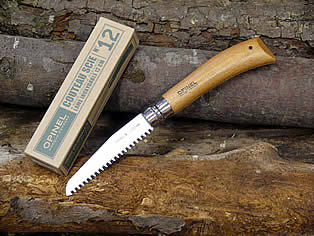
Soon others arrive, a trio of twentysomethings from Hackney who have come in search of waterfalls. They join us around the campfire. Together we sit up until past two in the morning, telling old Hackney stories and chopping wood. One of their party is a carpenter and becomes enamoured with my Opinel saw; it is a beautiful thing, cheap, efficient and classic: a symbol of French genius.
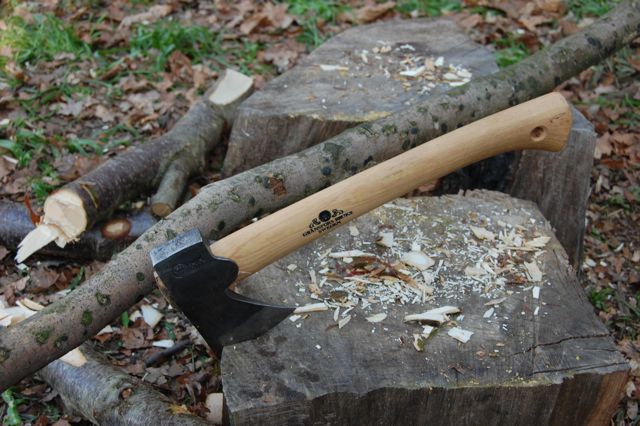
In his essay on the Opinel knife, Jean-Marie Floch describes it as “a secret hero”. I have a Gransfors Bruks hatchet for logs; lethally sharp and operated with a ostentatious swing, there is nothing secret about it. The way the Opinel saw folds out of its handle, is secured in place by a ring collar, and then discretely cuts through branches before slipping quietly back into my pocket confirms the truth of Floch’s observation.
The saw, the axe, and the beer jug are my loyal companions.
I share the jug around and we drink it dry. The moon shines brightly through the trees. When everyone is in bed, I walk back up the road to gaze southward over the beacons; the heads of the wind turbines are concealed in mist. The night shimmers with the unfamiliar, the incipiently strange. The stream burbles noisily by. Something moves nearby. I am not afraid.
The next morning, two other groups arrive; a couple from Wales who have a son each from a previous relationship, and an extended family from Golders Green. He is Syrian, she is Spanish. They have three children of their own, and then a couple of cousins they have taken in to spare them the horrors of the conflict in Syria, and a Spanish cousin who wants to learn English. The father has never been camping before and has brand new kit and an enormous Syrian shisha pipe – indistinguishable to my eyes from an Egyptian hookah.
“The way each camper confounds my gut prejudice makes me feel such joy”
Their children offer my children marshmallows and soon everyone is sitting around the campfire. The midges persist all weekend but this common hardship only bonds us all together; such a disparate collection of souls, Cath and I with our three children are the only conventional nuclear family on show. It is Jubilee Weekend, and in London, meaningless pagentry and sycophancy are offered as a symbol of the nation. I prefer the symbols of these campers and this campsite, an ad hoc unplanned bunch of people from South Africa, Cardiff, Syria, Bilbao and Liverpool who have come together to share an experience of the land and find a way to get along without rules or authority of any kind. A Royal Family? Really? Still?
The midges also stick around. Their persistence is exceptional, apparently. The site itself has a pair of perfectly decent toilets and a shower, a kitchen for campers to use, a bassett hound and a big grey-muzzled dog. There are argumentative geese and a pair of ducks living in a hutch that, on my first night, I mistake for a toilet and the birds never quite forgive me.
Our various children glom together into one group, play football during the day and hide-and-seek past midnight. We sit around the campfire and tell stories of home. The way each camper confounds my gut prejudice makes me feel such joy. I am released from the mean-spirited fear of others, and the weekend becomes, for me, an affirmation that what defines this nation is not the pomp of the homogenous few but the underlying decency of the diverse many.
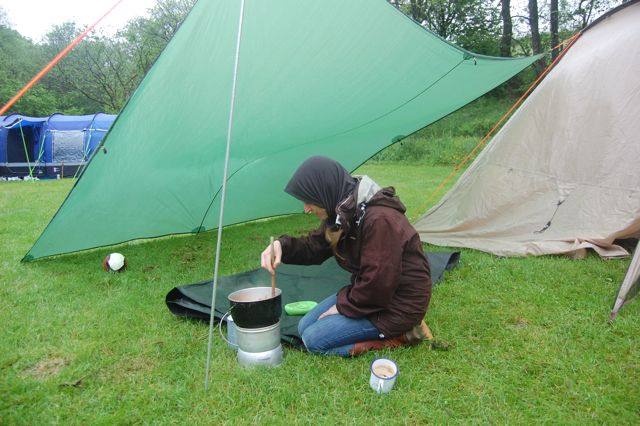
I have wanted a tarp for a while now to create a sheltered area outside of the tent under which I could cook or loiter during a long rainy day. The Terra Nova Tarp Shelter is not cheap but it is extremely light and shimmers to the touch in a pleasingly quasi-organic fashion. The good people of Idealo.co.uk were kind enough to send me one to test out and you can find similar products on their site here. The Terra Nova Tarp Shelter is here.
The tarp comes without guy ropes or poles. Fortunately I had a some lying around, left over from my previous aborted attempt to turn a spare groundsheet into a tarp. I set to improvising the best way to set the tarp up, eventually arriving at this set up attached to my tent.
If camping near a tree, I would have used a high branch instead of the exterior of our tent. There is a loop in the middle of the tarp that – if strung up to a tree – would make it drape in a triangle shape, ideal for sleeping under during a wild camp.
When the rain came, I cooked under the tarp and made a few notes on how to improve the pitching of it next time out. I’ll need more guy ropes, for a start. The tarp is full of possibility, a shelter against the sun, the wind and the rain. That’s why I’ve always hankered after one. I feel that I am only at the very beginning of mastering my tarp skills.
Update
The following weekend we camped at Forgewood in Kent in the pitch known as Nick’s Nook. This gave me the chance to pitch the tarp without poles and tethered to the surrounding trees. It makes such pleasing shapes.
My essay on the River Mersey is included in the forthcoming paperback of Caught By The River’s collection of words on water, along with writers such as Roger Deakin, Chris Yates, Jarvis Cocker, Bill Drummond, Irvine Welsh and Jon Savage. The essay covers the time I worked as a security guard at Liverpool docks.
“The Mersey is an industrious river. Too wide and cold for pleasure boating, its toil is visible in the treacherous contrary current. At the Runcorn gap, its course is bounded by Runcorn Railway Bridge, a bracing engineering marvel of wrought iron lattice girders. The arch sweeps overhead like rollercoaster track. The engineering of man and nature compliment one another. Under dour daylight, the Mersey runs muddy and rusty. At dusk, it turns belly-up, showing a pallid steel hide. Neither nature nor industry are built to the scale of a man. To stand under a giant bridge that passes over a great river is to be doubly dwarfed.”