The Art of Camping tour

To launch my camping book The Art of Camping: The History and Practice of Sleeping Under the Stars, I will be performing at various festivals throughout the summer.


The talk will range from obscure camping cults to the best way to make pancakes over a campfire. There will be diversions on camping etiquette and the role of camping in alternative culture. We will address what to do in case of rain, sex, or loss of faith.

Campers around campfire illustration from The Art of Camping
Illustration by Paul Blow

I will be compering and reading at The Free University of Glastonbury in The Park area of the festival, and extolling why we must camp at Port Eliot and Camp Bestival. In August, I am doing a joint event at the Edinburgh International Book Festival with Tom Hodgkinson (How To Be Idle and the forthcoming Brave Old World: A Practical Guide to Husbandry, or the Fine Art of Looking After Yourself). I will add events as and when they are confirmed to the feed below. And if any festival organisers or literary campsite owners want to bring my rolling camping talk to their event or site, you can contact me via the comments section of any post, the About page at the bottom of this page or twitter on @MDeAbaitua.

Glastonbury – 10 Things to Consider When Taking Children to a Festival

Glastonbury is many things to many different people. To the hippies in the Green Field, Glastonbury is a space for spiritual enlightenment. To the kids moshing around in the mud before the Pyramid stage, Glastonbury is a chance to get wasted and listen to bands. To my son, Glastonbury is a tractor-and-lorry convention. To me, Glastonbury is a challenge to my Dadness. The logistics involved in getting in and out of the festival with the minimum of delay, camping with three young children, and coming out of the experience with all limbs and offspring intact requires the kind of fortitude, foresight, judgement and brute physical strength that constitute Dadness.

alice-glastonbury-fairy-wings

I have camped at Glastonbury for two consecutive years with my three children and will do so again this year. I have some insights to share with other Dads who might consider attempting the festival with their children:

1) Camp high
As a performer, I camped backstage at the Park, on a high pitch overlooking the festival, close to the fence. The effort involved in hauling the gear uphill was offset by the relative peace and quiet of the spot throughout the festival. If I was going there as a common-or-garden Dad punter, I would aim far away and high.

2) Take a wheelbarrow or trolley

Hauling your gear from car to site is a difficult and unpleasant experience if you’ve got a big family tent and all the extra beds and sleeping bags that come with children. Glastonbury has metal reinforced pathways that are wide and hard enough to take a large trolley or barrow. The walk from car to campsite for me was about half an hour. I had to make two trips. I would struggle to carry my tent more than ten minutes on my back. Keep a tight rein on the amount of gear you are taking. Take some rope to secure your gear to the barrow and some string to tie all the sleeping bags and mats together.

[ad#Google Adsense-solid bar]

3) Cooking
I never used to cook at festivals but these days finances mean we have to bring all our food with us. So what to take? We live off a big home-cooked chicken pie and sausage rolls, large jars of homemade pesto with bags of pasta, and a bag of croissants. You can’t wash up easily at Glastonbury, and you don’t want to lug a coolbox there, so I avoid meat and food that requires anything more complex than heating a pan of water. Don’t stop off at Tescos on your way there, as then you will have to carry thin shopping bags across the festival.

4) Kids’ field
Bugaboo hell. None of the parents we travelled with enjoyed the kids’ field. First of all, who wants to sit around watching their children do stuff? Secondly, children aren’t going to learn to juggle in the hour or two you spend there. I’d rather see family experiences more integrated with the festival such as…

Doctor Who Matt Smith at Glastonbury with the girls of the House of Fairy Tales

5) House of Fairy Tales
Established by artists Deborah Curtis and Gavin Turk, the House of Fairy Tales is “a child-centred artist led project which draws on an extensive team of artists, performers, writers, educationalists, designers, musicians, film makers, dreamers and philosophers to create magical, parallel worlds where learning is play and play is directed learning.” The people at the House of Fairy Tales are one highlight of Glastonbury and my three children get thoroughly involved. Last year Doctor Who himself, Matt Smith, dropped by and was photographed with all the kids.The House of Fairy Tales is located in the Park area.

6) The Park
Established by Emily Eavis in 2007, the Park is ideal for Dads. The bar is not so packed, the stage is full of interesting and alternative acts (all the bands I want to see – in Glastonbury 2011, that’s James Blake, Tame Impala, John Grant), and you are well out of the maddening throng. Also the Free University of Glastonbury is in the Park area – I am talking about the history and meaning of camping there on Sunday at 1pm.

7) But what about the headliners?
I didn’t see any of the big acts. I’ve been in those crowds without kids. I couldn’t face them with small children. One of the consequences of taking kids with you is that you are excused Must Seeing the Must See events. I wouldn’t cross the road to watch Bono sing, never mind jostle for position amongst thousands of other people. Free yourself of festival fret – that feeling that something better is happening somewhere else and you must trudge off to see it.

8) You sound like a really dull man
I am speaking only from the Dad perspective here, from that portion within me concerned with the logistics of shifting a family around. But it’s a fair comment.

9) When should Dads arrive at Glastonbury, and when should they leave?
Judging arrival and departure is the real trick. Over the last few years, because of the recession and the poor rate of exchange with the euro, many people take Glastonbury as their holiday. This skews the usual traffic patterns, with lots of people arriving on a Wednesday. I aim to arrive around 11am on Thursday morning. and have never any problems and barely any delay. We leave on Sunday about 4-5pm and likewise there is no queue. To put that in perspective, my mate spent six hours in the car park on Monday. Six hours! Fortunately he did not have his children with him

10) Buggy?
We went for two backpacks in which to haul the children around, each packed up with wet and hot weather gear. Just don’t take a buggy that runs on casters, as I saw a lot of Dads digging the mud and grass out from the wheels. My reasoning is that a buggy will struggle in the really deep Glasto mud. The last two years have been dry. But it won’t always be so.

Why Glastonbury is like Star Wars

Why do people tell stories about Glastonbury but not about The Big Chill?

The Big Chill lacks drama. As the name suggests, it has no narrative arc.

The layout of the Glastonbury camp is a narrative arc. If the festival-goer travels that arc, they will fashion their own individual myth. Miss out on one of these plot points, one of these locations in the camp, and they will not have a Glastonbury story.

The myth of the festival follows the hero’s journey as set down by Joseph Campbell in his study of comparative mythology, the Hero with a Thousand Faces.

The diagram of the narrative of the hero's journey
Campbell’s ur-plot was famously used by George Lucas for Star Wars and has since acted as scaffold for a thousand Hollywood blockbusters. Likewise, each stage of the hero’s journey as identified by Campbell is inscribed in the Glastonbury campsite and accompanying rituals.

How so, exactly?

The hero’s journey must pass from the known land into the unknown. It begins with the call to adventure. In Star Wars, this is the moment Luke Skywalker, an ordinary farm boy, receives a holographic message from Princess Leia via R2D2. In Glastonbury, the call to adventure comes when the humble farm boy or social media consultant receives their ticket.

Once the call to adventure is accepted, then the hero grasps the supernatural aid. A lightsaber for Luke Skywalker, Excalibur for King Arthur, the lyre for Orpheus’ descent into the underworld. I may sound like Super Hans from Peep Show when I say this, but it cannot be avoided: in the Glastonbury myth that supernatural aid is drugs.

It is worth taking a brief detour to discuss what drugs are for.

Drugs are bound up with rites of passage. In some traditional cultures, psychoactives such as ibogaine or yage are employed in a ritual that turns a boy into a man. In the modern Western civilisation, intoxication is a rite of passage, the first drink, the first cigarette, the first spliff.

The wide array of drugs provide an assault course which individual psyches must conquer and emerge battered and repentant at the other end. Drugs catalyse the most basic narrative of rise and fall, up and down. Because I do not take drugs, I do not have Glastonbury stories, and the failure to fully mount the myth is why my account of the festival is so boring.
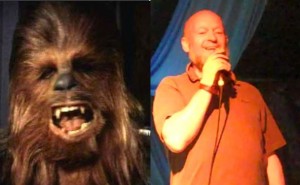
Chewbacca and Michael Eavis
The next stage in the hero’s journey is the threshold and the mentor. In Star Wars, the mentor is obviously Obi-Wan Kenobi, and it is Obi-Wan who introduces Luke to the ways of the Force. The Force and the galaxy beyond Tatooine are the unknown through which Luke must journey. The threshold is the cantina of Mos Eisley, a borderland or liminal space populated by weird and wonderful creatures. He requires the help of his mentor to survive these creatures and to enter the unknown of outer space.

(By the way, the sooner someone recreates Mos Eisley cantina in Glastonbury, the better).

At Glastonbury, the musicians are the mentors. Their performances are judged on how successfully they fulfil the role as mentor in the arc. That is why a successful Glastonbury performance is unique to the camp, because it has to play its role in the yearning for personal myth. The stars and the music are invested with the wisdom of the unknown. They instruct the crowd in the ways of the Force: or, in the case of rock music, a collection of romantic myths concerning derangement of the senses, sexual exploration, and mass catharsis through loss of self.

The faces of the Glastonbury crowd as they seek rapture in the moment, suspending rationality, coasting on pure emotion, is the face of Luke Skywalker as he feels the Force.

The music takes the Glastonbury hero across the threshold.
Then they must faces the challenges and temptations of the unknown.
Otherwise known as Bez’s Acid House.
Or Club Dada. Or Trash City. Or the Rabbit Hole.
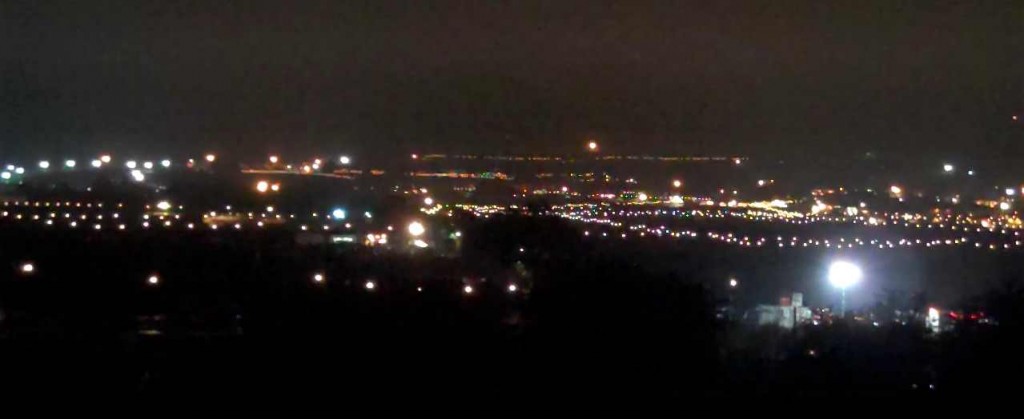
The lights of Glastonbury festival as seen at night
The Glastonbury hero will set off into these challenges with friends but temptations will ensure he or she loses everyone along the way. After all, Luke Skywalker loses Han Solo to the temptation of paying off Jabba the Hut. Luke’s fellow pilots are picked off one by one, and he must face the “big bad”. Alone, Luke Skywalker skims the valley of the Death Star, pursued by Darth Vadar, trying to pop a bomb in a ventilation shaft.

I don’t know what Glastonbury experience corresponds to this encounter. The narrative pattern of myth requires an abyss. We all have our abyss. Our four-in-the-morning hollowing out. These after-dark areas of Glastonbury exist so that you can experience the abyss. If you do not face the abyss, you will not have a Glastonbury story.

After this encounter, the hero heads out for transformation and atonement. This is the area of Glastonbury known as the Green Fields, and it is here that all Glastonbury stories should end. Dawn rising, the hero weary but changed by their adventure, bringing back some scrap of knowledge for civilisation, even if that knowledge is just a story about a really weird night.

So when people talk about the unique atmosphere of Glastonbury, or a Glastonbury spirit that makes it different from all other festivals, what I believe they are actually identifying is the mythological potential of the campsite, through which they can realise through their own hero’s journey.

Matthew De Abaitua is performing at the Free University of Glastonbury in the Park area on Sunday at 1pm. He will talk about his new book The Art of Camping and he might speak of this matter, or not; it’s possible that he will never mention this again.