Islands | page 2

The rule that there is always another island first struck me on the isle of Arran, which is further south than the Western Isles, directly west from Glasgow in Argyll.
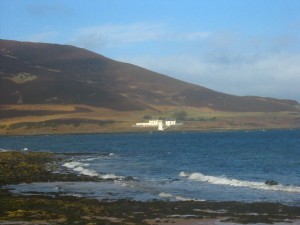
View of the retreat on Holy Island from the mainland

While staying in the southernmost pincer of Lamlash Bay on Arran, I looked out at the enormous hump of Holy Island, (not to be confused with the more famous Holy Island of Lindisfarne) and plotted a trip there. It was a few days before the boat resumed its run to the island. In Lamlash’s Co-Op, the alpaca wool of my hat attracted the interest of a Buddhist monk. He too was keen to get back to Holy Island. His partner had recently died. Together they were responsible for the striking rock paintings that dot the path around the island.

He pointed to my hat and asked me if I had been to Tibet. I hadn’t.
“Tibet is not an island,” I replied.
He looked confused.
“I only go to islands,” I explained.
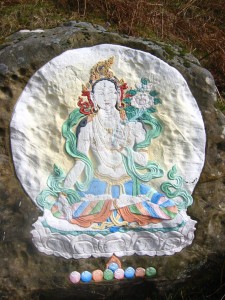
One of numerous striking rock paintings on Holy Island

In order to become a Buddhist monk, one must undertake the long retreat of three years and three months. Certainly this man, I think his name was Christopher, had the spacey air of a man who had spent a lot of time on a remote island. Watching him navigate a supermarket, I coined the simile of “looking as pained as a Buddhist in the Co-op, trying to chose between Flora and I Can’t Believe It’s Not Butter.” The aisles enforced bathos on this remote islander. He was sullied with his earthly concern. Yet he needed it. He needed it for his toast.

For three days, Holy Island remained coy under a habit of cloud. I sat on the beach, angry with lust for it. At moon rise, its silhouette was that of a narrow waist and voluptuous hips. The wing beats of gulls ricocheted across the bay and at dusk, the seals lolled in the shallows, turned their tails up and watched me sulk. The world turned within me, moved onto the next tooth of the cog. Finally, the skirt of cloud was hitched up, inviting us in, and we were able to take the boat across the bay.

The Holy Island project began in 1992 when the island was purchased by the Rokpa Trust. The peace centre on the North of the island is open to people of all faiths, but you must follow the five golden rules; while on the island, you are requested not to kill, steal, lie, intoxicate or fornicate, at least until you are back on Arran. The peace centre is on the retreat circuit, a path followed by people whose sense of well-being requires that the world be kept at arm’s length. On arrival at Holy Island, I had barely traversed the mandala garden before I overheard two self-examiners discussing the inevitable politics of communes as they had arisen in the various retreats they had embarked upon. Nothing I heard made me change my opinion that all communes are doomed to acrimony over lentil allocation.

The condition of contemporary life – its incessant chatter, its deprived public space – turns our faces once again out to sea, in search of peace

Just to walk around the island was retreat enough for me. A path takes you from North to South, where there is an International Women’s Buddhist retreat, then turns over the low hump of the peak and back down the other side. Along the walk, there is a grove of young trees planted for the lost children of Dunblane, a hermit’s cave, and Christopher’s striking, colourful rock paintings of Buddhist icons.

Retreat is a possibility modern man worries about on a daily basis, the way you tongue a cavity and consider the dentist. No one wants to be suburban. You want to live extremes. Either be the junction box through which all the currents of the metropolis flow, or live in a dark cave on an island a few miles out from another island. The condition of contemporary life – its incessant chatter, its deprived public space – turns our faces once again out to sea, in search of peace.

Against such romantic idealisations, there are the realities of island life. As Samuel Johnson wrote of Talisker on the isle of Skye; “Talisker is the place beyond all that I have seen, from which the gay and the jovial seem utterly excluded; and where the hermit might expect to grow old in meditation, without possibility of disturbance or interruption.”

In For The Islands I Sing, a fragmentary autobiography by the Orkney writer George Mackay Brown, he considers the sea valley of Rackwick on the isle of Hoy – “a green bowl gently tilted between the hills and the ocean”. “We must always be on our guard not to romanticise: life in a place like Rackwick must always have been stark and dangerous and uncomfortable.”

That kind of life is more meaningful by far than the lives of people who set out each morning for an office by train

Islands have been used as prisons. Consider Alcatraz or its forebear, the prison isle of Chateau D’If off the coast of Marseilles. It was on the Chateau D’If that Dumas imprisoned The Count Of Monte Cristo (even in Dumas’ lifetime, sightseers journeyed to the isle to see the cell in which the Count was held, and so one was constructed, along with a hole from which the character supposedly escaped). The prison is a forbidding construction. The boat drops you at the base of a rock staircase zig-zagging up the side of the stark fortress. The sun hammers away at the anvil of your skull. You get off the boat and immediately want to get back on again.

Still, we are people of extremes. Could we not cope with the privations of island life, especially as we would now have a few tricks of modern technology up our sleeve? Let Mackay Brown spell out our case for becoming an islander:

“Yet I believe that their closeness to the elements, their pursuit of whale and herring and their anxious tending of the corn all summer, the winter flame on the hearth that their own hands had dug from the moor, while – if the harvest of sea and land had yielded an adequate bounty – the cupboard was well stocked till spring; that kind of life is more meaningful by far than the lives of people who set out each morning for an office by train with The Times to read; a holiday in Spain with wine and sun the only oasis in their desert.”

Back >> Islands | page 1

Islands

The vision of an island, coming out of the fog as you approach it by boat, or surveyed from a beach on the mainland, is alluring.

The cliff at Foula as featured in The Edge Of The World (1937)

What is the promise of an island? Isolation? Certainly contemporary fears stoke in all our hearts a secret desire to hide away, with a good few miles of water between us and them. An island promises untapped resources. Fantasy Island. Treasure Island. Stand on the cliff and look out at the promise of an island, and you understand some of the urges that drove the ancient peoples to make perilous sea journeys to them.

The myth of a Great Flood appears in many cultures, not just in the story of Noah in the Old Testament. The Aborigines of central Australia say that in the Great Flood, man retreated to the mountain tops. Hawaiian legend tells of a time when the sea entirely overcame the land, aside from one peak on Maunakea, where two people were spared. In the Great Flood, mountain tops become islands. The peak of Ararat where the Ark tottered is the Ur-island, the point from which Man started all over again.

As soon as you land on one island, you are hunting on the horizon for another. There is always another island. This is an ancient rule. When hopping between the islands of the Western Isles and Outer Hebrides, I read of an axe-head discovered in the moorland of Lewis, dating from somewhere between 3500 and 3000BC, the late Neolithic Age. The material it was made of – porcellanite – is found in Northern Ireland, suggesting that there was trade between the Lewis and Ireland. Trade across two hundred miles of Atlantic Ocean, with no map, no lighthouse, no lifejackets! Was the prospect of a barter solely what drove the ancient peoples to make such a trip, or was it the irresistible prospect of landing on another isle.

The island is a grave, opening into the great void of the Atlantic

Admittedly in 3000BC, the climate of the Western Isles was warmer and drier than it is today. This was before the climate change of 1500BC, when higher rainfall waterlogged the soil, turning it into recalcitrant peat. The islands were more bucolic. Treacherous prehistoric journeys from isle to isle make more sense if you reckon in a more hospitable climate, a more fertile soil. Isn’t that a prospect? A fecund virgin isle (for some reason, islands stoke my libido – we’ll consider that question in more depth later, unless you prefer to draw a discrete veil over it now). Once the Western Isles became clad with peat, it was harder for the crofters to scratch a living. As Dr Samuel Johnson remarked in his A Journey To The Western Islands Of Scotland, the islands of the Hebrides have little to recommend them unless one is a “mere lover of naked nature”. (There – you see – his sexual turn of phrase shows that even Dr Johnson felt the stirrings of isle lust somewhere below his enormous gut.)

Perhaps an adolescent viewing of The Wicker Man, set on the fictional Summerisle, where every young lad was obliged to lose their virginity to Britt Ekland, is the crucial influence here

The endpoint of Dr Johnson’s journey was the spiritual island of Iona. Boswell, his traveling companion, was very keen to visit the isle, supposed burial place of the Kings Of Scotland and the point from which St Columba spread Christianity to the wild highlanders. Iona is a mere kerb of land off the coast of Mull, reached today by a small ferry from Fionnphort. It is an island just beyond an island, a hop and a skip from the mainland. This makes traveling to Iona feel even more like an adventure.

When I visited, on 11 September 2001, the beach at Fionnphort was riddled with jellyfish, a dozen flesh Frisbees. Down in the narrow sound, fishing boats meditated at anchor.  The silence was prehistoric. The ferry to Iona is full of Catholic pilgrims to the sacred isle. It pulls up by a line of whitewashed cottages and the island’s fine hotel, The Argyll. The stone of Iona is rich in iron, and at sundown the Argyll looks like it is constructed out of chunks of steak, with the mortar resembling the marbling of fat. Take the rainslick Street Of The Dead through the ruined nunnery and you come to the grounds of the Abbey.  Sitting out as the last of the light lurks above the distant hills of Mull, one feels negligible. A bystander in the eternal war between the sea, the sky and the rock, that red rock, stained with the blood of Oran, a pictish convert buried alive in the foundations of the Abbey by his friend St Columba. When the burial was done, Columba decided he wanted to see the face of his friend one last time. Heaving the earth aside, he found Oran still alive and uttering such blasphemous descriptions of heaven and hell that he was briskly buried once again. There is a lot of flesh in the rock. The Kings of Ireland, Scotland and Norway were buried here. The island is a grave, opening into the great void of the Atlantic.

"There is a lot of flesh in the rock"

There is always another island, another stepping stone. At Iona, just as I was smugly downing malts in the bar of Argyll, enjoying that edge-of-the-world frisson, I learnt of the remotest inhabited island in the British Isles; the isle of Foula, separated from the Shetland Isles by fourteen miles of ocean. A place so remote that its people still observe the Julian Calendar, celebrating Old Yule on January 6th with the New Year not beginning until January 13, and so storm-tossed that the ferry has to be winched out of the water in case it is dashed against the harbour. One of its sea cliffs rises to over 1200 feet, topped by a rock platform that hangs over the abyss, a natural diving board. It is this cliff that features at the opening of Michael Powell’s film The Edge Of The World about the evacuation of St Kilda (Powell wanted to film on St Kilda but it proved impossible so Foula stood in for it). Two young virile men race to the top of the peak to decide whether they will abandon the island or not. But one of them, taking a short cut, doesn’t make it and falls to his death.

The loss of a young man is catastrophic to the community, unleashing the forces that will lead them to abandon the isle. At its peak, St Kilda supported two hundred people. By the time of its evacuation on 29 August 1930, the population was down to thirty (after an outbreak of smallpox in 1720, Foula’s population was down to three). In Powell’s film, the modern world in the form of trawlers provide too much of a lure to the young people. Also, they lack the medical resources to care for a young baby. In Powell’s fiction, the islanders leave the place “where life as our fathers knew it is no longer possible”.

St Kilda had been inhabited for 4000 years. Go and find a map. Look how far out it is! One hundred and twelve miles west of the mainland, forty one miles west of the Outer Hebrides. Sea storms would isolate it for nine months of the year. How far out could you go there? Mentally, that is. And socially. Is that the libidinous appeal of the island? Being cut off from normal propriety? Perhaps an adolescent viewing of The Wicker Man, set on the fictional Summerisle, where every young lad was obliged to lose their virginity to Britt Ekland, is the crucial influence here. Yet, with their low populations, on these islands you were obliged to breed. Urgently breed. And young men are wanted, needed, for survival. Teenagers are useless in cities but on islands, they are the ones who can climb down the steep cliffs to fetch the puffin’s eggs for breakfast.

"There is always another island"

In my imagination, Foula is a terrifying place, a mist-shrouded rock with Atlantic winds speeding you over its sheer cliffs. As Samuel Johnson noted, the monks had a habit of building their retreats in the most beautiful of spots, and they never really bothered Foula. That there is one further island than Foula, the abandoned St Kilda, the two bound together by Michael Powell’s film, makes me shiver.

More >> “Holy Island remained coy under a habit of cloud. I sat on the beach, angry with lust for it”

Secret sites

Yesterday I met up with the neighbours for drinks. Talk turned to summer plans and I mentioned our intention to spend the whole season camping.

Cath and Alice at Caherdaniel campsite in Ring of Kerry

The recession has introduced a natural break into my working life. I will seize the chance to live more freely, at least until the leaves turn in Autumn. On hearing our plans to camp, the neighbours all chipped in with suggestions for places to go, but then withdrew those suggestions when it became clear that I intended to include them on this website. “But they are secret,” they pleaded. No, I will have no secrets. Slapton Sands in Devon was mentioned, the scene of a terrible disaster in the Second World War, when Exercise Tiger – a rehearsal for D-day – was attacked by German motor torpedo boats. The tragedy was kept secret lest it damage morale.

My neighbour clammed up before revealing precisely which site they had stayed on, but I reckon this one looks a likely candidate. No secrets around here.

Vintage camping

Tom and Florence sit side by side in deck chairs: he is wearing a cap and glasses and she has her hands resting on her lap, holding a handbag. Arrayed before them, their three daughters on sun loungers, Brenda, Sheila and Sylvia. Then the two son in laws Billy and my father Eddie are in shot (I presume the missing son in law took the photograph), sat apart and at the edges, with an intermingling of grandchildren in the foreground (but not me, I am unborn).

Tom and Florence Bateman with family

This picture captures the outpouring of family that has issued from my grandparents, and it shows how the extended family came together on these holidays – with the matriach and patriach in their tin bubble of a caravan surrounded by the next generation in their A-frame tents. My earliest memories involve such pan-generational camping trip. My father drove non-stop from Liverpool to Brittany and we arrived at near midnight, far too late to camp. As the youngest of the entire family, I was given the privilige of sleeping in Tom and Florence’s caravan while my parents and siblings kipped in their awning. But I am upset. Tom can’t understand why. I am asking for a cherry. Cherry! He won’t go to sleep without a cherry. No, Jerry. He wants Jerry. His bear. Eventually Jerry was tracked down. My father, already asleep, was using him as a pillow. My teddy.

King Kong’s Valet | part 2

My rucksack contained three beds, two sleeping bags, a small ration of underwear, a shirt, a pair of shorts, Birkenstocks sandals, a stove, methlylated spirits, some of the shoe overflow from Cath’s rucksack, an Opinel knife, two torches, a rubber mallet, a notebook, a bottle of Talisker single malt, a pair of speakers, an iPod, a sheepskin rug, a baby doll, and its sleeping bag, and indeed all of its baby camping equipment, none of which looked particularly practical to my eye.

Graham Road in Hackney

Margaret Thatcher is often attributed as saying, “If a man finds himself a passenger on a bus having attained the age of twenty-six, he can account himself a failure in life.” So how should I account of myself as a man past the age of thirty, who has turned his beautiful young wife into a pack horse and commandeered his toddler’s buggy into this Dunkirk of a holiday?

The other passengers on the bus did the accounting for me. The Hackney buses are renowned for the eccentricities of their passengers. For many weeks, the bus carried a sign reading “Please do not transport your fish on this bus,” in honour of the Vietnamese man who used it to transport polystyrene crates of tilapia between Billingsgate and the Dalston restaurants: he disturbed the implaccable sang froid of London commuters by splashing icy fishwater over their trouser suits at 8am. So when Cath whispered to me, as we jostled around one another like tortoises on their hind legs, “Oh my god. We’re the fish man,” I knew exactly what she meant. And the shame of being the fish man was keen. So keen that I could take it no longer, and decided to tromp up to the second deck.

Downstairs, the passengers were mainly older black British citizens. Cath fielded concerned inquiries from a kindly member of the Windrush generation. What were we doing? Going camping. That was insufficient explanation. Cath knew from her conversations with colleagues at Waltham Forest council that, in the words of Ralph, the leisure officer, “Black British people don’t do camping.” Ralph, of Caribbean descent himself, took his children camping every year for two weeks in the classic ‘A’ frame tent – but he had never managed to persuade any of his friends or family to join him. When the office talk turned to holidays, Cath would mention our plans to camp around Ireland or Cornwall and her enthusiasm would meet a dead bat.

Cath did her best to explain to the doubting passengers the method in our seeming madness. Cath is always quick to shoot me down if I make it sound as if these camping trips were all my idea, as if this was some mad man project to which the family was in thrall. No, she was as much the architect of this activity as I.

Camping and parenting are two activities that, from the outside, appear to be a perverse and wilful abandonment of ease.

There are very good reasons for going camping. Even if you’ve got small children? Especially if you’ve got small children. The decision to have children, to embark upon such a messy and demanding adventure as parenthood, is analogous to the decision to go camping, heedless of the weather forecast, with limited resources to hand, a hazy idea of the destination, and most importantly with no certainty of what the future will bring.  Camping is unpredictable, and that is why it is superior to two weeks in a Spanish resort, or a month in a Tuscan villa, or any other home-from-home respite from work.

The same desire for unpredictability lay behind my advocacy of having children. As ridiculous as it seems in retrospect, I grew bored of the twentysomething life of parties and drunken angsty conversations and dithering around with committment, and saw parenting as an adventure with an uncertain outcome. 

Camping is one of the defining decisions Cath and I have taken as parents, even if we have no idea how that decision will turn out, at least it has been made and life moves on.

These are different arguments than the ones Cath would have essayed on the bus that rainy Friday morning.

Cath let the facts speak for themselves.

“We like camping.”

“But what about the child?” asked the passenger.

“She likes it too.”

“You must get very cold.”

“We take jumpers.”

“Why don’t you have a car?”

Now that was a good question. The fact is that Hackney has the lowest ratio of car owners per head in the UK. For the decade we had lived in Hackney, a car was unnecessary. Where would you park it? How could you leave anything of any value out on these streets? Tesco was five minutes from our house. My Dad tried to drive there once, through Saturday’s traffic, a tiresome stalled argument of cars that stretched from Dalston Junction to Mare Street; it took him an hour, and he was a wreck by the end of it.  Cath and I were defined by our walking, our bus-bothering and our dashes to the station. The money I could have blown on car insurance and petrol went on taxis and train tickets. All very reasonable until you start camping.

I look back on my years of carless camping with admiration. The difficulty of travelling to remote rural Britain using only public transport contributed to the vital sense of defamiliarisation that a good camping trip requires; a campsite should not be a home-from-home, rather it should be a place where you shake off the mental habits of domesticity and renew your connection to the ever-unfolding reality of your existence. In 2009, we went camping with a car for the first time, as we now have three children, and even King Kong’s Valet cannot carry all their gear on his back. An intensity was missing from our trips, the urgency of the timetable, the adrenalin of chasing a bus while you are wearing a backpack.

But it was nice to have chairs, for once.

King Kong’s Valet

The people at the back of the bus stared at us with mild scrutiny. Some of their faces showed a less inhibited setting, somewhere between Appalled Fascination and Frankly Aghast.

What on earth were a couple in their early thirties doing on the 242 bus that runs between Hackney and the City carrying enormous ruck sacks and a tent on a trolley?

Wait. No! They’ve got a child with them as well. I bowed my head with shame at the situation into which I had placed my family.

We were going camping, despite not having a car, despite living in the inner city. We were going camping using only public transport. With my enormous rucksack, I looked like King Kong’s valet.

Math is King Kong's valet

Cathy’s rucksack was also outsized, hung off her five-foot tall, blonde, petite frame. My mother describes my wife as a trooper, and this trip resembled a kind of troop training exercise for a young mother. Cath’s rucksack contained two weeks worth of clothes – hers and our daughter’s – packed into water-proof sacks, a sleeping bag, three sections of plastic origami that unfolded into seats, a bag of tea candles and flame-retardant paper lanterns, various soft toys and various thin and flat works of children’s literature, a tupperware box of ground spices, shoes and more shoes and wellies, toilet rolls, bin bags, warm jumpers, waterproofs and sunglasses. Ready for anything. The tent was lashed to a small trolley, mere hand luggage. Balanced on top of the baby buggy, a blue cool bag containing frozen litres of milk, baby bottles, fruit, snacks, sausages.

The bus juddered to a halt and as one over-laden four-legged beast we stumbled back and forth.

More >> “This Dunkirk of a holiday”

Camping light

Cath and I used to go camping without a car.

The absolute minimum gear while still packing a kid.

I wrote this for The Guardian on the subject.

Now I can drive. But I’ll never forget heaving all that kit around the public transport system.