Secret campsites – Dernwood Farm

Our second visit to Dernwood Farm in the heart of the Sussex Weald offered a completely different perspective to this wild campsite from our first; at the Lovewood festival we pitched beneath a pylon at the wrong end of the field. On our return, we pitched at the entrance of a glade, a patch of the wood which the dozen children in our party quickly turned into a secret world, building dens, climbing trees and putting on a show.

Bacon cooking on a campfire at Dernwood Farm campsite in East Sussex

The campsite is at the end of a winding woodland path, necessitating a twenty minute trek pushing your kit in a wheelbarrow. I have no wheelbarrow skills, never having worked on a building site, and it was only last weekend when I barrowed my kit across the entire length of Glastonbury that I discovered the trick of tying all your gear together and then securing the heaped bundle to the barrow with an X of rope. So I made more of a meal of this task at Dernwood than was necessary.

The allure of wild camping is freedom. Freedom to have a campfire, freedom to arrange your camp as you see fit. And there is plenty of freedom at Dernwood. Our party consisted of a dozen adults and a dozen children, so the pitch-where-you-like system meant we could circle our wagons as we pleased.

My campfire skills are basic. I set bricks around a shallow fire pit, and sparked up the logs. The job of building and maintaining this fire was quickly taken up by two more experienced firebugs, and soon they were prepping wood, and erecting an ad-hoc cooking tripod from cast-iron lantern stands. The sight of iron and fire made my heart leap, and the boys crowded around the men, fascinated by this primal display.

Wild camping demands responsibility, especially when it comes to waste. At Dernwood Farm, I barrowed everyone’s rubbish back to the recycling bins at the entrance. When you spend the best part of an hour “putting the bins out” you are confronted with the fact of your own consumption. All that thoughtlessly acquired packaging at the supermarket comes back to haunt you. Most wild camping sites make no provision for rubbish. You are expected to take it away with you, and this is something to consider when you are loading up.

The facilities at Dernwood Farm stretch to a single WC toilet and water pipe. Check in at the farm on your way in to pay for your pitch and firewood. They also have freezers of their meat for sale.

Cloud Farm campsite

For me, North Devon means idleness. On the edge of Exmoor lies the farmhouse rented by my friends Tom Hodgkinson, editor of The Idler, and his girlfriend Victoria. We decided to visit them during a camping tour of the area. Bearing in mind the maxim that house guests, like fish, go off after three days, Cath and I decide to camp near a few miles south of the Idler farmhouse at Cloud Farm, a campsite in the “Doone Valley”, off the coastal road between Lynton and Minehead.

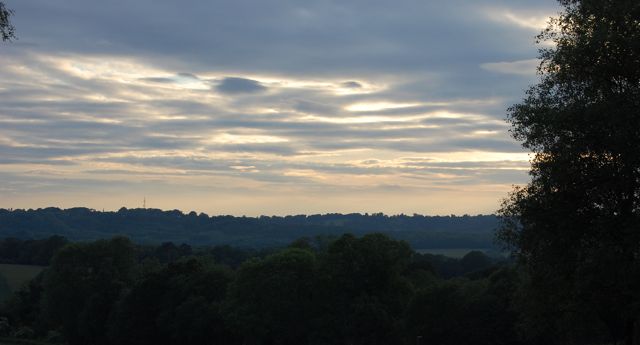
At sunset, Cloud Farm staged a spectacular display of Gavs: a low mauve cloudscape gathered underneath a spectrum of purples enlivened with a streak of red

Of all the places we camped that rainy August, Cloud Farm was my favourite, and I will return. Like all good sites, you are encouraged to park away from the tents, only driving down to pitch or pack up. There was a good shop stocked with real ale and a cafe that the locals spoke warmly about. We wandered down to a pair of small fields and pitched beside a river, which was fenced off from our inquiring toddlers. Snug between the flanks of the valley, I set a fire. The last time I saw Tom, he demonstrated his device for checking the moisture level in logs; the Cloud Farm shop sold some wickedly dry wood, and soon I was roasting marshmellows over its uninhibited dancing flames.
I spent most of my twenties working and writing for The Idler. As Deputy Editor, I was part of a trio consisting of Tom, myself and art director and co-founder, Gavin Pretor-Pinney.

Gavin Pretor-Pinney, Matthew De Abaitua and Tom Hodgkinson of The Idler

Situated in Clerkenwell in the 1990s and the fun bit of the new millennium, we took full advantage of the city. Since those happy carefree days, each of us has sought out an individual vision of the English pastoral: while I beaver away on a book about camping, Tom’s bestseller How To Be Free posits a way of life that draws on medievalism and rural self-sufficiency; Gavin has enjoyed such international success with his Cloudspotting books that I can no longer gaze up at the clouds without thinking of him. My daughter even calls clouds “Gavs”.
Cloud Farm

At sunset, Cloud Farm staged a spectacular display of Gavs: a low mauve cloudscape gathered underneath a spectrum of purples enlivened with a streak of red. Purple is the colour of inbetween, the veil between reality and imagination, day and night. For a moment, I was transported out of my immediate responsibilities, that carousel of Dad Tasks, and experienced a sense of well-being that lasted until the sun went down; the silent knowing wisdom of idleness about which we had spent our hectic twenties extolling, but rarely experiencing.

View Campsites, campfires, UK in a larger map
Doone Valley
Oare, Lynton, EX35 6NU
01598 741 234

The Sexually Repressed Bees
of Plaw Hatch Farm

I was woken by the intricate melodies of the song thrush marking its territory. The dawn chorus was astonishingly loud through the thin walls of a tent. Nature called. I unzipped the door and clambered out onto the long dewy meadow grass.

The cold waters of night lay over the land. First light pulsed in the East. In the West, the crescent moon and its court of stars were still up. North into the valley, first light drew the pitch out of the black; the lower fields lurked through thick grainy bands of blue. In the towns and cities the day is either on or off; you miss the long in-between of dawn and dusk, the magically prolonged moment in which the sun rises to challenge the nocturnal supremacy of the moon.

I feel most alive when I am camping. My first response, on finding myself jobless in late Spring, was that my family should spend the summer camping

The moon is taken seriously at Plaw Hatch Farm, a small two hundred acre biodynamic farm near Ashdown Forest in East Sussex. Biodynamic agriculture was devised by Rudolf Steiner, the founder of Anthroposophy and a respectable figure in the progressive underground that flourished in the late nineteenth century and the first decades of the twentieth century. Steiner’s thought is broadly categorised as spiritual science; he sought to unify science’s exacting practicality with mankind’s mystical yearnings. Biodynamic farming belongs to the later practical phase of Steiner’s philosophy, bringing together sound practices we now recognise as mainstream due to the organic food movement, with a touch of the occult: preparations made from cow horn and crystals infuse the soil with cosmic forces, while the respective rhythms of the earth, the moon and the cosmos influence the planting calendar.

Biodynamic cows at Plaw Hatch Farm

The biodynamic farm aspires to a closed system: the animals are born and reared on the farm, and their manure fertilises the grass that feeds the animals which in turn produces more manure. At Plaw Hatch Farm, the cycle encompasses lambs, sheep and pigs, chickens and ducks, a rabbit field, cows, a milking shed and polytunnels of vegetables. And two beehives. New inputs into the system – such as campers – are taken in reluctantly.

I have long felt that camping could hold the key to a new way of life, and there was certainly an appetite for a new way of life in the economic wreckage

I feel most alive when I am camping. My first response, on finding myself jobless in late Spring, was that my family should spend the summer camping. After two rainy summers of commuting and childcare, the long-term weather forecast predicted a barbecue British summer. More prosaically, the pound was weak against the euro and the British public were pulling their horns in as the economy collapsed. So economically and meteorologically, the summer of camping seemed the fit response to unemployment. More than that, I have long felt that camping could hold the key to a new way of life, and there was certainly an appetite for a new way of life in the economic wreckage. The summer was my chance to explore the meaning and history of camping and how it related to a new view of society, our approach to parenting, even my manhood. The long boom was the era of Big Tent politics, in which our leaders drew together disparate factions under the promise of endless economic growth, a promise that seemed free of ideology. That era was over, and it was time to discover what Little Tent politics might bring. Instead of house prices, I would think only of tents and where to pitch them. As an article in the LA Times on music festivals noted, there was a “growing prominence of temporary structures in a world suddenly drained of capital.” Camping seemed a fit response to the failed property cult.

Continue reading The Sexually Repressed Bees
of Plaw Hatch Farm

We Are Camping at Port Eliot

I unveiled my We Are Camping project at Port Eliot festival this year, 23rd-25 July. The event took place on Sunday 25 July in the camping field at 2pm.

I am a big fan of the Port Eliot festival, being their very first paid customer way back when. I have been researching We Are Camping for a year now. For the event, I lead festival goers through the campsite while talking about the meaning and history of camping.
The house at Port Eliot during the festival

Tom’s Field campsite

Tom’s Field is a popular campsite on the Southern end of the Isle of Purbeck, which is not really an island so much as a hearty peninsula situated on a turn-off from the holiday traffic crawling West through Dorset.
Like so many of the Cool Camping selections, Tom’s Field struggles to maintain its allure now that the secret is out.

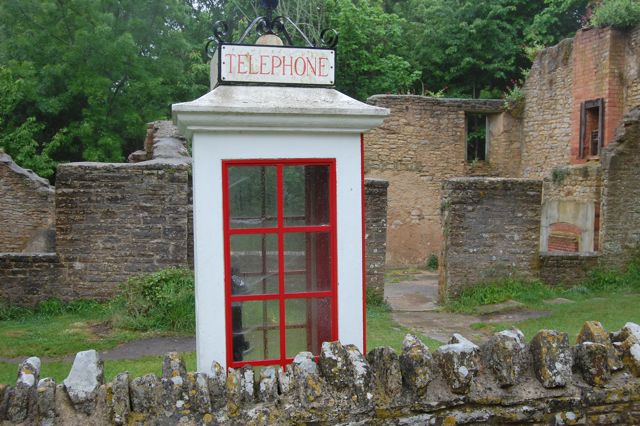
Phone box in the deserted village of Tyneham

We booked well in advance as Tom’s Field is relatively small, being a collection of fields divided by dry stone walls and covering four and a half acres. There is a renowned walk from the site down to a dancing ledge, a flat area of rock with a man-made rock pool at the foot of Jurassic cliffs. Unfortunately our children were too small to manage the descent.

We found Tom’s Field friendly but uninspiring. Campers are encouraged to park their cars in the field outside the site, which is a positive, as nothing spoils a camp like traffic. But fires are forbidden, so the nights we spent there felt suburban. A strict lights-out policy and allocated pitches contributed to the boredom.

The site in Langton Matravers is near to the popular National Trust destination of Corfe Castle; an iconographic ruin, beautiful from a distance but meaningless up close. On a rainy day, campers flee to Dorchester, which becomes crammed with soaked families seeking any distraction from the unrelenting rain, and some risible museums have sprung up to serve this need. The nearby town of Swanage is a dispiriting, down-at-heel seaside town.

[ad#Google Adsense-solid bar]

I judge camping trips by the moments of intensity they deliver, and on that gauge, the best reason to visit Tom’s Field is as a base from which to explore the nearby deserted village of Tyneham. Dorset has strong literary connections: Lyme Regis was the location for John Fowles’ The French Lieutenant’s Woman and Ian McEwan saw in the tightly packed pebbles of Chesil Beach a suitable backdrop for a novel of sexual repression and misunderstanding. Unlike these well-visited places, Tyneham, the subject of Patrick Wright’s digressive history The Village That Died For England, retains an aura of poetic intensity.

Tyneham was a small village cleared by the army during the Second World War so that the area could be used as an artillery and tank firing range. The villagers were promised that they would be able to return once the war was over, but the military reneged on this promise. Today, access to Tyneham is intermittent (check here before heading out), which makes a trip there all the more meaningful; the drive down into the village seems to take much longer than the map indicates, suggesting a topography warped by military intelligence.

phone box at Tyneham
Pristeen phone box against the village ruins

“To drive down into the Tyneham valley is to sink into a zone where even the sharpest of actualities seems overtaken by myth,” observes Patrick Wright. The birdsong is rich and multi-layered, as if the birds have expanded and deepened their repertoire free of the distracting presence of mankind. The graveyard and restored schoolyard – both scrupulously maintained by the Army – are poignant reminders of the temporariness of our places. The small Elizabethan mansion, unstable and gutted, speaks of wayward shelling.

Deserted places exert a particular pull. If Nature abhors a vacuum, the imagination adores one, drawn in by the possibility and promise of an empty lost place.

Sussex days out map

We finally bought a car late last year and have spent every weekend since exploring the area. I have plotted our favourite local destinations for a family day out onto a Google map. So if you are camping or new to Sussex, here are my ideas for days out with children.

View Sussex days out in a larger map


Secret campsites – Plaw Hatch Farm

Every camper longs to discover a secret site, an isolated glade they can call their very own. This is one of contradictions in the soul of camping, the desire for isolation pulls against the pleasure of community. For some, the perfect site is an empty field. For others, it is a field full of new friends.
math-woodpile-plaw-hatch

The secret is out concerning cool camping sites in Sussex; this summer, you will struggle to get a weekend pitch at Blackberry Wood, Waspbourne Manor Farm, Hidden Spring or Heaven Farm. Still, necessity is the mother of invention. Following a tip-off we turned up a secret site all of our own, a secret I shall now share with you.
plaw-hatch-biodynamic-cattle
Plaw Hatch Farm in Sharpthorne follows the principles of biodynamic farming as inspired by Rudolf Steiner. The mixed farm strives to be a closed system, aiming to use only its own seeds, fertilisation and animal feed. Camping is a recent addition to the system and one the farm is tentatively exploring: a composting toilet has been installed; a nearby spring tapped; a woodpile of firewood stacked in the centre of the field; a hacksaw left for the campers to share.

We camped on the upper reclaim field of Plaw Hatch Farm amongst meadow grass looking down into the valley where the milking herd graze. There is no shower block or reception, just a small caravan, an unfinished tree house, and a pair of bell tents. Lewes is leading the revival of the bell tent, although I cleave to the opinion of T.H. Holding, author of the Camper’s Handbook of 1908, who wrote “Bar its frightful weight and bulk, a second-hand War Bell Tent would do, though, without exception, this type of tent is the most dismal inside that I know.”

There was just us, one other family and the cows. The life of the herd makes for a good soap opera, with its bovine comings and goings, its chewing gossip, and its drama – when a bull bellows from a neighbouring field, all the cows stand to attention as if commanded by their sexual sergeant major.

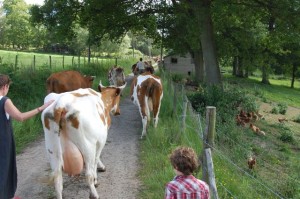
In mid-afternoon, we walked amongst the herd as it was ushered off for milking, the farmer whistling the cows on, swishing their backsides with a reed when the mischievous beasts dwelt on the delicious herbs tufted in the verges.

The results are there on the shelves of the farm shop; thick delicious yoghurt, pints of raw creamy milk, and Gouda and cheddar cheeses. The biodynamic movement comes out of the ideological ferment of the inter-war years, arising from a series of lectures delivered by Rudolf Steiner in 1924. Biodynamic agriculture is precursor to organic farming, with a little magic sprinkled in there too, as befitting Steiner’s anthroposophy. Star charts are consulted when sowing and planting, and preparations made from cow horn play a homeopathic role in the composting.
campfire-plaw-hatch-farm

Such spiritualism gives the farm a hushed, reverent air. Needless to say, my children and I launched ourselves upon that peace and quiet like a collection of power tools. By the end of the weekend, roles had reversed and we were the soap opera for the cows. Sometimes you want a secret site not to hide from other people, but to spare them.

Lovewood

Follow the track down into a clearing in the wood and there is a stage, a barbecue and the makings of a bonfire. On that stage, a young Amy Winehouse-lookalike in leopard-print dress, high black belt and fake tattoos is working through the hits with more precision than Amy herself can muster, these days.

Amy Winehouse tribute performance at Lovewood
There is not much of a crowd. The sun is overhead and the punters are still pitching their tents at the other end of the field, where the pylons overhead make my daughter’s hair crackle.

This is the first Lovewood festival, a collaboration between the Love Is All You Need charity and Little Dernwood Farm. The plan is to raise money for the charity and its work in South Africa, including an education centre in Mdumbi, caring for children orphaned by HIV and AIDS in communities where 170 adults die every week.


A handmade, friends-of-friends type of event, Lovewood is not so much a festival as an expression of goodwill and support for this charity.

I don’t dance for the same reason I don’t walk around in a pair of speedos – out of consideration for others

Little Dernwood can be found along the narrow country lanes around East Hoathly, and the campsite has a growing reputation for providing an experience closer to wild camping than the manicured order of the nearby Caravan Club site. There is no shower block. There is a composting toilet somewhere but I can’t find it. As it is late Spring, the bluebells turn down their bonnets in the dappled glade. On stage, a collection of children called Jazz Code come on. The adults hide behind the barbecue stall, smoking the cigarettes they promised their children they had quit.

A silver heart in the trees of Lovewood

A Streets-style trio called Twisted Link perform an impressive collection of raps over beats taken from the 8-bit and 16-bit videogames of yesteryear. I look around for their parents. No sign. Perhaps the boyfriend of the daughter of someone. Their set coaxes a few more bodies into the big empty rectangle at the front of the stage. Now the Mum and Dad dancing begins in earnest. Mum grooving her baby’s arms in time to the beat, Dad gallumphing around in front of the stage with his son on his shoulders. The baby is in a papousse, and its arms and legs flail around as Mum dances.

Dirty Ugly Punk Monkeys play a set that turns a variety of beloved classic songs into shouty musical mince

Needless to say, I don’t dance. Not anymore. I can’t lose myself in the beat. These days, my mind wanders off and starts thinking about bills and art and things and before I know it, I am just standing in the middle of the dancefloor as if startled from a dream. Nor do I encourage my children to dance. I don’t dance for the same reason I don’t walk around in a pair of speedos – out of consideration for others. Emo offspring skulk around, discover their parents having a cheeky fag in the woods, and roll kohl-rimmed eyes. I’m with them.

The land cools quickly. The pylons with their rigging are ship masts sailing off into the sunset. My brood returns to its tent. It takes longer than ever to load the children into bed. Elsewhere, the party is just starting. Soon the bonfire will be lit, and Dirty Ugly Punk Monkeys will play a set that turns a variety of beloved classic songs into shouty musical mince. And somewhere in the woods, a grey-haired old badger will put its paws over its ears and suffer for a good cause.

Secret sites

Yesterday I met up with the neighbours for drinks. Talk turned to summer plans and I mentioned our intention to spend the whole season camping.

Cath and Alice at Caherdaniel campsite in Ring of Kerry

The recession has introduced a natural break into my working life. I will seize the chance to live more freely, at least until the leaves turn in Autumn. On hearing our plans to camp, the neighbours all chipped in with suggestions for places to go, but then withdrew those suggestions when it became clear that I intended to include them on this website. “But they are secret,” they pleaded. No, I will have no secrets. Slapton Sands in Devon was mentioned, the scene of a terrible disaster in the Second World War, when Exercise Tiger – a rehearsal for D-day – was attacked by German motor torpedo boats. The tragedy was kept secret lest it damage morale.

My neighbour clammed up before revealing precisely which site they had stayed on, but I reckon this one looks a likely candidate. No secrets around here.