
Looking for the best campsites in the UK? I’ve plotted a selection of recommendations from our own experiences on one big Google UK camping map, including campsites in England, Scotland and Wales. The flame symbol denotes UK campsites that allow campfires.
Tag: UK
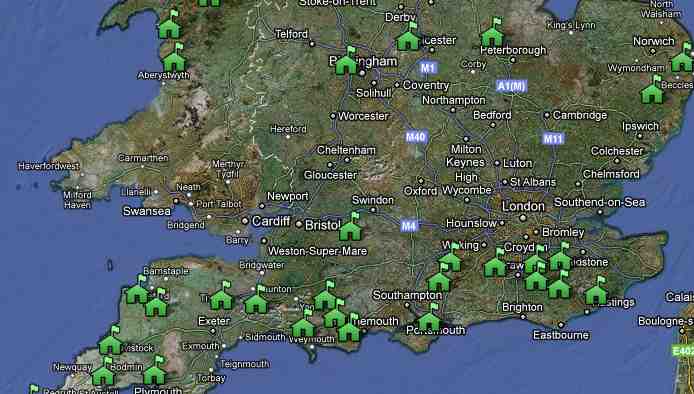
Glamping in the UK map
View Glamping in a larger map
[ad#Google Adsense-solid bar]
Cloud Farm campsite
For me, North Devon means idleness. On the edge of Exmoor lies the farmhouse rented by my friends Tom Hodgkinson, editor of The Idler, and his girlfriend Victoria. We decided to visit them during a camping tour of the area. Bearing in mind the maxim that house guests, like fish, go off after three days, Cath and I decide to camp near a few miles south of the Idler farmhouse at Cloud Farm, a campsite in the “Doone Valley”, off the coastal road between Lynton and Minehead.

Of all the places we camped that rainy August, Cloud Farm was my favourite, and I will return. Like all good sites, you are encouraged to park away from the tents, only driving down to pitch or pack up. There was a good shop stocked with real ale and a cafe that the locals spoke warmly about. We wandered down to a pair of small fields and pitched beside a river, which was fenced off from our inquiring toddlers. Snug between the flanks of the valley, I set a fire. The last time I saw Tom, he demonstrated his device for checking the moisture level in logs; the Cloud Farm shop sold some wickedly dry wood, and soon I was roasting marshmellows over its uninhibited dancing flames.
I spent most of my twenties working and writing for The Idler. As Deputy Editor, I was part of a trio consisting of Tom, myself and art director and co-founder, Gavin Pretor-Pinney.

Situated in Clerkenwell in the 1990s and the fun bit of the new millennium, we took full advantage of the city. Since those happy carefree days, each of us has sought out an individual vision of the English pastoral: while I beaver away on a book about camping, Tom’s bestseller How To Be Free posits a way of life that draws on medievalism and rural self-sufficiency; Gavin has enjoyed such international success with his Cloudspotting books that I can no longer gaze up at the clouds without thinking of him. My daughter even calls clouds “Gavs”.

At sunset, Cloud Farm staged a spectacular display of Gavs: a low mauve cloudscape gathered underneath a spectrum of purples enlivened with a streak of red. Purple is the colour of inbetween, the veil between reality and imagination, day and night. For a moment, I was transported out of my immediate responsibilities, that carousel of Dad Tasks, and experienced a sense of well-being that lasted until the sun went down; the silent knowing wisdom of idleness about which we had spent our hectic twenties extolling, but rarely experiencing.
View Campsites, campfires, UK in a larger map
Doone Valley
Oare, Lynton, EX35 6NU
01598 741 234
The Sexually Repressed Bees
of Plaw Hatch Farm
I was woken by the intricate melodies of the song thrush marking its territory. The dawn chorus was astonishingly loud through the thin walls of a tent. Nature called. I unzipped the door and clambered out onto the long dewy meadow grass.
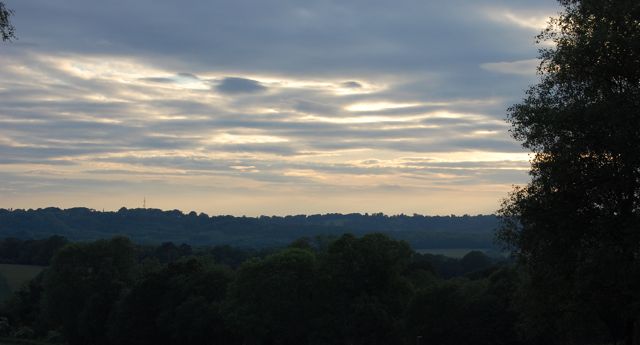
The cold waters of night lay over the land. First light pulsed in the East. In the West, the crescent moon and its court of stars were still up. North into the valley, first light drew the pitch out of the black; the lower fields lurked through thick grainy bands of blue. In the towns and cities the day is either on or off; you miss the long in-between of dawn and dusk, the magically prolonged moment in which the sun rises to challenge the nocturnal supremacy of the moon.
I feel most alive when I am camping. My first response, on finding myself jobless in late Spring, was that my family should spend the summer camping
The moon is taken seriously at Plaw Hatch Farm, a small two hundred acre biodynamic farm near Ashdown Forest in East Sussex. Biodynamic agriculture was devised by Rudolf Steiner, the founder of Anthroposophy and a respectable figure in the progressive underground that flourished in the late nineteenth century and the first decades of the twentieth century. Steiner’s thought is broadly categorised as spiritual science; he sought to unify science’s exacting practicality with mankind’s mystical yearnings. Biodynamic farming belongs to the later practical phase of Steiner’s philosophy, bringing together sound practices we now recognise as mainstream due to the organic food movement, with a touch of the occult: preparations made from cow horn and crystals infuse the soil with cosmic forces, while the respective rhythms of the earth, the moon and the cosmos influence the planting calendar.
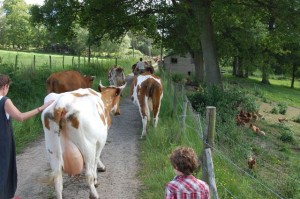
The biodynamic farm aspires to a closed system: the animals are born and reared on the farm, and their manure fertilises the grass that feeds the animals which in turn produces more manure. At Plaw Hatch Farm, the cycle encompasses lambs, sheep and pigs, chickens and ducks, a rabbit field, cows, a milking shed and polytunnels of vegetables. And two beehives. New inputs into the system – such as campers – are taken in reluctantly.
I have long felt that camping could hold the key to a new way of life, and there was certainly an appetite for a new way of life in the economic wreckage
I feel most alive when I am camping. My first response, on finding myself jobless in late Spring, was that my family should spend the summer camping. After two rainy summers of commuting and childcare, the long-term weather forecast predicted a barbecue British summer. More prosaically, the pound was weak against the euro and the British public were pulling their horns in as the economy collapsed. So economically and meteorologically, the summer of camping seemed the fit response to unemployment. More than that, I have long felt that camping could hold the key to a new way of life, and there was certainly an appetite for a new way of life in the economic wreckage. The summer was my chance to explore the meaning and history of camping and how it related to a new view of society, our approach to parenting, even my manhood. The long boom was the era of Big Tent politics, in which our leaders drew together disparate factions under the promise of endless economic growth, a promise that seemed free of ideology. That era was over, and it was time to discover what Little Tent politics might bring. Instead of house prices, I would think only of tents and where to pitch them. As an article in the LA Times on music festivals noted, there was a “growing prominence of temporary structures in a world suddenly drained of capital.” Camping seemed a fit response to the failed property cult.
Continue reading The Sexually Repressed Bees
of Plaw Hatch Farm
Tom’s Field campsite
Tom’s Field is a popular campsite on the Southern end of the Isle of Purbeck, which is not really an island so much as a hearty peninsula situated on a turn-off from the holiday traffic crawling West through Dorset.
Like so many of the Cool Camping selections, Tom’s Field struggles to maintain its allure now that the secret is out.

We booked well in advance as Tom’s Field is relatively small, being a collection of fields divided by dry stone walls and covering four and a half acres. There is a renowned walk from the site down to a dancing ledge, a flat area of rock with a man-made rock pool at the foot of Jurassic cliffs. Unfortunately our children were too small to manage the descent.
We found Tom’s Field friendly but uninspiring. Campers are encouraged to park their cars in the field outside the site, which is a positive, as nothing spoils a camp like traffic. But fires are forbidden, so the nights we spent there felt suburban. A strict lights-out policy and allocated pitches contributed to the boredom.
The site in Langton Matravers is near to the popular National Trust destination of Corfe Castle; an iconographic ruin, beautiful from a distance but meaningless up close. On a rainy day, campers flee to Dorchester, which becomes crammed with soaked families seeking any distraction from the unrelenting rain, and some risible museums have sprung up to serve this need. The nearby town of Swanage is a dispiriting, down-at-heel seaside town.
[ad#Google Adsense-solid bar]
I judge camping trips by the moments of intensity they deliver, and on that gauge, the best reason to visit Tom’s Field is as a base from which to explore the nearby deserted village of Tyneham. Dorset has strong literary connections: Lyme Regis was the location for John Fowles’ The French Lieutenant’s Woman and Ian McEwan saw in the tightly packed pebbles of Chesil Beach a suitable backdrop for a novel of sexual repression and misunderstanding. Unlike these well-visited places, Tyneham, the subject of Patrick Wright’s digressive history The Village That Died For England, retains an aura of poetic intensity.
Tyneham was a small village cleared by the army during the Second World War so that the area could be used as an artillery and tank firing range. The villagers were promised that they would be able to return once the war was over, but the military reneged on this promise. Today, access to Tyneham is intermittent (check here before heading out), which makes a trip there all the more meaningful; the drive down into the village seems to take much longer than the map indicates, suggesting a topography warped by military intelligence.
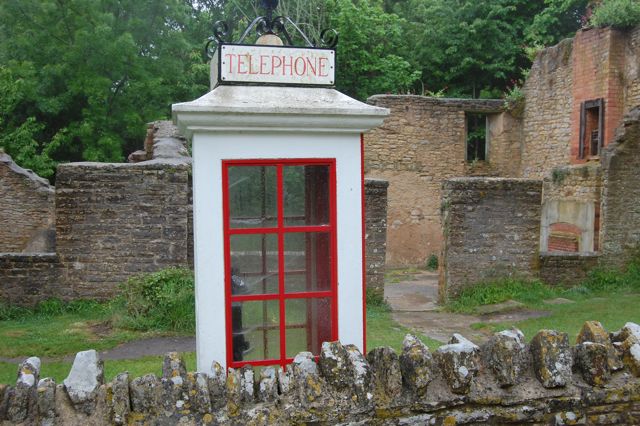
“To drive down into the Tyneham valley is to sink into a zone where even the sharpest of actualities seems overtaken by myth,” observes Patrick Wright. The birdsong is rich and multi-layered, as if the birds have expanded and deepened their repertoire free of the distracting presence of mankind. The graveyard and restored schoolyard – both scrupulously maintained by the Army – are poignant reminders of the temporariness of our places. The small Elizabethan mansion, unstable and gutted, speaks of wayward shelling.
Deserted places exert a particular pull. If Nature abhors a vacuum, the imagination adores one, drawn in by the possibility and promise of an empty lost place.
Met office predicts ‘odds on for a barbecue summer’
The Met Office predicts that Britain is in for a hot dry summer: “Summer temperatures across the UK are likely to be warmer than average and rainfall near or below average for the three months of summer.” After the wash-out summers of 2007/08, in which July and August were monsoon season, this is welcome news.

Chief Meteorologist at the Met Office, Ewen McCallum, said: “After two disappointingly-wet summers, the signs are much more promising this year. We can expect times when temperatures will be above 30 °C, something we hardly saw at all last year.”
Combine the prospect of good weather with a weak pound and a recession, and you have the prospect of a mammoth camping season.