Welsummer campsite

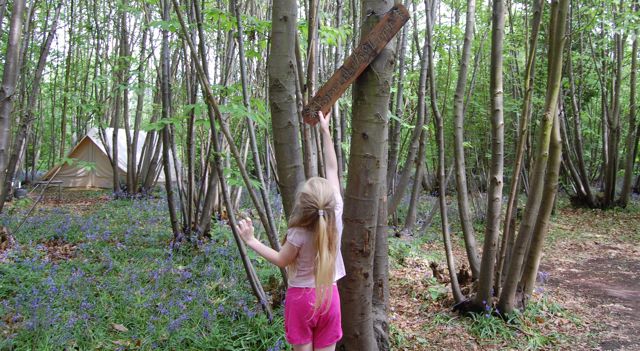
When Thomas Hiram Holding, the gentleman tailor who founded the Camping Club, wanted to camp, he knocked on a farmer’s door and agreed a price for a pitch. The Edwardian camper ranged far and wide and free over the land. That freedom was eroded as the state grew anxious about the impact of camping upon the English countryside. The 1936 Public Health Act contained the first national measures for the control of camping. Only one moveable dwelling – tent – was permitted per acre. Landowners required a licence from the local authority. Large licensed campsites contained the problem of mass tourism in the British countryside. This was the kind of camping I knew as a child, a tent pitched in a manicured internment camp, a suburb under canvas.Adjusting a sign in the woods at Welsummer campsite
The beginning of this century has seen a rehabilitation of the reputation of camping. There are demographic reasons for this – the rise of a new generation of campers with peak outdoors experiences at festivals – and economic reasons – a middle class adjusting to a decline in income by embracing the simple, cheap pleasure of sleeping under the stars. The culture wants an alternative to screen-based lives of work and play, and camping is one option. But not camping as it used to be.

[ad#Google Adsense-solid bar]

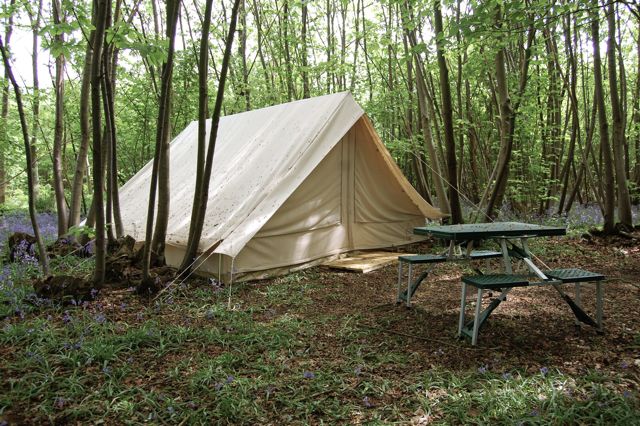
The tiny Welsummer campsite in Kent shows us how much camping has benefitted from shrinkage. It is a small site of twenty pitches set over two cosy meadows and a handful of rugged pitches in a dense wood. An hour and half’s cross-country drive from our home in Lewes, and within reach of a late evening dash from London, Welsummer campsite is run by Med and Laura Benaggoune, a couple in the early forties who lived together in France before returning to Laura’s home in Kent. Ridge tent in the woods of Welsummer campsite
Med and I share a cup of tea. “Where else in Europe you would encounter a site like Welsummer?” I ask. Italy? the Czech republic? The Netherlands? Certainly not in France. “This is not how the French camp,” says Med. “The campfires would be impossible” – dry Southern France is a tinderbox – “ and French campers expect a bar, a disco, a playground.” In other words, everything that the modern British camper eschews. But why have we turned our back on such facilities?

The formula is simple: the smaller the site, the fewer the rules, the greater the freedom. Welsummer has a minimum of signage: in a small site, a friendly word from the owner replaces a blizzard of forbidding notices. Cars must be parked in an adjacent field, which always makes a site more child-friendly and less like a car park. There is a family bathroom, a blessing for anyone who has ever tried to shower three small children in a cubicle, and pre-erected bell tents for metropolitan glampers, keen to dip a Converse galousher in the camping lifestyle. Everyone’s children glom together into a tribe and disappear into the woods. That’s all we ask of camping: freedom for the children, from the children.

Book Welsummer.

Matthew De Abaitua’s book The Art of Camping: The History and Practice of Sleeping Under the Stars is published by Hamish Hamilton in July. Order this new camping book from Amazon.
The Sexually Repressed Bees
of Plaw Hatch Farm

I was woken by the intricate melodies of the song thrush marking its territory. The dawn chorus was astonishingly loud through the thin walls of a tent. Nature called. I unzipped the door and clambered out onto the long dewy meadow grass.

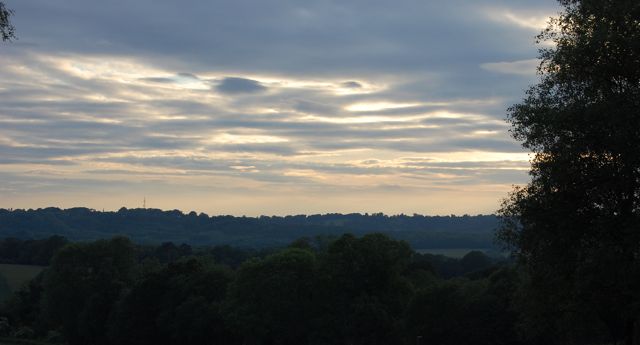
The cold waters of night lay over the land. First light pulsed in the East. In the West, the crescent moon and its court of stars were still up. North into the valley, first light drew the pitch out of the black; the lower fields lurked through thick grainy bands of blue. In the towns and cities the day is either on or off; you miss the long in-between of dawn and dusk, the magically prolonged moment in which the sun rises to challenge the nocturnal supremacy of the moon.

I feel most alive when I am camping. My first response, on finding myself jobless in late Spring, was that my family should spend the summer camping

The moon is taken seriously at Plaw Hatch Farm, a small two hundred acre biodynamic farm near Ashdown Forest in East Sussex. Biodynamic agriculture was devised by Rudolf Steiner, the founder of Anthroposophy and a respectable figure in the progressive underground that flourished in the late nineteenth century and the first decades of the twentieth century. Steiner’s thought is broadly categorised as spiritual science; he sought to unify science’s exacting practicality with mankind’s mystical yearnings. Biodynamic farming belongs to the later practical phase of Steiner’s philosophy, bringing together sound practices we now recognise as mainstream due to the organic food movement, with a touch of the occult: preparations made from cow horn and crystals infuse the soil with cosmic forces, while the respective rhythms of the earth, the moon and the cosmos influence the planting calendar.

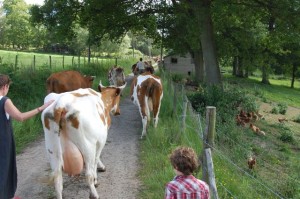
Biodynamic cows at Plaw Hatch Farm

The biodynamic farm aspires to a closed system: the animals are born and reared on the farm, and their manure fertilises the grass that feeds the animals which in turn produces more manure. At Plaw Hatch Farm, the cycle encompasses lambs, sheep and pigs, chickens and ducks, a rabbit field, cows, a milking shed and polytunnels of vegetables. And two beehives. New inputs into the system – such as campers – are taken in reluctantly.

I have long felt that camping could hold the key to a new way of life, and there was certainly an appetite for a new way of life in the economic wreckage

I feel most alive when I am camping. My first response, on finding myself jobless in late Spring, was that my family should spend the summer camping. After two rainy summers of commuting and childcare, the long-term weather forecast predicted a barbecue British summer. More prosaically, the pound was weak against the euro and the British public were pulling their horns in as the economy collapsed. So economically and meteorologically, the summer of camping seemed the fit response to unemployment. More than that, I have long felt that camping could hold the key to a new way of life, and there was certainly an appetite for a new way of life in the economic wreckage. The summer was my chance to explore the meaning and history of camping and how it related to a new view of society, our approach to parenting, even my manhood. The long boom was the era of Big Tent politics, in which our leaders drew together disparate factions under the promise of endless economic growth, a promise that seemed free of ideology. That era was over, and it was time to discover what Little Tent politics might bring. Instead of house prices, I would think only of tents and where to pitch them. As an article in the LA Times on music festivals noted, there was a “growing prominence of temporary structures in a world suddenly drained of capital.” Camping seemed a fit response to the failed property cult.

Continue reading The Sexually Repressed Bees
of Plaw Hatch Farm