Being brief readings from Matthew’s De Abaitua’s book The Art of Camping: The History and Practice of Sleeping Under the Stars (Hamish Hamilton) mixed with campfire tracks by the legendary Richard Norris (The Time and Space Machine, Beyond the Wizard’s Sleeve).
Voice: Matthew De Abaitua
Mix: Richard Norris
Recorded and mixed in Lewes, East Sussex.
4. The Fire in My Head by Voice of the Seven Woods from the album Voice of the Seven Woods. Reading from ‘In Yosemite with John Muir’ by Theodore Roosevelt from his An Autobiography (1913), and quoted in The Art of Camping.
5.Farmland, Freeland by The Advisory Circle from the album Other Channels. Reading from Letter to the Editor of Forest and Stream by Nessmuk, quoted in The Art of Camping.
6. Campfire by Grizzly Bear from the album Horn of Plenty. ‘How to Light a Fire Without a Match’ adapted from Ernest Thompson Seton’s Two Little Savages for The Art of Camping.
10. Ancient Campfire by Biosphere from the album Shenzhou. Reading ‘The Camping Years’ from Leslie Paul’s Angry Young Man, quoted in The Art of Camping.
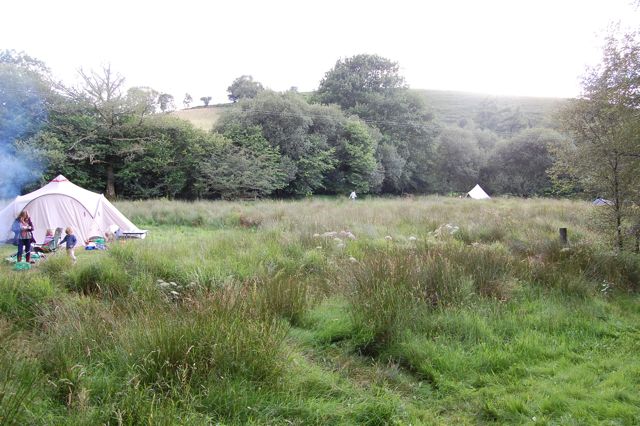
We arrive at a small deserted field at the dead end of a track, sloping gently down to a stream, just in time to pitch our tent in the last of the light. A woodpile of branches is set beside a campfire circle. The adjacent farmhouse is quiet, with a smattering of fowl. The decision to camp came late, about two hours before we set off. With the Hay Literature Festival ongoing, and a double Bank Holiday weekend to mark the Queen’s Diamond Jubilee, this small site was all we could find that fitted our criteria at such short notice.
Cath is modelling a merino wool buff which is ideal for protecting the head from midges
Cwmnanthir campsite is situated in Banwen, to the south-east of the Brecon Beacons, where a range of wind turbines plunge into the valleys of waterfall country. I haul the tent out of the back of the car and begin pitching. The first peg penetrates the earth and releases the midges within; it blows the biters all up in my face and down my vest and into the yawning crack at the back of my trousers. Where is the Avon Skin So Soft? On the recommendation of the military, we use this moisturiser as midge repellent. When it mixes with the burly odours of a few days camping, the Avon Skin So Soft makes me smell like a transvestite down on their luck. I apply it too late. My forehead is braille.
Cath finishes off pitching the tent while I set a campfire as quickly as possible. The children remain in the car. Conditions are testing. I mean, we’ve only driven five hours in Bank Holiday traffic, barely keeping our temper through backseat provocations, a car sick lad, and a few wrong turnings. And now this. Hateful tiny insects. The fire chases them away. The children are put to bed. I open an eight pint jug of Harvey’s ale, fresh from the brewery. Cath sits down next to me wearing a buff to protect her head from the midges, and we exchange our first words since our arrival:
“That was my idea of hell,” she says.
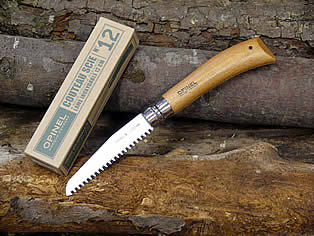
Soon others arrive, a trio of twentysomethings from Hackney who have come in search of waterfalls. They join us around the campfire. Together we sit up until past two in the morning, telling old Hackney stories and chopping wood. One of their party is a carpenter and becomes enamoured with my Opinel saw; it is a beautiful thing, cheap, efficient and classic: a symbol of French genius.
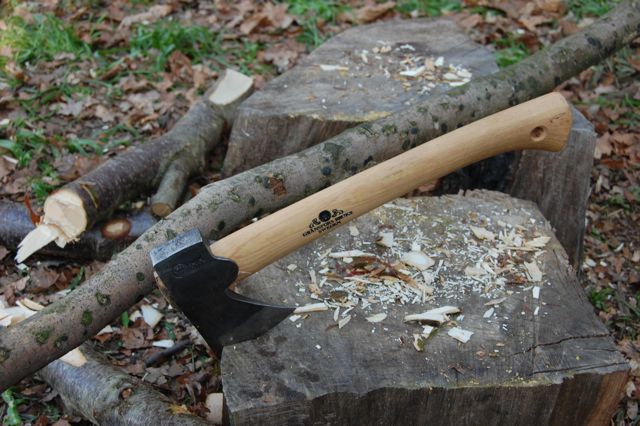
In his essay on the Opinel knife, Jean-Marie Floch describes it as “a secret hero”. I have a Gransfors Bruks hatchet for logs; lethally sharp and operated with a ostentatious swing, there is nothing secret about it. The way the Opinel saw folds out of its handle, is secured in place by a ring collar, and then discretely cuts through branches before slipping quietly back into my pocket confirms the truth of Floch’s observation.
The saw, the axe, and the beer jug are my loyal companions.
I share the jug around and we drink it dry. The moon shines brightly through the trees. When everyone is in bed, I walk back up the road to gaze southward over the beacons; the heads of the wind turbines are concealed in mist. The night shimmers with the unfamiliar, the incipiently strange. The stream burbles noisily by. Something moves nearby. I am not afraid.
The next morning, two other groups arrive; a couple from Wales who have a son each from a previous relationship, and an extended family from Golders Green. He is Syrian, she is Spanish. They have three children of their own, and then a couple of cousins they have taken in to spare them the horrors of the conflict in Syria, and a Spanish cousin who wants to learn English. The father has never been camping before and has brand new kit and an enormous Syrian shisha pipe – indistinguishable to my eyes from an Egyptian hookah.
“The way each camper confounds my gut prejudice makes me feel such joy”
Their children offer my children marshmallows and soon everyone is sitting around the campfire. The midges persist all weekend but this common hardship only bonds us all together; such a disparate collection of souls, Cath and I with our three children are the only conventional nuclear family on show. It is Jubilee Weekend, and in London, meaningless pagentry and sycophancy are offered as a symbol of the nation. I prefer the symbols of these campers and this campsite, an ad hoc unplanned bunch of people from South Africa, Cardiff, Syria, Bilbao and Liverpool who have come together to share an experience of the land and find a way to get along without rules or authority of any kind. A Royal Family? Really? Still?
The midges also stick around. Their persistence is exceptional, apparently. The site itself has a pair of perfectly decent toilets and a shower, a kitchen for campers to use, a bassett hound and a big grey-muzzled dog. There are argumentative geese and a pair of ducks living in a hutch that, on my first night, I mistake for a toilet and the birds never quite forgive me.
Our various children glom together into one group, play football during the day and hide-and-seek past midnight. We sit around the campfire and tell stories of home. The way each camper confounds my gut prejudice makes me feel such joy. I am released from the mean-spirited fear of others, and the weekend becomes, for me, an affirmation that what defines this nation is not the pomp of the homogenous few but the underlying decency of the diverse many.
Campers are rightly afraid of Scotland’s voracious midge, but even in August I found the high meadow of this campsite, with a spectacular view of the surrounding glen, blissfully midge-free. Campfires are permitted, so I perfected the art of baking eggs, fresh from the site chickens, on a grill in foil parcels.
Gwalia Farm, Cemaes, Machynlleth, Powys, SY20 9PZ
If you like rough camping on a tiny campsite, then the overgrown Gwalia is an excellent cheap option, deep in the hills of mid-Wales. Consisting of a few pitches around the back of a B&B, and allowing campfires, Gwalia is a peaceful and amenable spot.
Our first camp last year was at Forgewood, on the Eridge Park Estate. The estate is enormous, with a modest camping field surrounded by ancient woodland in which you can also camp. We pitched our tent in a glade and cooked venison stew – deer are hunted in the park – over the fire.
A friendly, busy site near Grizedale Forest in the Lake District. There are no allocated pitches, and fires are allowed, but an order of sorts emerges and soon a low cloud of campsite smoke drifts over the fells.
Mannix Point in Caherciveen, Kerry
Located at the westernmost tip of the Ring of Kerry, on the outskirts of Caherciveen, campsite owner Mortimer has crafted some beautiful pitches from which you can watch the waters flow into Valentia Bay. There is a music room for ad-hoc singalongs and a campers’ kitchen, which really helps if it rains.
I cooked a big batch of small, fat American-style pancakes for breakfast in the woods. I used a muurikka, a large skillet on legs that sits over a hot campfire. The muurikka was new so it required seasoning with a hunk of pork fat. It is a large pan, so I could cook nearly all pancakes and bacon for five people at once: result.
The weighing-out of the “dry” ingredients is best done at home and then, once at camp, you can add the “wet” ingredients. Remember to pack a whisk, a large bowl and something to measure the milk.
2 eggs
300ml milk (this generally equates to a large mug-full)
Butter for frying
Method
Put all the dry ingredients into a large mixing bowl and whisk in the eggs. Gradually add the milk, whisking all the time until you have a smooth batter. Batters should always be left to rest awhile, so you have time to set the campfire and heat up the muurikka (or whatever pan you are using). The pancakes should be cooked rather quickly so a small hot fire is ideal.
Once you have a rested batter and a hot pan, melt a knob of butter and add one large spoonful of batter to the pan per pancake. Once the pancakes start to bubble, it is time to flip and cook the other side. For each batch, melt another knob of butter before cooking more pancakes. Serve hot and with any of the following fillings:
Maple syrup and streaky bacon
Fried eggs and bacon
Fresh fruit
Fried bananas
Caramelized apples
Caramelized oranges
I discovered Gwalia Farm, a small campsite in Wales, through Tiny Campsites, Dixie Willis’ selection of campsites that are an acre or under in size. The farm is tucked away amongst the lower ranges of the eastern side of Snowdonia, not too far from Machynlleth, a Welsh market town with a progressive stripe. Cath and I grew up in Liverpool, and North Wales is the city’s psychedelic and spiritual retreat. Often, we would hear stories of an auntie or uncle who set the controls for the heart of the sun only to crashland on a welsh croft. The Centre for Alternative Technology, nine miles away from the farm, and its small community of sustainable living, crystallises the spirit of numerous experiments in living that have been conducted over the centuries in the Welsh valleys.
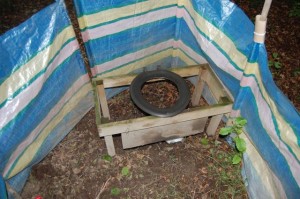
Gwalia Farm is a field around the back of a vegetarian bed and breakfast. Beside a narrow road, there is a rough shoulder where you park up and then trot a dozen yards down to a gate. Beyond the gate there is an overgrown field with half a dozen or so large pitches cut out of the long grass. There is gulley running across the field, a rivulet trickling through it, and after a quick scramble to the woods, there are the latrines – or “lats” as rough campers call them. Holes in the ground. There is a proper WC back at the bed and breakfast. Just past the wood, on the other side of a fence, a pond where some young lads foolishly camped.
"The lats". My mother would never have stood for this
I watched the gang of young men set their camp. They were no different than we had been all those years ago, compelled to come out into the country for some freedom and fire. Upon arriving, they discovered that the thirty-five-hour-a-week shifts they put in consuming entertainment media had in no way equipped them for camp. Never before had I witnessed an attempt to pitch a tent in a bog. Beside a wild pond surrounded by tall grass, they gallumphed around for fire wood, bringing back the greenest, dampest looking branches; I suspect they tried to light the wood directly with a zippo. A couple of hours later, they came to visit our camp, lured in by the smell of wood smoke and the leg of lamb roasting over the campfire.
“I don’t think we should have camped in a bog,” said one lad, shirtless and tattooed.
“The campfire’s not…” his friend hesitated.
“It’s not working.”
“You will need a campfire to keep away the insects,” Cath observed. “Because you’ll get a lot of midges and mosquitos near that pond.”
Their disconsolate scratching was eloquent on this matter, even if they were not. Still, I understood how difficult it was to ask for help in setting a campfire, (not that they asked directly for help; the lads presented their wounds like a dog with an injured paw, and hoped that I would infer what was required.) It is embarrassing to admit that you cannot make fire, that the basic technology of humanity eludes you. I gave them a couple of firelighters, some dry wood and a smouldering log. As they loped back to their sinking, midge-ridden camp, I briefly entertained the fantasy of a network of sites like Gwalia Farm spread across the country, rough and ready glades where young people could learn to build Indian shelters, and set campfires, get out of bedrooms and the forecourts of late-night supermarkets to take risks in nature rather than the plastic risks of video games, a fantasy in which camping in Britain is dedicated to the call of the campfire.
It had been years since I laughed so hard. There were four of us around a campfire set on a hill overlooking Glastonbury festival. It was Saturday night and the vale was a constellation echoing with music, a party that our small children precluded us from attending.
Luke had foraged wooden stakes for fuel; they were laid flat upon the long, dry grass, their tips aflame in the fire pit. As the stakes burned, he got up and adjusted their length. It was not the safest of arrangements; the edges of the pit smouldered as the fire spread along the stake, and visitors tripped over them in the dark. But he seemed to know what he was doing. For the weekend, he was the keeper of the flame.
The conversation turned to meat. Rupert had been to St John’s Market in Liverpool and watched a man auction off bags of assorted meats. Five quid a bag. Ten quid for a bigger bag. No indication of the contents. Just meats, a variety thereof. Cath remembered the tripe and tongue stall at St John’s. Then Luke mentioned the grill steaks advert that made a grand claim of their “pocket of juice”. Other processed burgers lacked this pouch of indeterminate fluid. They were dry. The design flaw of high fat content was made into a point of differentiation and that was why I was laughing, at the thought of all the meetings and money that had gone into marketing the advantage of a “pocket of juice”.
We talked about the impossibility of cooking a frozen chicken kiev, and the experimental fillings foisted upon us by Findus pancakes, then it branched out to the cheese dartboard, with its alternating sections of Cheddar, Edam, Red Leicester, Lancashire, Cheshire cheese and a Baby Bell for a bullseye. Assorted cheeses. Various cheeses.
There was a bottle of brandy, and then the bottle was empty. More people arrived to sit around the campfire and tell tales of their adventures in the festival below. A bottle of Jaegermeister was produced, medicinal and tacky. I spoke of the women’s clothing shop in Lewes were the clothes are made entirely of felt: stiff brightly-coloured felt dresses, felt blouses, felt shoes. Hooded felt capes accessorised with a dream catcher and a large amulet.
“What’s it called?” asked Luke.
“Felt Up,” I replied.
I laughed so much that the next day I had the clear, light sense of well-being that comes after taking a swim or a long walk.
Earlier that afternoon, I had interviewed Peter Hook on stage at the Free University of Glastonbury. Our conversation was mainly about the Hacienda, the club in Manchester that he had invested enormous amounts of money in, and saw nothing in return. His book How Not To Run A Club is a conversational wander through the mistakes that were made at the Hacienda.
“You were losing twenty thousand pounds a week,” I asked him, “why did you carry on with the club?”
“Because I was having a good time,” he replied. The club was somewhere to be with his mates; for all the losses, the pull of having somewhere to go to where he could hang out with friends and have a drink was too strong.
A campfire should be at the centre of any camp yet few sites allow you to set one. Sussex is well-served for campfires, with Spring Barn Farm and Blackberry Wood being the closest places to allow them.
For our annual “iPodival”, a gathering of a dozen adults and an ever-increasing haul of children, we returned to Dernwood Farm in Heathfield. After wheelbarrowing our gear through the woods, we pitched at the entrance to a glade. The first task was to prepare the fire site.
I dug out a rectangle of turf about one and half feet by two feet and set it aside. Then I foraged stones to act as a fireproof ring. A hanging bag of water was on hand in case things went awry. Modern tents made of polyester are exceptionally flammable. I once saw a tent catch fire and become engulfed in seconds. I set the fire a good distance from any tent in case it threw out flaming sparks.
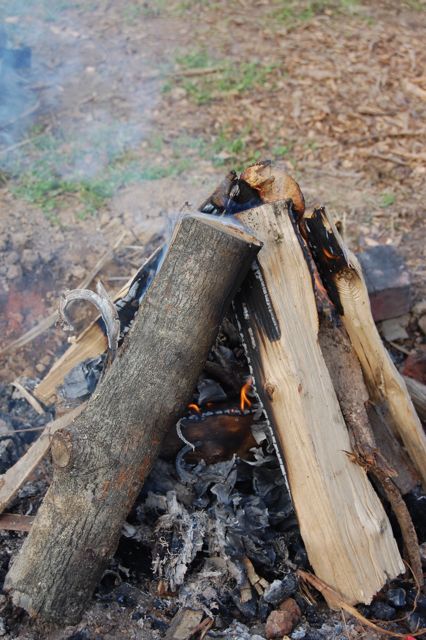
The scouts can light a fire in under two minutes without the use of a match. You can even generate a spark with a twisted coil of wire wool and the contacts on a mobile phone battery. I prefer the trusty Swan Vestas dropped into a pile of tinder in the centre of a pyramid of thin dry kindling. The pyramid or tipi fire provides a directional heat that is good for cooking, although it is liable to tip over when you add new fuel. So dig the vertical lengths of kindling into the ground.
Dared one another to get close to the thrill of iron and flame
My fussing over this small fire proved unbearable to the experienced firebugs in our party. Tim had a pair of sharp axes he had picked up at the Woodfair last autumn. He quickly trimmed logs down to the desired length and set them burning. Then he assembled a tripod from which he suspended a kettle on chain links. My modest conflagration leapt and bounded. I counseled Tim to keep it small, as a small fire will give out a good amount of steady heat. The buzz of masculine interest attracted the boys,
who gawped and dared one another to get close to the thrill of iron and flame.
Fire is a technology, a tool to be used with care and precision
Over at the next encampment, a circle of drunk men whooped as their large fire burnt hot and brief, gobbling up plywood and paper, all spectacle and no practicality.
Fire is a technology, a tool to be used with care and precision. Over the weekend, we cooked on it, warmed ourselves around it, and burnt our leftover food upon it. I took care to extinguish it at night, and when I awoke, Tim coaxed the ashes back to life.
A camping trip should have a purpose, writes Thomas H Holding in the Campers Handbook of 1908. That aim could be archeology, boating, geology, angling, whatever. For our “iPodival” the aim was the sharing of new music, in which each camper took their turn showcasing a playlist of their favourite songs on the stereo. But over the course of the weekend, the music waned and it became apparent that the object of our camping trip had become the fire, with man and boy alike slipping into the rhythms of the element.
When the weekend was over, the fire was put out, the ashes dispersed in the woods, the turf replaced and patted down. The camping ethos of Leave No Trace was there in Holding’s century-old Handbook and it is essential at a site like Dernwood Farm, where you must wheelbarrow your rubbish back to the entrance for recycling. Next time I will bring nothing that cannot be disposed of by fire.