
Looking for the best campsites in the UK? I’ve plotted a selection of recommendations from our own experiences on one big Google UK camping map, including campsites in England, Scotland and Wales. The flame symbol denotes UK campsites that allow campfires.
Tag: campsite
Campfires Not Jubilees
We arrive at a small deserted field at the dead end of a track, sloping gently down to a stream, just in time to pitch our tent in the last of the light. A woodpile of branches is set beside a campfire circle. The adjacent farmhouse is quiet, with a smattering of fowl. The decision to camp came late, about two hours before we set off. With the Hay Literature Festival ongoing, and a double Bank Holiday weekend to mark the Queen’s Diamond Jubilee, this small site was all we could find that fitted our criteria at such short notice.
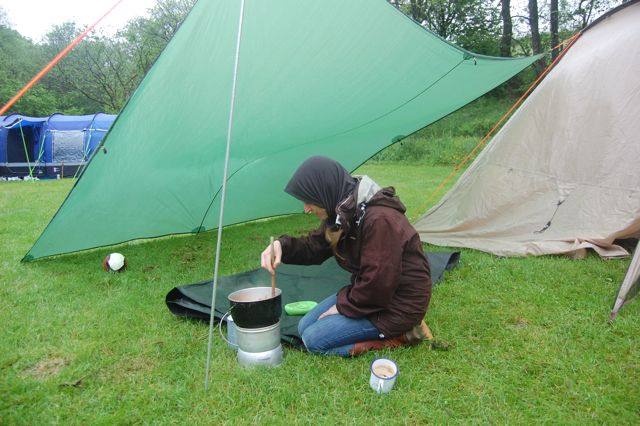
Cwmnanthir campsite is situated in Banwen, to the south-east of the Brecon Beacons, where a range of wind turbines plunge into the valleys of waterfall country. I haul the tent out of the back of the car and begin pitching. The first peg penetrates the earth and releases the midges within; it blows the biters all up in my face and down my vest and into the yawning crack at the back of my trousers. Where is the Avon Skin So Soft? On the recommendation of the military, we use this moisturiser as midge repellent. When it mixes with the burly odours of a few days camping, the Avon Skin So Soft makes me smell like a transvestite down on their luck. I apply it too late. My forehead is braille.
Cath finishes off pitching the tent while I set a campfire as quickly as possible. The children remain in the car. Conditions are testing. I mean, we’ve only driven five hours in Bank Holiday traffic, barely keeping our temper through backseat provocations, a car sick lad, and a few wrong turnings. And now this. Hateful tiny insects. The fire chases them away. The children are put to bed. I open an eight pint jug of Harvey’s ale, fresh from the brewery. Cath sits down next to me wearing a buff to protect her head from the midges, and we exchange our first words since our arrival:
“That was my idea of hell,” she says.
Soon others arrive, a trio of twentysomethings from Hackney who have come in search of waterfalls. They join us around the campfire. Together we sit up until past two in the morning, telling old Hackney stories and chopping wood. One of their party is a carpenter and becomes enamoured with my Opinel saw; it is a beautiful thing, cheap, efficient and classic: a symbol of French genius.
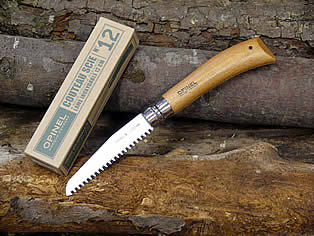
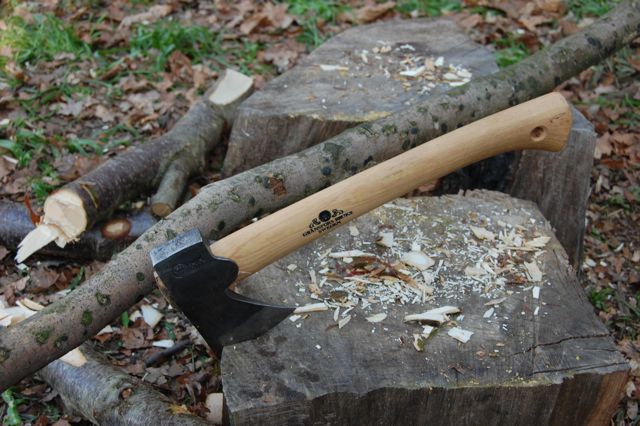
In his essay on the Opinel knife, Jean-Marie Floch describes it as “a secret hero”. I have a Gransfors Bruks hatchet for logs; lethally sharp and operated with a ostentatious swing, there is nothing secret about it. The way the Opinel saw folds out of its handle, is secured in place by a ring collar, and then discretely cuts through branches before slipping quietly back into my pocket confirms the truth of Floch’s observation.
The saw, the axe, and the beer jug are my loyal companions.
I share the jug around and we drink it dry. The moon shines brightly through the trees. When everyone is in bed, I walk back up the road to gaze southward over the beacons; the heads of the wind turbines are concealed in mist. The night shimmers with the unfamiliar, the incipiently strange. The stream burbles noisily by. Something moves nearby. I am not afraid.
The next morning, two other groups arrive; a couple from Wales who have a son each from a previous relationship, and an extended family from Golders Green. He is Syrian, she is Spanish. They have three children of their own, and then a couple of cousins they have taken in to spare them the horrors of the conflict in Syria, and a Spanish cousin who wants to learn English. The father has never been camping before and has brand new kit and an enormous Syrian shisha pipe – indistinguishable to my eyes from an Egyptian hookah.
“The way each camper confounds my gut prejudice makes me feel such joy”
Their children offer my children marshmallows and soon everyone is sitting around the campfire. The midges persist all weekend but this common hardship only bonds us all together; such a disparate collection of souls, Cath and I with our three children are the only conventional nuclear family on show. It is Jubilee Weekend, and in London, meaningless pagentry and sycophancy are offered as a symbol of the nation. I prefer the symbols of these campers and this campsite, an ad hoc unplanned bunch of people from South Africa, Cardiff, Syria, Bilbao and Liverpool who have come together to share an experience of the land and find a way to get along without rules or authority of any kind. A Royal Family? Really? Still?
The midges also stick around. Their persistence is exceptional, apparently. The site itself has a pair of perfectly decent toilets and a shower, a kitchen for campers to use, a bassett hound and a big grey-muzzled dog. There are argumentative geese and a pair of ducks living in a hutch that, on my first night, I mistake for a toilet and the birds never quite forgive me.
Our various children glom together into one group, play football during the day and hide-and-seek past midnight. We sit around the campfire and tell stories of home. The way each camper confounds my gut prejudice makes me feel such joy. I am released from the mean-spirited fear of others, and the weekend becomes, for me, an affirmation that what defines this nation is not the pomp of the homogenous few but the underlying decency of the diverse many.
Five of our favourite campsites

Five campsites
Comrie Croft, Braincroft, Crieff, Perthshire PH7 4JZ
Campers are rightly afraid of Scotland’s voracious midge, but even in August I found the high meadow of this campsite, with a spectacular view of the surrounding glen, blissfully midge-free. Campfires are permitted, so I perfected the art of baking eggs, fresh from the site chickens, on a grill in foil parcels.
Gwalia Farm, Cemaes, Machynlleth, Powys, SY20 9PZ
If you like rough camping on a tiny campsite, then the overgrown Gwalia is an excellent cheap option, deep in the hills of mid-Wales. Consisting of a few pitches around the back of a B&B, and allowing campfires, Gwalia is a peaceful and amenable spot.
Forgewood, Sham Farm Road, Danegate, Nr Tunbridge Wells, Kent, TN3 9JD
Our first camp last year was at Forgewood, on the Eridge Park Estate. The estate is enormous, with a modest camping field surrounded by ancient woodland in which you can also camp. We pitched our tent in a glade and cooked venison stew – deer are hunted in the park – over the fire.
Grizedale Campsite, Bowkerstead Farm, Satterthwaite, Ulverston, Cumbria
A friendly, busy site near Grizedale Forest in the Lake District. There are no allocated pitches, and fires are allowed, but an order of sorts emerges and soon a low cloud of campsite smoke drifts over the fells.
Mannix Point in Caherciveen, Kerry
Located at the westernmost tip of the Ring of Kerry, on the outskirts of Caherciveen, campsite owner Mortimer has crafted some beautiful pitches from which you can watch the waters flow into Valentia Bay. There is a music room for ad-hoc singalongs and a campers’ kitchen, which really helps if it rains.
For more campsite recommendations, use our uk campsite map
Welsummer campsite
When Thomas Hiram Holding, the gentleman tailor who founded the Camping Club, wanted to camp, he knocked on a farmer’s door and agreed a price for a pitch. The Edwardian camper ranged far and wide and free over the land. That freedom was eroded as the state grew anxious about the impact of camping upon the English countryside. The 1936 Public Health Act contained the first national measures for the control of camping. Only one moveable dwelling – tent – was permitted per acre. Landowners required a licence from the local authority. Large licensed campsites contained the problem of mass tourism in the British countryside. This was the kind of camping I knew as a child, a tent pitched in a manicured internment camp, a suburb under canvas.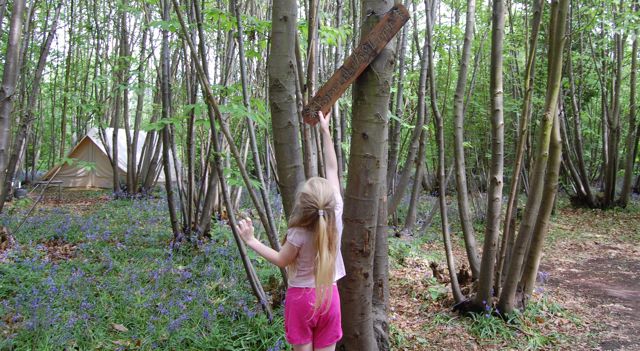
The beginning of this century has seen a rehabilitation of the reputation of camping. There are demographic reasons for this – the rise of a new generation of campers with peak outdoors experiences at festivals – and economic reasons – a middle class adjusting to a decline in income by embracing the simple, cheap pleasure of sleeping under the stars. The culture wants an alternative to screen-based lives of work and play, and camping is one option. But not camping as it used to be.
[ad#Google Adsense-solid bar]
The tiny Welsummer campsite in Kent shows us how much camping has benefitted from shrinkage. It is a small site of twenty pitches set over two cosy meadows and a handful of rugged pitches in a dense wood. An hour and half’s cross-country drive from our home in Lewes, and within reach of a late evening dash from London, Welsummer campsite is run by Med and Laura Benaggoune, a couple in the early forties who lived together in France before returning to Laura’s home in Kent. 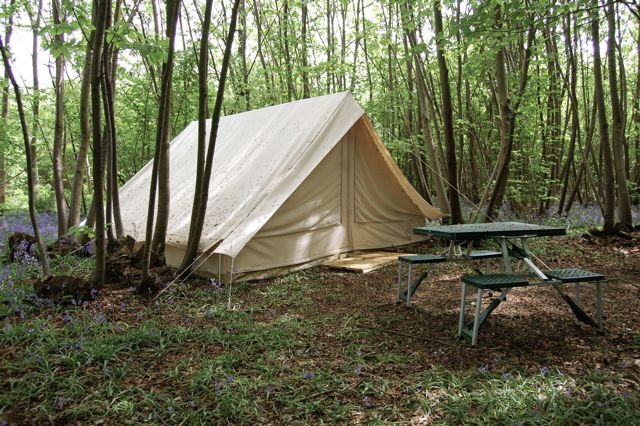
Med and I share a cup of tea. “Where else in Europe you would encounter a site like Welsummer?” I ask. Italy? the Czech republic? The Netherlands? Certainly not in France. “This is not how the French camp,” says Med. “The campfires would be impossible” – dry Southern France is a tinderbox – “ and French campers expect a bar, a disco, a playground.” In other words, everything that the modern British camper eschews. But why have we turned our back on such facilities?
The formula is simple: the smaller the site, the fewer the rules, the greater the freedom. Welsummer has a minimum of signage: in a small site, a friendly word from the owner replaces a blizzard of forbidding notices. Cars must be parked in an adjacent field, which always makes a site more child-friendly and less like a car park. There is a family bathroom, a blessing for anyone who has ever tried to shower three small children in a cubicle, and pre-erected bell tents for metropolitan glampers, keen to dip a Converse galousher in the camping lifestyle. Everyone’s children glom together into a tribe and disappear into the woods. That’s all we ask of camping: freedom for the children, from the children.
Book Welsummer.
Matthew De Abaitua’s book The Art of Camping: The History and Practice of Sleeping Under the Stars is published by Hamish Hamilton in July. Order this new camping book from Amazon.