The Sex, Drugs and Rock ‘N’ Roll Were Incidental

The festival issue of Five Dials (number 13) included my story The Sex, Drugs and Rock ‘N’ Roll Were Incidental, which is a review of the Woodstock music festival as a failed camping holiday.

The story is reproduced here.

Five Dials issue 13 the Festival IssueFive Dials is an online literary magazine from my publishers Hamish Hamilton, and it is free. With an impressive roster of contributors (who I am honoured to join), Five Dials can be downloaded here.

The Art of Camping: The History and Practice of Sleeping Under the Stars

I am pleased to announce that my book The Art of Camping: The History and Practice of Sleeping Under the Stars will be published next year July 2011 by Hamish Hamilton, as reported in the Bookseller.

Cath and Math camping The Art of Camping

The last year has been largely spent researching and preparing a proposal for the book, which I am currently deep in the throes of writing. The book will include American characters such as Ernest Thompson Seton, Nessmuk and Horace Kephart alongside the eccentric, progressive British camping movements of The Kindred of the Kibbo Kift and The Order of Woodcraft Chivalry. Thomas Hiram Holding will stand beside Edward Whymper, American Indian beside Romany Gypsy, Buckminster Fuller beside Stewart Brand, on a campsite where Glastonbury, Woodstock, neolithic hunters, and the Boston Methodist camp meetings of the nineteenth century are all taking place simultaneously.

So, I’ve got my work cut out. Wish me luck

Matthew De Abaitua

Cath is also contributing to the book. She is currently setting down her thoughts on taking babies camping; the first woman to join the Camping Club, Mrs F. Horsefield, took her boys of twelve years and her baby of twelve months camping, and we have just returned from the festival where there was a baby of about a month old.  It can be done.

Laughing my head off around the campfire

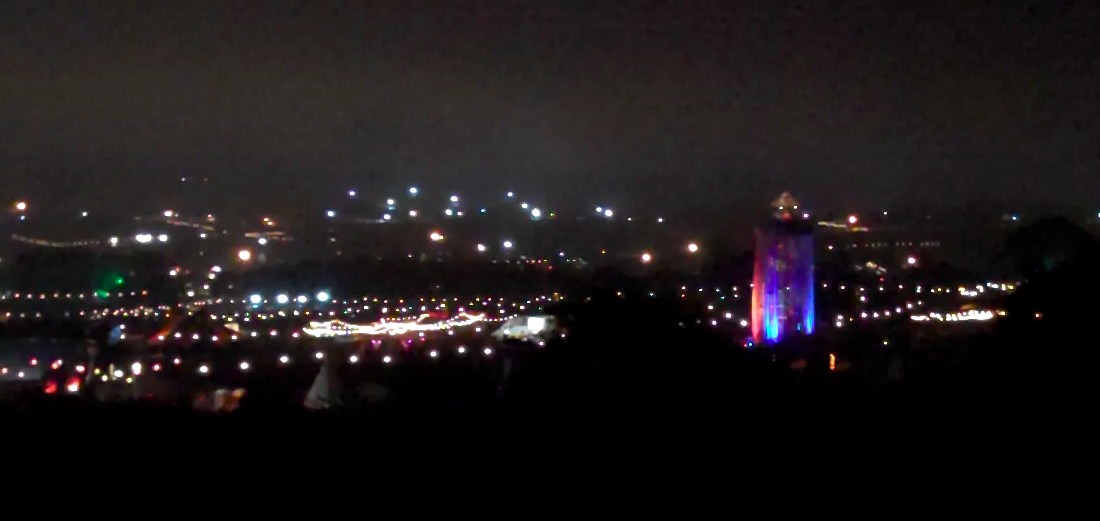
It had been years since I laughed so hard. There were four of us around a campfire set on a hill overlooking Glastonbury festival. It was Saturday night and the vale was a constellation echoing with music, a party that our small children precluded us from attending.

Glastonbury festival at night

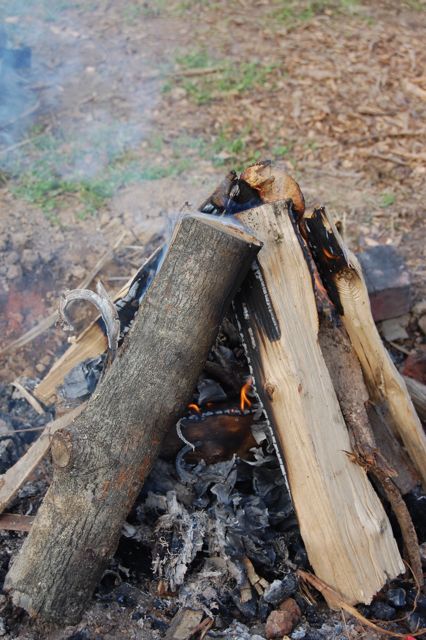
Luke had foraged wooden stakes for fuel; they were laid flat upon the long, dry grass, their tips aflame in the fire pit. As the stakes burned, he got up and adjusted their length. It was not the safest of arrangements; the edges of the pit smouldered as the fire spread along the stake, and visitors tripped over them in the dark. But he seemed to know what he was doing. For the weekend, he was the keeper of the flame.

The conversation turned to meat. Rupert had been to St John’s Market in Liverpool and watched a man auction off bags of assorted meats. Five quid a bag. Ten quid for a bigger bag. No indication of the contents. Just meats, a variety thereof. Cath remembered the tripe and tongue stall at St John’s. Then Luke mentioned the grill steaks advert that made a grand claim of their “pocket of juice”. Other processed burgers lacked this pouch of indeterminate fluid. They were dry. The design flaw of high fat content was made into a point of differentiation and that was why I was laughing, at the thought of all the meetings and money that had gone into marketing the advantage of a “pocket of juice”.

Campfire made from a teepee of wood

We talked about the impossibility of cooking a frozen chicken kiev, and the experimental fillings foisted upon us by Findus pancakes, then it branched out to the cheese dartboard, with its alternating sections of Cheddar, Edam, Red Leicester, Lancashire, Cheshire cheese and a Baby Bell for a bullseye. Assorted cheeses. Various cheeses.
There was a bottle of brandy, and then the bottle was empty. More people arrived to sit around the campfire and tell tales of their adventures in the festival below. A bottle of Jaegermeister was produced, medicinal and tacky. I spoke of the women’s clothing shop in Lewes were the clothes are made entirely of felt: stiff brightly-coloured felt dresses, felt blouses, felt shoes. Hooded felt capes accessorised with a dream catcher and a large amulet.
“What’s it called?” asked Luke.
“Felt Up,” I replied.
I laughed so much that the next day I had the clear, light sense of well-being that comes after taking a swim or a long walk.
Earlier that afternoon, I had interviewed Peter Hook on stage at the Free University of Glastonbury. Our conversation was mainly about the Hacienda, the club in Manchester that he had invested enormous amounts of money in, and saw nothing in return. His book How Not To Run A Club is a conversational wander through the mistakes that were made at the Hacienda.
“You were losing twenty thousand pounds a week,” I asked him, “why did you carry on with the club?”
“Because I was having a good time,” he replied. The club was somewhere to be with his mates; for all the losses, the pull of having somewhere to go to where he could hang out with friends and have a drink was too strong.
Peter Hook had the Hacienda. I have a campfire.

Camping in the rain

We have been on a camping tour of South West England, rainy-day-camping beginning at the Port Eliot festival, moving onto South Penquite Farm atop Bodmin Moor, then up along the coast and over Exmoor, descending steeply at Cloud Farm in Doone Valley.

It rained all the time. It rained in the morning when the children screamed for breakfast. It rained in the car when the children fought over pencils like old lags bickering over snout. It rained when I pitched camp and it rained when I struck camp.

On Twitter, I received numerous messages requesting my tips for wet camping. I had two, and have since added a third:

1) Hide in the car.
2) Never go to the local museum.
3) Let the children get wet and muddy. And give them more biscuits than they require.

Three small children, seven days and seven nights of rain: not an arrangement that springs to mind upon hearing the word “holiday”. The British people were promised a “barbecue summer”. We got the usual monsoon. The Daily Mail ran photographs of flooded campsites in the Lake District alongside stories of midnight evacuations. Campers muttered darkly to me about government conspiracies: was the weather forecast faked so that we holidayed at home to help the flatlining economy? Was Gordon Brown, in a headdress of turquoise feathers, leading the naked cabinet through the ancient ritual of bringing down the rains to douse the joy of the electorate lest sunlight distract us from our lot of hopeless, ill-rewarded, desperate, pointless, hated toil?

Seven days and seven nights of rain can strip a man of his reason. It’s the sound of the rain against the tent: an unending ovation of sarcastic applause with the occasional catcall of children. Parenthood is a performance. I had a tough audience. In the tent, no-one requested an encore.

Previously I have been cavalier about rainy days camping, based on my now discredited conviction that it rarely rains every hour of the day. I maintained that there is the odd shower, an hour of downpour, and then the clouds move on. In Thomas H Holding’s The Camper’s Handbook from 1908 he shares the delight of a walk he undertook during two wet days: “I put on my waterproof and strolled onto a pulpit of lofty rock. Gazed across Loch Erne; saw the whirlwind gathering a column of water under the steep mountain opposite. This spiral pillar of water towered up, scattered and broke, and gathered again until it came and spent itself at a little point of rock five hundred yards away in the bay.”

I envy his solitary wet walk. Holding was a confirmed bachelor who identified one of the uses of camping as “It enables a man to get away from his family; or his family to get away from him for a spell”. Notice he did not write “It confines a man with his family, and prevents his family from gaining any respite from him.”

Complaining about the rain when you are camping is like complaining about traffic in central London: what else did you expect?

I devised the rule about local museums during a late Spring deluge at Tom’s Field in Dorset, when we headed out to Dorchester, mistakenly seeking refuge in the “attractions”. Other families in steaming waterproofs formed a forbidding queue outside the dinosaur museum. I refused to queue in the rain for an experience I would – under normal conditions -have paid good money to avoid so we ended up in a deservedly less popular museum dedicated to the Chinese Terracotta Warriors. Here replicas of the statues created by “museum and conservation technicians in China” were pompously positioned behind velvet ropes and security devices. Dad anger consumed me. Perhaps one day I will go down to the garden centre, buy a bunch of replicas of Michaelangelo’s David and stick them behind a velvet rope and charge the thick end of twenty quid so that families can experience the wonder of the Italian Renaissance.

That difficult week when the British people were betrayed by the Met Office

Rain is a part of camping. Complaining about the rain when you are camping is like complaining about traffic in central London: what else did you expect? And if you take children camping, you must expect them to get wet and perhaps if you let them run around baptising each other in the muddy waters, then they will learn for themselves the importance of protecting their gear from the rain. So much of our troubles stemmed from resisting the children’s natural inclination to run around heedless of the weather. I devised the third rule while lying in my bed, back at home, wondering what could have been done to improve that difficult week when the British people were betrayed by the Met Office.

Soon I will take our wet tent out to a playing field to dry. We struck and pitched camp in the rain frequently on the holiday, working with silent efficiency to slide poles into sleeves and peg out while our little audience in the steaming car brayed and threw food. There is nothing to it. Pitch the outer tent first. Keep your groundsheet dry. At the entrance of the tent, fold back a yard of groundsheet so that – as you enter the tent – you step first on grass, which will absorb the water running off yourself. Take your boots off here and then step onto the groundsheet. There, that is the only practical advice I have to offer for wet days at camp.

For consolation, I offer the thoughts of Jerome K Jerome on the subject from Three Men In A Boat, so that we are reassured that it was ever thus – with one exception: Jerome was spared the false hope peddled by the Met Office.
“It is evening. You are wet through, and there is a good two inches of water in the boat, and all the things are damp. You find a place on the banks that is not quite so puddly as other places you have seen, and you land and lug out the tent, and two of you proceed to fix it.

Instead of helping you, it seems to you that the other man is simply playing the fool

It is soaked and heavy, and it flops about, and tumbles down on you, and clings around your head and makes you mad. The rain is pouring down steadily all the time. It is difficult enough to fix a tent in dry weather: in wet, the task becomes herculean. Instead of helping you, it seems to you that the other man is simply playing the fool. Just as you get your side beautifully fixed, he gives it a hoist from his end, and spoils it all.”

How to pitch a tent – Glastonbury

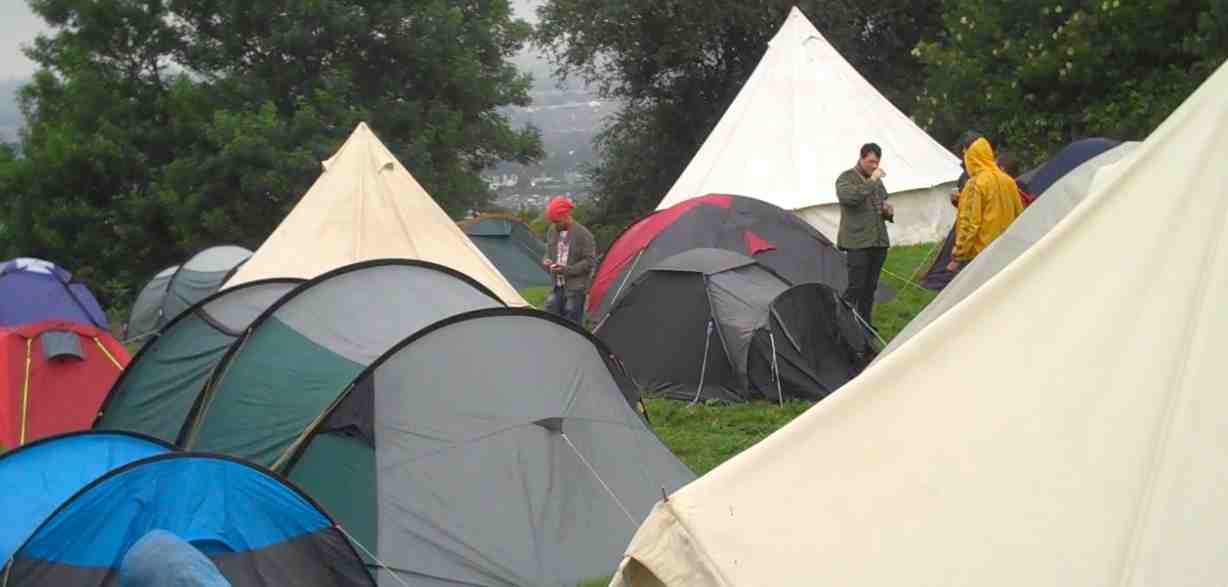
The serried ranks of tents at Glastonbury

We are heading to Glastonbury again this year. Math will be compering talks at the Free University of Glastonbury on the Saturday, 11am-2pm. Guests will include John Niven, Rob Chapman discussing Syd Barrett, and Joy Division and New Order bassist Peter Hook. The weather forecast for Glastonbury weekend is good, and Math is hard at work prepping for the festival. Here is his tip for pitching your tent at Glasto:

Pitching a tent at a festival

Since it is likely you will be returning to the tent at night and in a state of confusion, making the tent easy to find is your first concern. Some people make flags with distinctive homemade patterns. I can still recall the “horse, hand, star” crest used by my friends twenty years ago. Etch the flag with strips of fluorescent material. Others will pitch the tent in a memorable location, near to a thoroughfare or at the very back of the field. I disagree with this approach. The edges of the field, whether it be hedge or fence, will invariably become an improvised urinal – or worse – over the course of the weekend. And thoroughfares are absolutely to be avoided, as confused people are likely to blunder off the walkway into camp.

At a festival, the tent is only for sleeping in. Camp serves no other purpose. The enemy of sleep is noise. Camp as far away from the dance tent as possible, and steer clear of fellow campers bearing acoustic guitars or bongos, or indeed any individual who looks susceptible to paranoia, as nothing disturbs a good night’s sleep like a conspiracy theory concerning aircraft contrails and chemicals being sprayed over the city. Worse case scenario is a paranoid musician.

Britain Goes Camping on BBC2

Britain Goes Camping documentary for BBC4
Britain Goes Camping is a new BBC documentary from Brian Henry Martin and Doubleband Films, showing on the BBC iPlayer now.

After a successful premiere on BBC4, Britain Goes Camping will be shown on BBC2 at 10pm on Sunday 8th August, a sign of both the documentary’s and the subject’s appeal.

Earlier this year, Cath and myself spent a day filming with Brian and his small crew, and some of that interview footage is included in the programme. This is my favourite section as it includes a close-up of my Dad as a young man

The crew accompanied us on an early Spring camp in March. The ground was hard with frost and the trees were bare. The first camp of the year is invariably disorganised and fretful, but in this particular case, circumstances were against us; Cath seemed shivery and weak and I was aware of a sickness creeping upon me. But Brian and his crew had travelled from Ireland for the filming and there was no way I would disappoint them so we pressed on, prepping and packing for a cold night outdoors.

“Had the TV crew  stuck around, they would have witnessed horrors”

The crew put us at our ease, thanks to Brian’s careful and friendly manner. But due to our growing illness, any hope we might have entertained as to putting on good front was quashed; we undertook our child and tent tasks with our characteristic stoicism, but we lacked the energy to brush our hair and scrub the crayon from the walls for their arrival. After a brief interview at our flat, we headed into the outdoors.

At the campsite, we erected the tent and then conducted separate interviews with Brian. Once filming was done, the crew departed for their bed and breakfast. The night fell quickly, and the land grew cold. Cath shivered. I broke out in a sweat. In any other circumstances, I would have broken camp and headed for home. But I couldn’t. The scandal about television fakery was uppermost on my mind, of people pretending to do things and then not. I would not go on camera eulogising camping and then break for home at the first sign of trouble.

Had the TV crew stuck around, they would have witnessed horrors.

“No, I would not be a TV faker. We would stick it out”

I lit a fire and the barbecue but was unprepared for the overwhelming blackness of the night. The barbecue has a lid and so was effectively invisible to the small children swarming around me. The fire made no inroads into the dark. For safety’s sake, I decided to tip the barbecue into the fire, burning my fingertips in the process. Agony! I ran around in the blackness wailing my lot, cursing my condition, chased by hungry screaming children. A handful of sausages survived the crisis. The two toddlers wolfed them down. Neither Cath nor myself felt like eating, and our eldest child was swaying and sickening.

Surely I should drive us home.

No, I would not be a TV faker. I would not join the ranks of the pampered presenters who had cut and run. The honour of camping was at stake.

In retrospect, I was far too mad at this point to drive. Mad with the night, and the sickness. We attempted bedtime. A fitful hour of sleep was had, and then the vomiting began.

We had swine flu.

One unexpected consequence of inoculating the toddlers against swine flu was that they were bursting with energy and wanting attention and activity at the same time as Cath, myself and our eldest daughter, Alice, were crawling around the groundsheet in a hallucinatory condition of perpetual evacuation.

At four in the morning, the only one of our party still awake, I spent a tense five minutes thinking I was about to die. Ever considerate, I did not wake Cath to inform her of this, reasoning that it would be better for everyone if they slept through my death, and then cleared up after me in the morning.

Could I drive home now, I wondered? Waking the children and loading them into the car was easy. Driving along dark field and the night lanes less so. And there was the risk, what with my impending death, that driving might be beyond me.

No, I would not be a TV faker. We would stick it out. The swine flu wrung me out like a wet cloth, then dawn arrived with its meagre gifts, a weak grey haze and two spoonfuls of warmth.

The sickness abated. I took the family to a National Trust cafe. The toddlers fell ravenously upon the cakes while their filthy stinking parents ignored the quizzical looks from the other families, so immaculate in their unstained skiing jackets.

I look forward to watching Britain Goes Camping, and to discovering what Brian and his team have unearthed concerning the history of camping; Hopefully, in my brief appearance, I do not come across as unduly deranged.

Tom’s Field campsite

Tom’s Field is a popular campsite on the Southern end of the Isle of Purbeck, which is not really an island so much as a hearty peninsula situated on a turn-off from the holiday traffic crawling West through Dorset.
Like so many of the Cool Camping selections, Tom’s Field struggles to maintain its allure now that the secret is out.

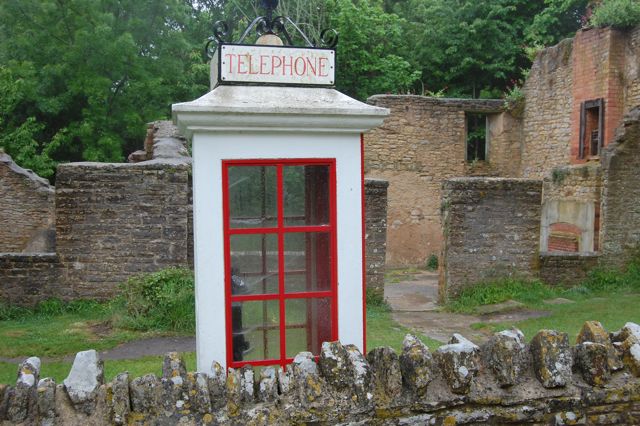
Phone box in the deserted village of Tyneham

We booked well in advance as Tom’s Field is relatively small, being a collection of fields divided by dry stone walls and covering four and a half acres. There is a renowned walk from the site down to a dancing ledge, a flat area of rock with a man-made rock pool at the foot of Jurassic cliffs. Unfortunately our children were too small to manage the descent.

We found Tom’s Field friendly but uninspiring. Campers are encouraged to park their cars in the field outside the site, which is a positive, as nothing spoils a camp like traffic. But fires are forbidden, so the nights we spent there felt suburban. A strict lights-out policy and allocated pitches contributed to the boredom.

The site in Langton Matravers is near to the popular National Trust destination of Corfe Castle; an iconographic ruin, beautiful from a distance but meaningless up close. On a rainy day, campers flee to Dorchester, which becomes crammed with soaked families seeking any distraction from the unrelenting rain, and some risible museums have sprung up to serve this need. The nearby town of Swanage is a dispiriting, down-at-heel seaside town.

[ad#Google Adsense-solid bar]

I judge camping trips by the moments of intensity they deliver, and on that gauge, the best reason to visit Tom’s Field is as a base from which to explore the nearby deserted village of Tyneham. Dorset has strong literary connections: Lyme Regis was the location for John Fowles’ The French Lieutenant’s Woman and Ian McEwan saw in the tightly packed pebbles of Chesil Beach a suitable backdrop for a novel of sexual repression and misunderstanding. Unlike these well-visited places, Tyneham, the subject of Patrick Wright’s digressive history The Village That Died For England, retains an aura of poetic intensity.

Tyneham was a small village cleared by the army during the Second World War so that the area could be used as an artillery and tank firing range. The villagers were promised that they would be able to return once the war was over, but the military reneged on this promise. Today, access to Tyneham is intermittent (check here before heading out), which makes a trip there all the more meaningful; the drive down into the village seems to take much longer than the map indicates, suggesting a topography warped by military intelligence.

phone box at Tyneham
Pristeen phone box against the village ruins

“To drive down into the Tyneham valley is to sink into a zone where even the sharpest of actualities seems overtaken by myth,” observes Patrick Wright. The birdsong is rich and multi-layered, as if the birds have expanded and deepened their repertoire free of the distracting presence of mankind. The graveyard and restored schoolyard – both scrupulously maintained by the Army – are poignant reminders of the temporariness of our places. The small Elizabethan mansion, unstable and gutted, speaks of wayward shelling.

Deserted places exert a particular pull. If Nature abhors a vacuum, the imagination adores one, drawn in by the possibility and promise of an empty lost place.

The Al-thing of the Kindred of the Kibbo Kift

The Kindred camped four times a year, in tune with the seasons. They gathered at Crystal Palace and at Bradenham Common in High Wycombe. They met in Matlock in Derbyshire and Missenden in Shropshire, always in search of new camping grounds.

Dancers entertain a gathering of the Kindred of the Kibbo Kift

At Whitsun, the great meeting of all the Kindred took place. Named the Al-Thing, it was a group camp of 60 to 70 men and women and their children in over a hundred tents, arranged in a semi-circle on a large flat common bordered by a wood. At the Al-Thing, there were wrestling contests and the performance of plays and mummeries. Here the Kindred held their council meetings at which disputes were aired and resolutions made. Whole sheep were roasted and giant loaves baked with a symbolic K marked in the dough.
A performance of The Great Taboo at the Al-Thing of 1924

Activity was divided between art and war, between the writing of songs and poetry, the playing of music, embroidery of banners, the fashioning of puppets and masks, and trials to harden the spirit and stiffen the sinews, such as night hikes and fleet-foot races. Some of the Kindred survived solely on rations prepared the previous winter to test out their preparedness for a state of emergency. Their formidable company of archers honed their skills.

From Matthew De Abaitua’s essay on the Kindred of the Kibbo Kift to be published in The Idler in 2010.

Kindred of the Kibbo Kift

“Jerkin and Hood. Tents in a half circle. Pitched at sundown, gone in the morning. Outlaws…?”

The hooded figures marched up the Long Man of Wilmington. The men wore knee-length braided shorts, brown leather belts, jerkins and pointed green cowls in imitation of the forest outlaws of Robin and his Merry Men. The women wore Arabian keffiyeh-styled headdresses to protect against the sun and one-piece knee-length dresses tied with leather-belts. On the flap of their gray Bergan rucksacks, a mark was painted – a large letter K beside the curling smoke of a campfire and a single green fir tree. The men and women greeted one another with the Native American salute of the open palm, right hand raised high. All the hikers bore rough ash hiking staves, which pushed against the earth as they ascended the Long Man, singing a song of their own devising: “The Kindred is Coming.”

Long Man of Wilmington from the Kinlog of the Kindred of the Kibbo Kift

Carved into the north-facing scarp slope of Windover Hill, the Long Man stands two hundred feet tall. In each hand he clutches what appear to be two staves. The provenance of the Long Man of Wilmington is uncertain: we cannot be sure if it is a sixteenth century tribute or symbol of pagan antiquity. Today, the outline is defined with concrete, and the Long Man is visible to the traffic passing on the A27. But in the year of the hike, August 1929, the figure outlined in the long grass was a mystical watermark on the hillside.

Hawk, gleemaster of the Kindred of the Kibbo Kift

Windover Hill and the surrounding area are rich with remnants from England’s ancient past: Neolithic flint mines, Bronze age burial barrows and a Roman terrace way. The hikers marched up the steep hill in their variant of the classical wedge formation and, at the heart of the Long Man, performed a brief ritual of dedication. Their voices echoed around the distinctive acoustics of the concave slope. Thus they reached back, far, far back into the void-faced hood of prehistory. Mankind’s evolution has been a progressive degeneration, with alienation at every stage. First Man was alienated from oneness with his god, then cast out from the harmony of Nature. The process of separation is remorseless, each severance placing another partition between Man and the Golden Age. He lost his link to his ancestors. He grew apart from others, from his community and fellow man, until even his wife and his own children were alien to him. Each cut was made by the instruments of knowledge and industry, two scissor blades cutting in unison. The final divorce, the ultimate decree nisi, was issued by Freud: man was alienated from his own self. The hikers reached through the void and into the hood searching for the rough hand of Neolithic man, their ancient guide to living in harmony with the subtle, undulating forms of the Downs.

[ad#Google Adsense-solid bar]

Ritual completed, the hikers continued up over the featureless head of the Long Man to the brow of the hill. There, they looked down over the South Downs, a cumuliform landscape of “whale-backed” hills and verdant valleys founded on a bank of chalk. Cloud shadows passed over ploughed wheatfields. In the distance, coastal bays and the glittering English Channel. On the coast the seven peaks of the chalk cliffs rise and fall. Known as the Seven Sisters, each Sister is the measure of a terrifying eternity: trillions of coccolithophores – nanoplankton – lived and died here in a deep warm sea, leaving behind their scales of calcium carbonate to build up over time into the gleaming white cliffs. On the beach, a stunning everywhere of light as the high sun was reflected by these geological mausoleums.

From a leaflet distributed by the Kindred of the Kibbo Kift

The Sussex downs, their name derived from the Saxon word ‘dun’, meaning hill, were one of many sites in the English landscape stalked by these strange hikers. Their rituals summoned the ancient British pagan tradition, from back before the Romans, back to a Neolithic Albion of menhir, tor and cromlech, Silbury Hill and the White Horse of Ulmington. The ancient sites throbbed with dormant meaning. For a joke – in the Freudian sense that there is no such thing as a joke – one of their men stripped naked and squatted at the root of the enormous phallus of the Cerne Giant, as if drawing the sexual potency into himself. Such ancestor worship sounds preposterous now: in the twenty-first century, Stonehenge is a tourist attraction at which the passing traffic on the A303 slows to gawp, before speeding on to holidays in Dorset. But in 1929, the remains of English prehistory retained sufficient mystical charge to inspire this select group of hikers and campers as they sought to change the direction of Western civilisation. They were the most intriguing and inspiring of English reform movements, an elite cell a few hundred strong, already nine years into their existence come the occasion of the dedication to the Long Man of Wilmington: they were the Kindred of the Kibbo Kift.

This is the opening of a long essay on the Kindred of the Kibbo Kift to be published by The Idler in 2010.