We finally bought a car late last year and have spent every weekend since exploring the area. I have plotted our favourite local destinations for a family day out onto a Google map. So if you are camping or new to Sussex, here are my ideas for days out with children.
A campfire should be at the centre of any camp yet few sites allow you to set one. Sussex is well-served for campfires, with Spring Barn Farm and Blackberry Wood being the closest places to allow them.
For our annual “iPodival”, a gathering of a dozen adults and an ever-increasing haul of children, we returned to Dernwood Farm in Heathfield. After wheelbarrowing our gear through the woods, we pitched at the entrance to a glade. The first task was to prepare the fire site.
I dug out a rectangle of turf about one and half feet by two feet and set it aside. Then I foraged stones to act as a fireproof ring. A hanging bag of water was on hand in case things went awry. Modern tents made of polyester are exceptionally flammable. I once saw a tent catch fire and become engulfed in seconds. I set the fire a good distance from any tent in case it threw out flaming sparks.
The scouts can light a fire in under two minutes without the use of a match. You can even generate a spark with a twisted coil of wire wool and the contacts on a mobile phone battery. I prefer the trusty Swan Vestas dropped into a pile of tinder in the centre of a pyramid of thin dry kindling. The pyramid or tipi fire provides a directional heat that is good for cooking, although it is liable to tip over when you add new fuel. So dig the vertical lengths of kindling into the ground.
Dared one another to get close to the thrill of iron and flame
My fussing over this small fire proved unbearable to the experienced firebugs in our party. Tim had a pair of sharp axes he had picked up at the Woodfair last autumn. He quickly trimmed logs down to the desired length and set them burning. Then he assembled a tripod from which he suspended a kettle on chain links. My modest conflagration leapt and bounded. I counseled Tim to keep it small, as a small fire will give out a good amount of steady heat. The buzz of masculine interest attracted the boys,
who gawped and dared one another to get close to the thrill of iron and flame.
Fire is a technology, a tool to be used with care and precision
Over at the next encampment, a circle of drunk men whooped as their large fire burnt hot and brief, gobbling up plywood and paper, all spectacle and no practicality.
Fire is a technology, a tool to be used with care and precision. Over the weekend, we cooked on it, warmed ourselves around it, and burnt our leftover food upon it. I took care to extinguish it at night, and when I awoke, Tim coaxed the ashes back to life.
A camping trip should have a purpose, writes Thomas H Holding in the Campers Handbook of 1908. That aim could be archeology, boating, geology, angling, whatever. For our “iPodival” the aim was the sharing of new music, in which each camper took their turn showcasing a playlist of their favourite songs on the stereo. But over the course of the weekend, the music waned and it became apparent that the object of our camping trip had become the fire, with man and boy alike slipping into the rhythms of the element.
When the weekend was over, the fire was put out, the ashes dispersed in the woods, the turf replaced and patted down. The camping ethos of Leave No Trace was there in Holding’s century-old Handbook and it is essential at a site like Dernwood Farm, where you must wheelbarrow your rubbish back to the entrance for recycling. Next time I will bring nothing that cannot be disposed of by fire.
I spent yesterday in the British Library with The Campers’ Handbook by THH Holding, published in 1908. A sepia photograph shows us the author at camp; he is a chunky and kindly chap, grey at the temples and with an amenable unkempt moustache, relaxing in a straw boater and collarless white shirt with the sleeves rolled up. His pipe is tucked in the crook of his palm. I have much to write about Holding’s classic handbook but for now I will share only this alluring account of family camping:
“I have just visited an ideal family camp. It is on an island in a river. There was the eating tent, the sleeping tent, the servant’s tent, the cooking tent for wet weather, and the overboat tent. Here the family and their servants were spending a ‘savage’ holiday.”
And his observation of the enthusiasm Edwardian women brought to the pursuit.
“Perhaps I may be permitted to say here that I have seen them [women] excel men, too, in smartness and cleverness. How quickly they pick up the making and mounting of a tent and its appliances, the cooking and the tidying up, and how they take to the bathing. How the beautiful spirit of brightness and the merry ring of their laughter within hearing of the men is an added pleasure to all.”
We went for a stroll around a camping fair held in a field at the back of Middle Farm, near Lewes. Dozens of tents were pitched for the inspection of prospective buyers, from the Vango Dart 200 – a pop-up festival tent – to the enormous Wolf Lake 7, a grand’s worth of polycotton aircraft hanger.
Pitched on long grass, the zipped-in groundsheets were swampy underfoot, and the bigger the tent, the looser and sloppier they felt. I don’t like tents that pretend to be houses. They remind me of vegetarian sausages. Why pretend to be something you are not?
Thirty-three years after Bob Gillis revolutionised the industry by inventing the first geodesic backpacking tent, the Oval Intention, this camping fair seemed intent on taking a big step backward, being more in the spirit of those despised tan-and-orange monsters of Vintage Camping. The Oval Intention used tension to provide integrity to its structure, following the geodesic dome popularised by Buckminster Fuller. Here the design of large tunnel tents like the Outwell Florida 6 owed more to Wisteria Lane – superfluous weight added to make a tent that looks like a suburban terrace, pitched with a rotary clothes drier in the yard to add to the air of domesticity.
I have a strong aversion to tents with windows. A tent is not a house. You should not be sitting in your tent peering out at your neighbours through a thick sheet of plastic. I don’t want a tent with a wardrobe either. Or a carpet. Outwell’s wall-to-wall carpet comes in a box illustrated with a picture of a happy couple laughing sensuously. Because that’s how in-tent wall-to-wall carpet makes you feel. This is campsite as temporary suburb.
We wandered into the camping shop. We are in the market for a table but none of the tables on show survived five minutes with the boy toddler. We are also in the market for less stuff. That’s what camping teaches you – that you don’t need all that stuff. After an hour, I bought a five quid foot pump, ignoring the motorised ones. Let my children inflate an airbed. Let them know what that feels like.
The highlight of the fair was Outwell’s Indian Lake tent, a teepee with a porch, erected around a thick central pole. I would have liked to have a crack at pitching it, to test the promise of it being “easy to pitch and pack”. Like the little conical hat atop the Vaude Badawi II, the peak is meant to aid ventilation, although the design of the Indian Lake felt like a pretentious hotch-potch where the Vaude Badawi II is a more elegant evocation of the nomad. Of the others on show, we like the Vango Tigris 800 and 600 tunnels, cheap and very easy to pitch for a family tent, although the extension looked like a right dog’s dinner slung onto the back. How long before some enterprising firm decides to cash-in on the British habit of suburbanising everything they touch by manufacturing a conservatory that attaches to the side of your tent?
It’s the beginning of Bank Holiday weekend and the traffic into Dorset crawls past accident after accident. On the verge and in the central reservation, the beautiful dandy faces of cars faces have been bashed ugly, as if set upon by jealous brutes. The unlucky participants stand around dazed, compressing bumps and scrapes with wet clothes and staring at the ongoing traffic with disbelief – how can you lot continue blithely on your journeys when this terrible thing has just happened? But it’s nothing, we reply. The damage is purely cosmetic.
On the return journey we pull up behind something far more serious and recent. Just over there, a driver – thoughtfully, mercifully – holds up a blanket behind which a man is dying. A motorcycle lies burnt out. The police move with a terrible and disturbing urgency. Witnesses leave their cars and walk through the traffic. I turn the music down and wait to be told what to do.
I have never driven on a Bank Holiday before. The anger involved is new to me. Anger is the energy men use to force their way through the crowd and up onto the promised freedom of a holiday. Even packing feels angry, stuffing and stuffing the gear into the back of the car and dismissing the bags deemed to be inessential. Later, we hear about an incident at a neighbouring site when a man driving a caravan completely loses himself to anger, screaming and swearing and demanding everyone got out of his effing way. Statistics tells us that Bank Holidays are always rife with accidents but I wonder if the anger is worse this year. Recession anger. Expenses anger. Hapless-sap-in-a-corrupt-sham-of-a-democracy anger. Or perhaps that man was angry because he was driving a caravan in Bank Holiday traffic, which is like trying to put out a fire with petrol.
Cath and I look at one another and wonder if we have made a terrible mistake
The angry head stays with me when it comes to pitching the tent. Anger makes it feel like I am staking and marking out territory. The nearby ball games make me seethe, none more so that when a tennis ball bounces off my head and onto the Trangia so that the boiling water lists. Now a football strikes the barbecue sending hot coals onto the dry grass. The fire attracts the baby’s interest. I burn my fingers flicking the embers away from the galloping approach of my concerned infants. The transition from angry driving into the community spirit of camping is almost too much for me, a gear change from fifth to first and the revs are roaring. Cath and I look at one another and wonder if we have made a terrible mistake.
We didn’t. The rest of the week camping was glorious. Our eldest thrived in the responsibility and freedom of running errands, making friends, building dens. The brains of the two infants lit up with being outdoors all day. Sure, at one point, in the precious hour between finally getting them all to sleep and taking to bed ourselves, Cath asked me if there would come a point in the holiday when we got to enjoy ourselves, but that was just the black parental humour talking.
Time passes, we adjust to tent life. The angry head becomes outdoor head, the expansive inner clarity that comes with spending all day on the land and under the sky. And that’s why we camp: for the perspective.
Math recently acquired a portable barbeque, the Weber Charcoal Go-Anywhere Grill. It has a pleasingly vintage shape, and is solidly constructed. We spent an afternoon at Homebase checking out the other portable barbecues, all of which felt rather neurotic and liable to fall apart in a complete collapse of nerve. The Weber has a vented lid which traps a convective circulating heat, much better for cooking larger boned joints. Birling Gap
We took the Weber out for a test run to Birling Gap, a pebbled beach tucked in amongst the Seven Sisters chalk cliffs. A steep tower of stairs leads down from the eroding cliff edge to the beach itself. It was late afternoon and the surf was lively. High tide was at six o’clock.
Math began cooking. The grill does not have separate settings, you cannot raise or lower it in relation to the heat. Once his pyramid of coals were lit, he arranged the heat into thirds, with two hot patches either side of an empty middle section. Having a section of the grill that is not over any coals works on a lidded barbecue because the circulating heat will be sufficient for slow cooking.
“Don’t make the mistake of presuming that we know what we are doing,” he warned
Some chefs prefer arranging the coals in a gradually declined slope from left to right, but the portable barbecues lack the depth necessary for this arrangement. The trick is to create the variety of temperatures required to cook a variety of meats – in this case, boned chicken thighs, venison kebabs and sausages, all with a light coating of oil so that they would not stick to the grill.
The tide battled its way up the beach, making for an anxious moment in which we wondered if we would have to strike camp and break for the stairs. Another family arrived with their barbecue, took a doubtful look at the churning rising waters, but were reassured by the sight of us blithely cooking. Math went over to speak to them;
“Don’t make the mistake of presuming that we know what we are doing,” he warned. They set up as far the encroaching waves as was possible on the narrow strip of beach, and started cooking. Fortune favours the brave.
The BBC weather forecast is like my mother: it fears the worst. Absolutely pissing down, say the BBC
Some of the most beautiful weekends of my life were – as far as the BBC was concerned – big black clouds. I wonder if their weather predictions intentionally err on the side of caution to leave them less open to blame if their prediction of a blazing barbecue Sunday goes wrong. Or perhaps the BBC wants to discourage their audience from leaving the house.
I am sure the fault lies in my perception of the situation. I am sure the BBC is blameless and perfect, and not the meteorological Daily Mail they appear to be.
Weather should be clear-headed, but news is clouding weather’s judgement
Residents of the Highland community of Carrbridge say that they live in one of the driest areas of Scotland. The residents claim that the BBC weather website forecasts a wet day and then it turns out that there are only a small number of isolated showers – and sometimes no rain at all. This tallies with my own experience – an hour of rain in an otherwise fine day billed in advance by the BBC as a weeping black cloud.
News and weather are always bundled together, like husband and wife. News accentuates the negative to create drama. Weather should be clear-headed, but news is clouding weather’s judgement. Perhaps it is time they ended their co-dependent relationship and then weather might be able to think more clearly about what is really happening outside its window.
Friday afternoon. Invariably the BBC five-day weather forecast has been chipping away at morale all week, only to change its tune just as Saturday is upon us, innocently maintaining that it had predicted bright with sunny spells all along. But it is too late to pack and so we must spend the weekend in the house, staring at the sunshine through hot windows and dreaming of green fields.
Follow the track down into a clearing in the wood and there is a stage, a barbecue and the makings of a bonfire. On that stage, a young Amy Winehouse-lookalike in leopard-print dress, high black belt and fake tattoos is working through the hits with more precision than Amy herself can muster, these days. Amy Winehouse tribute performance at Lovewood There is not much of a crowd. The sun is overhead and the punters are still pitching their tents at the other end of the field, where the pylons overhead make my daughter’s hair crackle.
This is the first Lovewood festival, a collaboration between the Love Is All You Need charity and Little Dernwood Farm. The plan is to raise money for the charity and its work in South Africa, including an education centre in Mdumbi, caring for children orphaned by HIV and AIDS in communities where 170 adults die every week.
A handmade, friends-of-friends type of event, Lovewood is not so much a festival as an expression of goodwill and support for this charity.
I don’t dance for the same reason I don’t walk around in a pair of speedos – out of consideration for others
Little Dernwood can be found along the narrow country lanes around East Hoathly, and the campsite has a growing reputation for providing an experience closer to wild camping than the manicured order of the nearby Caravan Club site. There is no shower block. There is a composting toilet somewhere but I can’t find it. As it is late Spring, the bluebells turn down their bonnets in the dappled glade. On stage, a collection of children called Jazz Code come on. The adults hide behind the barbecue stall, smoking the cigarettes they promised their children they had quit.
A silver heart in the trees of Lovewood
A Streets-style trio called Twisted Link perform an impressive collection of raps over beats taken from the 8-bit and 16-bit videogames of yesteryear. I look around for their parents. No sign. Perhaps the boyfriend of the daughter of someone. Their set coaxes a few more bodies into the big empty rectangle at the front of the stage. Now the Mum and Dad dancing begins in earnest. Mum grooving her baby’s arms in time to the beat, Dad gallumphing around in front of the stage with his son on his shoulders. The baby is in a papousse, and its arms and legs flail around as Mum dances.
Dirty Ugly Punk Monkeys play a set that turns a variety of beloved classic songs into shouty musical mince
Needless to say, I don’t dance. Not anymore. I can’t lose myself in the beat. These days, my mind wanders off and starts thinking about bills and art and things and before I know it, I am just standing in the middle of the dancefloor as if startled from a dream. Nor do I encourage my children to dance. I don’t dance for the same reason I don’t walk around in a pair of speedos – out of consideration for others. Emo offspring skulk around, discover their parents having a cheeky fag in the woods, and roll kohl-rimmed eyes. I’m with them.
The land cools quickly. The pylons with their rigging are ship masts sailing off into the sunset. My brood returns to its tent. It takes longer than ever to load the children into bed. Elsewhere, the party is just starting. Soon the bonfire will be lit, and Dirty Ugly Punk Monkeys will play a set that turns a variety of beloved classic songs into shouty musical mince. And somewhere in the woods, a grey-haired old badger will put its paws over its ears and suffer for a good cause.
I woke up this morning on the floor of a Hackney flat overlooking London Fields. As I lay there, mind churning to restart, I considered the question of where to pitch a tent. Keswick, 1968
On level ground free of stones or roots, with soil that is not so boggy as to indicate risk of flooding. Neither on top of a hill nor directly at the bottom and certainly not half-way up. Do not pitch directly under large leafy trees, as a steady run-off of rainfall and greenery can damage the outer tent, but stay proximate to any shade they may offer. Take advantage of natural cover from the wind such as hedgerows. So far, so obvious.
The sensible pitcher, having taken account of nature, then considers human needs. Close to water and ablutions but not too close. Plan out in your mind where you are going to cook and whether the smoke will blow into your tent or that of your neighbour’s. Leave a sufficient distance between yourself and other tents to perpetuate the illusion of privacy. When I prepare to pitch, my senses buzz with the awareness of territory already claimed; the temporary ownership rights of others, the fine line between joining a group and infringing upon it.
We pitch our tents far apart so that our hearts may stay closer together
Back in the Hackney flat, I rose and dressed, and took the liberty of making myself a cup of tea. The previous evening I had broken the cardinal rule of pitching – I had set my bed in the dark. The arrangement of sofa cushions, bust sleeping bag and empty cans of lager did not represent best practise. My host remained in bed. On the balcony I drank a brew and watched the school run. Three children in yellow safety helmets rode bikes of descending size behind their mother. A brother and sister hurried to make the bell but still did not let go of one another’s hands.
In my mind, I addressed these youngsters with the self-satisfaction of experience:
Don’t pitch your tent within sight of the pyramid stage, I thought. You’ll regret it.
Don’t pitch your tent next to the bonfire, unless you like to fall asleep to the sound of bongos and conspiracy theories concerning contrails.
Don’t pitch your tent right next door to your friends.
There is a Bedouin proverb: we pitch our tents far apart so that our hearts may stay closer together. Far apart so that the sound of their snoring will not disturb. Far apart so that the first thing you see in the morning is not their battered hungover face as it emerges from the tent to verify suspicions about the weather. And, most crucially, far apart so that we are spared the hell of one another domestic routines. No-one should have to listen to me harrying the children into line. No-one should have to listen to Cath and I debate breakfast, the constant exchange of banal information required to keep the family on target. Let us get our shit together before we are expected to be social. Let me at least wash my face.
We are both currently off the treadmill of regular paid employment, as is the fashion this season
I often cite this Bedouin proverb when friends suggest renting a cottage together. Regardless of everyone’s good intentions, such holidays have an undertone of passive aggressive negotiation about differing domestic standards. Families can’t share kitchens. Camping is better – let us come together around the ancient brotherhood of a campfire, rather than around a dining table, with its baggage of bourgeois food performance anxiety and over-familiar topics of conversation.
Nine o’clock came and went. My host remained in bed. We are both currently off the treadmill of regular paid employment, as is the fashion this season. Still, I had an appointment to keep with a job I once had. A job that I meet now and again for coffee: the final negotiations in the break-up of a long-term relationship. I called up the stairs to thank my host for his hospitality but he was asleep. So I packed up the sleeping bag, restored the sofa cushions to their place, and crushed up the empty cans and placed them in the recycling. How you strike camp is as important as how you pitch it. One simple rule applies. Leave No Trace. I opened the windows to air the room and thus I left it just as I had found it.
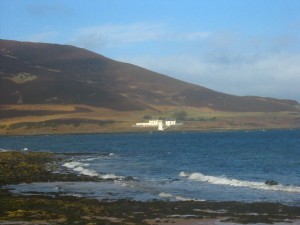
The rule that there is always another island first struck me on the isle of Arran, which is further south than the Western Isles, directly west from Glasgow in Argyll. View of the retreat on Holy Island from the mainland
While staying in the southernmost pincer of Lamlash Bay on Arran, I looked out at the enormous hump of Holy Island, (not to be confused with the more famous Holy Island of Lindisfarne) and plotted a trip there. It was a few days before the boat resumed its run to the island. In Lamlash’s Co-Op, the alpaca wool of my hat attracted the interest of a Buddhist monk. He too was keen to get back to Holy Island. His partner had recently died. Together they were responsible for the striking rock paintings that dot the path around the island.
He pointed to my hat and asked me if I had been to Tibet. I hadn’t.
“Tibet is not an island,” I replied.
He looked confused.
“I only go to islands,” I explained.
One of numerous striking rock paintings on Holy Island
In order to become a Buddhist monk, one must undertake the long retreat of three years and three months. Certainly this man, I think his name was Christopher, had the spacey air of a man who had spent a lot of time on a remote island. Watching him navigate a supermarket, I coined the simile of “looking as pained as a Buddhist in the Co-op, trying to chose between Flora and I Can’t Believe It’s Not Butter.” The aisles enforced bathos on this remote islander. He was sullied with his earthly concern. Yet he needed it. He needed it for his toast.
For three days, Holy Island remained coy under a habit of cloud. I sat on the beach, angry with lust for it. At moon rise, its silhouette was that of a narrow waist and voluptuous hips. The wing beats of gulls ricocheted across the bay and at dusk, the seals lolled in the shallows, turned their tails up and watched me sulk. The world turned within me, moved onto the next tooth of the cog. Finally, the skirt of cloud was hitched up, inviting us in, and we were able to take the boat across the bay.
The Holy Island project began in 1992 when the island was purchased by the Rokpa Trust. The peace centre on the North of the island is open to people of all faiths, but you must follow the five golden rules; while on the island, you are requested not to kill, steal, lie, intoxicate or fornicate, at least until you are back on Arran. The peace centre is on the retreat circuit, a path followed by people whose sense of well-being requires that the world be kept at arm’s length. On arrival at Holy Island, I had barely traversed the mandala garden before I overheard two self-examiners discussing the inevitable politics of communes as they had arisen in the various retreats they had embarked upon. Nothing I heard made me change my opinion that all communes are doomed to acrimony over lentil allocation.
The condition of contemporary life – its incessant chatter, its deprived public space – turns our faces once again out to sea, in search of peace
Just to walk around the island was retreat enough for me. A path takes you from North to South, where there is an International Women’s Buddhist retreat, then turns over the low hump of the peak and back down the other side. Along the walk, there is a grove of young trees planted for the lost children of Dunblane, a hermit’s cave, and Christopher’s striking, colourful rock paintings of Buddhist icons.
Retreat is a possibility modern man worries about on a daily basis, the way you tongue a cavity and consider the dentist. No one wants to be suburban. You want to live extremes. Either be the junction box through which all the currents of the metropolis flow, or live in a dark cave on an island a few miles out from another island. The condition of contemporary life – its incessant chatter, its deprived public space – turns our faces once again out to sea, in search of peace.
Against such romantic idealisations, there are the realities of island life. As Samuel Johnson wrote of Talisker on the isle of Skye; “Talisker is the place beyond all that I have seen, from which the gay and the jovial seem utterly excluded; and where the hermit might expect to grow old in meditation, without possibility of disturbance or interruption.”
In For The Islands I Sing, a fragmentary autobiography by the Orkney writer George Mackay Brown, he considers the sea valley of Rackwick on the isle of Hoy – “a green bowl gently tilted between the hills and the ocean”. “We must always be on our guard not to romanticise: life in a place like Rackwick must always have been stark and dangerous and uncomfortable.”
That kind of life is more meaningful by far than the lives of people who set out each morning for an office by train
Islands have been used as prisons. Consider Alcatraz or its forebear, the prison isle of Chateau D’If off the coast of Marseilles. It was on the Chateau D’If that Dumas imprisoned The Count Of Monte Cristo (even in Dumas’ lifetime, sightseers journeyed to the isle to see the cell in which the Count was held, and so one was constructed, along with a hole from which the character supposedly escaped). The prison is a forbidding construction. The boat drops you at the base of a rock staircase zig-zagging up the side of the stark fortress. The sun hammers away at the anvil of your skull. You get off the boat and immediately want to get back on again.
Still, we are people of extremes. Could we not cope with the privations of island life, especially as we would now have a few tricks of modern technology up our sleeve? Let Mackay Brown spell out our case for becoming an islander:
“Yet I believe that their closeness to the elements, their pursuit of whale and herring and their anxious tending of the corn all summer, the winter flame on the hearth that their own hands had dug from the moor, while – if the harvest of sea and land had yielded an adequate bounty – the cupboard was well stocked till spring; that kind of life is more meaningful by far than the lives of people who set out each morning for an office by train with The Times to read; a holiday in Spain with wine and sun the only oasis in their desert.”


 You should not be sitting in your tent peering out at your neighbours through a thick sheet of plastic. I don’t want a tent with a wardrobe either. Or a carpet. Outwell’s wall-to-wall carpet comes in a box illustrated with a picture of a happy couple laughing sensuously. Because that’s how in-tent wall-to-wall carpet makes you feel. This is campsite as temporary suburb.
 The highlight of the fair was Outwell’s Indian Lake tent, a teepee with a porch, erected around a thick central pole. I would have liked to have a crack at pitching it, to test the promise of it being “easy to pitch and pack”. Like the little conical hat atop the Vaude Badawi II, the peak is meant to aid ventilation, although the design of the Indian Lake felt like a pretentious hotch-potch where the Vaude Badawi II is a more elegant evocation of the nomad. Of the others on show, we like the Vango Tigris 800 and 600 tunnels, cheap and very easy to pitch for a family tent, although the extension looked like a right dog’s dinner slung onto the back. How long before some enterprising firm decides to cash-in on the British habit of suburbanising everything they touch by manufacturing a conservatory that attaches to the side of your tent?