Children stay up later when they are camping but you should be calling them back by nine o’clock. We all need at least an hour without them before the next day’s parenting shift begins.
If you feel a blazing row coming on, both parties should retire to the car, which is more sound-proofed.
Before leaving a campsite, feel free to offer any open, perishable comestibles to your fellow campers. Often, I have been grateful for open bottles of milk, loaves, vegetables etc.
Pitch the door of tent facing into the field so that you appear sociable.
Amplified music is no longer acceptable at a campsite. It sounds tinny and warped outdoors and the bass always ruins someone’s evening. Bongos and acoustic guitars are less frowned upon, but don’t bring them within earshot of my tent.
Tents do not afford aural privacy. The Bedouins have a saying: “we pitch our tents far apart so that our hearts may stay closer together.” Sex should be conducted in as near to silence as possible. Camping backstage at a festival, a musician friend of mine disturbed my sleep by conducting an elaborate menage a trois in his little pop tent. I didn’t mind being disturbed by the sex, so much as the interminable negotiation beforehand.
In a group camp, bring one item for the amazement and pleasure of the group. It could be a tripod for cooking over a campfire, a hand axe for trimming logs, or a barrel containing fifty pints of real ale. Camping is inherently socialist. Bring things to share and enjoy being equal.
Once you’ve unloaded, park your car away from your tent in the campsite car park. That one simple act will make it easier for every parent to give their children a little bit more freedom to roam.
Ball games in adjacent empty fields, not among the tents. I am cooking here, and I’ve got small children running around – I don’t want your ball knocking scalding hot water and coals everywhere.
When striking camp, leave no trace behind. Also, minimise the amount of waste you leave in the bins. Before leaving home, decant food into reusable plastic containers and old cake tins. It’s easier to pack and you are not leaving a landfill behind.
Campers are rightly afraid of Scotland’s voracious midge, but even in August I found the high meadow of this campsite, with a spectacular view of the surrounding glen, blissfully midge-free. Campfires are permitted, so I perfected the art of baking eggs, fresh from the site chickens, on a grill in foil parcels.
Gwalia Farm, Cemaes, Machynlleth, Powys, SY20 9PZ
If you like rough camping on a tiny campsite, then the overgrown Gwalia is an excellent cheap option, deep in the hills of mid-Wales. Consisting of a few pitches around the back of a B&B, and allowing campfires, Gwalia is a peaceful and amenable spot.
Our first camp last year was at Forgewood, on the Eridge Park Estate. The estate is enormous, with a modest camping field surrounded by ancient woodland in which you can also camp. We pitched our tent in a glade and cooked venison stew – deer are hunted in the park – over the fire.
A friendly, busy site near Grizedale Forest in the Lake District. There are no allocated pitches, and fires are allowed, but an order of sorts emerges and soon a low cloud of campsite smoke drifts over the fells.
Mannix Point in Caherciveen, Kerry
Located at the westernmost tip of the Ring of Kerry, on the outskirts of Caherciveen, campsite owner Mortimer has crafted some beautiful pitches from which you can watch the waters flow into Valentia Bay. There is a music room for ad-hoc singalongs and a campers’ kitchen, which really helps if it rains.
I was lying in my tent in the middle of a cold night when I received an urgent call from nature. I often camp in remote spots, seeking a connection with the land and respite from creditors. The call was urgent, and so I clambered over my sleeping wife, out of the inner tent and into the cold chamber under the flysheet.
I was wearing a thermal vest, long johns and thick hiking socks. To go outside, I would need footwear. In the corner of the tent, my boots – which require some lacing – and next to them, a pair of sandals. I gazed down at my stockinged feet, back at the sandals, and then at my sleeping wife:
Could I do it? Could I wear sandals and socks?
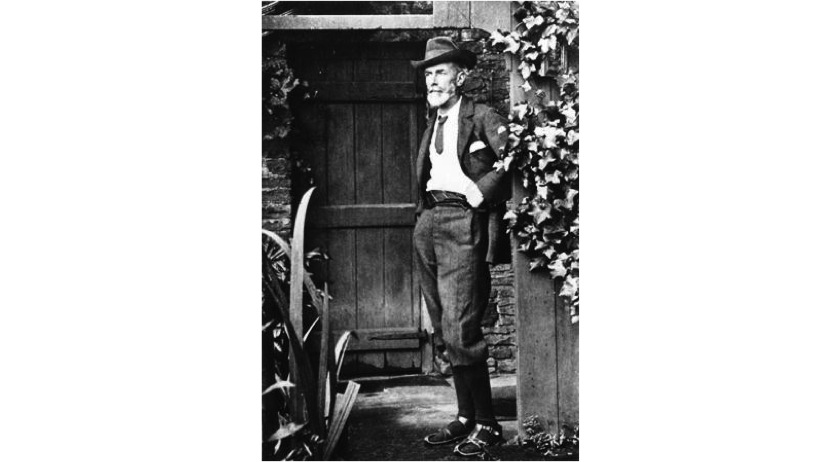
Edward Carpenter modelling his sandals with socks
Sandals and socks are reviled because they are a philosophical cop-out. The sock we associate with the shoe, with keeping one foot in the compromises and confinements of city life. The sandal yearns for the simple life, the toes wriggling free and tickled by spears of dewy meadow grass. To put a sock between the foot and the sandal is an ugly compromise.
Although Edward Carpenter could cast off the repressive expectations of Victorian society, he could never quite take off his socks
The shoe is a “leather prison” for the toes. So declared Edward Carpenter, a free-thinking socialist of the late Victorian period who was responsible for introducing the sandal into bohemian culture. A friend sent Carpenter two pairs of Kashmiri sandals from India, and he set about copying the design and distributing them to contemporary free-thinkers, in partnership with George Adams who he set up as sandal maker-in-chief.
Carpenter was gay, overtly so. His discretely circulated pamphlets did much to prepare the ground for what a same sex comradeship might be in the modern world. Born in Hove and educated at Cambridge, he set up home in Millthorpe in the countryside beyond industrial Sheffield, attracted both by the radical potential of the labour movement and by the sexual potential of the labourers. He met one such labourer, George Merrill, on a train. The two men enjoyed an open relationship, and Millthorpe became a site of pilgrimage for seekers of the simple life.
How would the spectacle of me in socks and sandals affect my wife? The marriage would survive, but it is likely that her libido would not
Although Edward Carpenter could cast off the repressive expectations of Victorian society, he could never quite take off his socks. Photographs of the lean bearded “Saint in Sandals” show him wearing them with socks pulled up to the knee. Freedom was more important that the restrictions of style: he dispensed with waistcoats, underlinen and ties and wore instead a minimal outfit of woolly shirt, coat and pants. His sandals cost 10s 6d, less for children, and were a symbol of belonging to the progressive cause.
All these thoughts assailed me on that cold night in my tent. How would the spectacle of me in socks and sandals affect my wife? I wasn’t worried about the damage that it might do to our marriage. Our marriage has solid economic underpinnings, and there are children involved. The marriage would survive, but it is likely that her libido would not. I checked that she was soundly asleep, and then carefully slipped on the sandal.
Archeological analysis of fibres found on Roman sandals suggest that when the soldiers were in colder climes, such as Britain, the sandal was worn with socks
The sensation was obscene. The thickness of the sock caused the strap of the sandal to tighten indecently around the foot. The sandal was a Birkenstock, a German family company who made contoured shoes contemporaneous with Edward Carpenter’s sandal business. The German people are associated with the sandal and the sock combination, a Teutonic assertion of pragmatism over aesthetics. One wonders if they even remove their white ankle socks during intercourse.Birkenstocks did not get into sandals until 1965 during the American revival of the simple life or hippy movement.
The sandal was mankind’s first article of footwear. In the age of Homer, both sexes wore a wooden sole fastened to the foot by thongs. The Mogollon Indian in Southwest America plaited their sandals from the leaves of the Yucca tree. In Roman times, the sandalium worn by women was a sole with a piece of leather covering the toes and was worn mainly indoors. The soldiers of the Emperor wore the caliga, a heavy and high-laced boot that was open at the toe. Archeological analysis of fibres found on Roman sandals suggest that when the soldiers were in colder climes, such as Britain, the sandal was worn with socks.
Today the British army issue sandals that are man-made with velcro fastenings. Far more appealing than these are the Northwest Frontier Chaplis worn by the Indian army during campaigns in the 1930s; with two thick leather straps crossing a tongue, only the merest peep of the toes is visible, thereby sparing passersby the sight of your ten blind blunt-headed worms.
In my sandals and socks, I went out into the night to heed the call of nature. It was the moment before the moment before dawn, and the land seethed with anticipation. Carpenter and his sandals stand for the lost mystical socialism of Albion; a place where the working man and the high-minded type could join together to exceed the bounds of the acceptable and push away the deadening influence of mindless consumerism. This mystical socialism did not survive the Second World War. Sandal-wearing cranks were seen as an impediment to the credibility of socialism. George Orwell famously railed against “every fruit-juice drinker, nudist, sandal-wearer, sex-maniac… in England.”
In his essay On Sandals and Simplicity, GK Chesterton also took the sandal-wearers to task. He complained that advocates of the simple life would make us simple in the things that do not matter – diet, costume, etiquette – and complex in the things that do – philosophy and spirituality. The mystical socialist believed in plain living and high thinking. Chesterton, the scruffiest man in England, corpulent and windblown, sought the opposite: high living and plain thinking.
In my socks and sandals, I walked across the meadow to the witchy silhouettes of the copse, where I satisfied the masculine urge to urinate against the vertical. The black tops of the trees thrashed around in a bohemian dance. Grainy bands of indigo lay over the land. I felt the spirit of vitality move within me, the urge to cast off all clothing and to run amok as a natural animal. The wind goaded the tree tops into complete self abandonment. Would I join them?
No. Donning the sock and sandal was a transgression that threatened my very being! What next: speedos in the office? Trainers? The age of mysticism is past. I tromped back across the meadow, removed my sandals and cast them into the undergrowth. Never again would I be tempted by the comfortable compromise of the sock and sandal. From that night onward, my toes would serve out a life sentence in brogue and Brasher boot.
I never used to be the kind of woman who made lists.
But trying to prep for a camping trip while being mithered by small children has changed me.
The only way I can be certain that some crucial item is not forgotten has been to put together an Excel spreadsheet of our required gear.
Having gone to this effort, Matthew suggested other campers might find it useful. If only as the basis for their own packing list. Ours is designed for two adults and three small children and by no means do we take every item on it every time we camp.
The spreadsheet has tabs divided into pantry, bedrooms, living room, clothes, bathroom, First Aid and Other Stuff.
I spent a morning erecting a tent with Evan Davis for the Today Programme.
To accompany the act, I wrote an article for the Radio 4 site on the resurgence of camping and glamping. Listen and read here.
There was a fascinating review of my book published in The Independent and written by Ken Wolpole. I like the sound of the Flysheet movement he mentions and will investigate further.
“The author does for camping what the late Roger Deakin did for wild swimming, infecting the reader with his enthusiasm, while chastening us with stories of the darker aspects of the back-to-nature movement. The lightweight tent can be the naturalist’s best friend, but it has also provided a refuge for the survivalist with the Book of Revelations and an automatic gun. De Abaitua is not afraid to discuss the concentration camp and the labour camp alongside the holiday camp – and sometimes worry about connections between them all. His enthusiastic tone is enlivened by a self-deprecating wit: there is no better account of the rain-soaked family camping holiday than here.”
The Telegraph also published another review, this time written by Toby Clements.
“De Abaitua goes on to give all sorts of tips on campsite etiquette, lore, equipment and best practice, and his advice is convincing and honest. He is a lovely writer and his history is enlivened with tremendous flashes of wit. What is lovely, too, is his ambiguity about his passion. He doesn’t want to persuade anyone to take up camping, and with good pitches so few and far between, hurrah for that.”
Little warning signs and polite notices are the ruin of many a good campsite.
The camp manager needs will power not to put up a little sign every time someone transgresses. Signs proliferate and before you know it, the laundrette has a warning against the washing of dog baskets in the sink. And then your campsite is ruined. Different rules apply at camp. “Camp regulations should be as few as possible but firm and consistent,” notes a pamphlet issued by the Ministry of Education in 1951 advising on the organisation of group camps. But what are those regulations? And can all of them be written down on little signs?
For example, I recently stayed at a campsite where there could easily have been a sign that read:
“Please do not drunk drive to the toilets at midnight in your nightie. Even if it is raining.”
These days, people arrive at a campsite expecting some kind of holiday. It is no such thing. Consumerism creates an outrageous sense of entitlement that camping, reliant on self-sufficiency, preparation and patience, cannot meet. During an interview with a campsite owner, one of the staff confessed that a yurt occupant complained that their hot water bottle was too hot. I offered to draw up the little sign myself:
“Yurt occupants: you’ll get what you’re bloody well given.”
Once you start making signs, it’s hard to stop:
“Couples: Arguments about whose bloody idea it was to camp in the first place should be confined to your car.”
Actually, all sites could benefit from –
“Warning: tents do not afford aural privacy.”
Neither marital arguments nor their opposite bother me (“Polite notice: Campers are advised to get out of their sleeping bags before attempting intercourse.”) In fact, I regard the campsite as a laboratory for studying the modern relationship. At Glastonbury Festival, I missed all the bands and had to find my entertainment in other people’s marriages. I’d never seen a grown man sent back to his tent to change his undies before.
“Warning to men: please change your undies DAILY. Or when the occasion DEMANDS.”
The main bone of contention is noise. I used to play music on little speakers but everyone hates it, no matter how trendy or ambient the playlist. Most campsites have signs suggesting times for silence. More accurate would be:
“Campers please refrain from sharing theories about what really happened at 9/11 after 1am.”
And,
“No cackling.”
Then there is snoring. It is acceptable to complain about the obscene snoring of other campers to their face the morning after. Apparently. All I can do is shrug. However I have made a little sign suggesting that:
“It is not acceptable to climb into the tent of a snorer and press a pillow over their face.”
As I have always found that disturbs my deep and sonorous sleep.
Matthew De Abaitua’s The Art of Camping: The History and Practice of Sleeping Under the Stars is available now.
A review of my book The Art of Camping was published in The Economist.
“In this delightful combination of history and memoir with a generous dollop of guidance thrown on top, Matthew De Abaitua, editor-at-large of the Idler and an inveterate backpacker, shines his torch under the flysheet of camping… read this gem of a book while you are sitting outside enjoying the fine art of camping.”