
 I contribute to Radio 4’s excellent programme on camping food, along with the Guyrope Gourmet himself, Josh Sutton, and presented by Fire And Knives founder Tim Hayward. I think it will be available on iPlayer for a while.

Campfire mix
Being brief readings from Matthew’s De Abaitua’s book The Art of Camping: The History and Practice of Sleeping Under the Stars (Hamish Hamilton) mixed with campfire tracks by the legendary Richard Norris (The Time and Space Machine, Beyond the Wizard’s Sleeve).
Voice: Matthew De Abaitua
Mix: Richard Norris
Recorded and mixed in Lewes, East Sussex.
Twitter
@MDeAbaitua
@MrRichardNorris
Buy
Tracklist
1. The Golden Morning Breaks by Colleen from the album The Golden Morning Breaks. Reading from ‘The Spirit’ taken from The Confession of the Kindred of the Kibbo Kift by John Hargrave.
2. Camping by Sunol from the album Ohlone. Reading from ‘The Perfect Campsite’ from The Art of Camping: The History and Practice of Sleeping Under the Stars by Matthew De Abaitua, published by Hamish Hamilton. Reading of ‘The glories of a mountain campfire’ by John Muir from John of the Mountains and quoted in The Art of Camping.
3. To The Fields by Circulus from the album Clocks Are Like People.
4. The Fire in My Head by Voice of the Seven Woods from the album Voice of the Seven Woods. Reading from ‘In Yosemite with John Muir’ by Theodore Roosevelt from his An Autobiography (1913), and quoted in The Art of Camping.
5.Farmland, Freeland by The Advisory Circle from the album Other Channels. Reading from Letter to the Editor of Forest and Stream by Nessmuk, quoted in The Art of Camping.
6. Campfire by Grizzly Bear from the album Horn of Plenty. ‘How to Light a Fire Without a Match’ adapted from Ernest Thompson Seton’s Two Little Savages for The Art of Camping.
7. The Magic Place by Julianna Barwick from the album The Magic Place. Reading from ‘At the Al-Thing’ from The Art of Camping: The History and Practice of Sleeping Under the Stars by Matthew De Abaitua (Hamish Hamilton).
8. Space Meadow by The Present from the album The Way We Are. Reading from ‘The figures marched up the Long Man of Wilmington” from The Art of Camping: The History and Practice of Sleeping Under the Stars by Matthew De Abaitua (Hamish Hamilton).
9. Harmonic Convergence by Enumclaw from the album Opening of the Dawn.
10. Ancient Campfire by Biosphere from the album Shenzhou. Reading ‘The Camping Years’ from Leslie Paul’s Angry Young Man, quoted in The Art of Camping.
To Download MP3:
Campfires Not Jubilees
We arrive at a small deserted field at the dead end of a track, sloping gently down to a stream, just in time to pitch our tent in the last of the light. A woodpile of branches is set beside a campfire circle. The adjacent farmhouse is quiet, with a smattering of fowl. The decision to camp came late, about two hours before we set off. With the Hay Literature Festival ongoing, and a double Bank Holiday weekend to mark the Queen’s Diamond Jubilee, this small site was all we could find that fitted our criteria at such short notice.
Cwmnanthir campsite is situated in Banwen, to the south-east of the Brecon Beacons, where a range of wind turbines plunge into the valleys of waterfall country. I haul the tent out of the back of the car and begin pitching. The first peg penetrates the earth and releases the midges within; it blows the biters all up in my face and down my vest and into the yawning crack at the back of my trousers. Where is the Avon Skin So Soft? On the recommendation of the military, we use this moisturiser as midge repellent. When it mixes with the burly odours of a few days camping, the Avon Skin So Soft makes me smell like a transvestite down on their luck. I apply it too late. My forehead is braille.
Cath finishes off pitching the tent while I set a campfire as quickly as possible. The children remain in the car. Conditions are testing. I mean, we’ve only driven five hours in Bank Holiday traffic, barely keeping our temper through backseat provocations, a car sick lad, and a few wrong turnings. And now this. Hateful tiny insects. The fire chases them away. The children are put to bed. I open an eight pint jug of Harvey’s ale, fresh from the brewery. Cath sits down next to me wearing a buff to protect her head from the midges, and we exchange our first words since our arrival:
“That was my idea of hell,” she says.
Soon others arrive, a trio of twentysomethings from Hackney who have come in search of waterfalls. They join us around the campfire. Together we sit up until past two in the morning, telling old Hackney stories and chopping wood. One of their party is a carpenter and becomes enamoured with my Opinel saw; it is a beautiful thing, cheap, efficient and classic: a symbol of French genius.
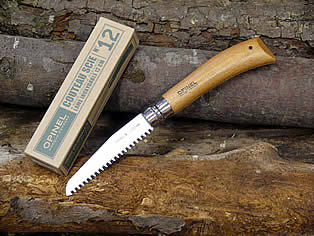
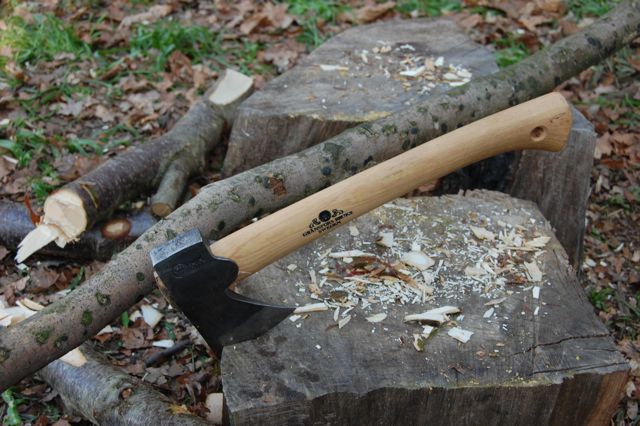
In his essay on the Opinel knife, Jean-Marie Floch describes it as “a secret hero”. I have a Gransfors Bruks hatchet for logs; lethally sharp and operated with a ostentatious swing, there is nothing secret about it. The way the Opinel saw folds out of its handle, is secured in place by a ring collar, and then discretely cuts through branches before slipping quietly back into my pocket confirms the truth of Floch’s observation.
The saw, the axe, and the beer jug are my loyal companions.
I share the jug around and we drink it dry. The moon shines brightly through the trees. When everyone is in bed, I walk back up the road to gaze southward over the beacons; the heads of the wind turbines are concealed in mist. The night shimmers with the unfamiliar, the incipiently strange. The stream burbles noisily by. Something moves nearby. I am not afraid.
The next morning, two other groups arrive; a couple from Wales who have a son each from a previous relationship, and an extended family from Golders Green. He is Syrian, she is Spanish. They have three children of their own, and then a couple of cousins they have taken in to spare them the horrors of the conflict in Syria, and a Spanish cousin who wants to learn English. The father has never been camping before and has brand new kit and an enormous Syrian shisha pipe – indistinguishable to my eyes from an Egyptian hookah.
“The way each camper confounds my gut prejudice makes me feel such joy”
Their children offer my children marshmallows and soon everyone is sitting around the campfire. The midges persist all weekend but this common hardship only bonds us all together; such a disparate collection of souls, Cath and I with our three children are the only conventional nuclear family on show. It is Jubilee Weekend, and in London, meaningless pagentry and sycophancy are offered as a symbol of the nation. I prefer the symbols of these campers and this campsite, an ad hoc unplanned bunch of people from South Africa, Cardiff, Syria, Bilbao and Liverpool who have come together to share an experience of the land and find a way to get along without rules or authority of any kind. A Royal Family? Really? Still?
The midges also stick around. Their persistence is exceptional, apparently. The site itself has a pair of perfectly decent toilets and a shower, a kitchen for campers to use, a bassett hound and a big grey-muzzled dog. There are argumentative geese and a pair of ducks living in a hutch that, on my first night, I mistake for a toilet and the birds never quite forgive me.
Our various children glom together into one group, play football during the day and hide-and-seek past midnight. We sit around the campfire and tell stories of home. The way each camper confounds my gut prejudice makes me feel such joy. I am released from the mean-spirited fear of others, and the weekend becomes, for me, an affirmation that what defines this nation is not the pomp of the homogenous few but the underlying decency of the diverse many.
Tarp
I have wanted a tarp for a while now to create a sheltered area outside of the tent under which I could cook or loiter during a long rainy day. The Terra Nova Tarp Shelter is not cheap but it is extremely light and shimmers to the touch in a pleasingly quasi-organic fashion. The good people of Idealo.co.uk were kind enough to send me one to test out and you can find similar products on their site here. The Terra Nova Tarp Shelter is here.
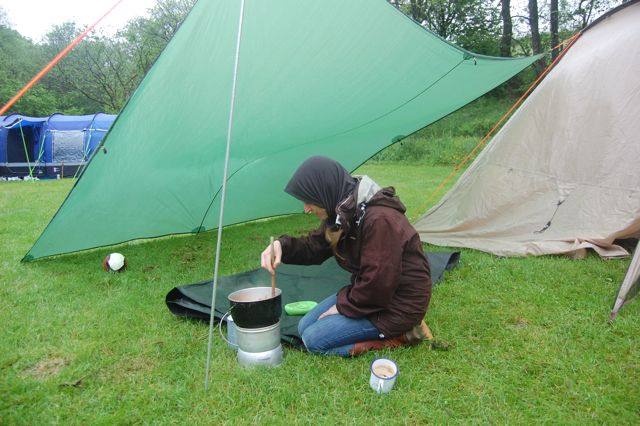
The tarp comes without guy ropes or poles. Fortunately I had a some lying around, left over from my previous aborted attempt to turn a spare groundsheet into a tarp. I set to improvising the best way to set the tarp up, eventually arriving at this set up attached to my tent.

If camping near a tree, I would have used a high branch instead of the exterior of our tent. There is a loop in the middle of the tarp that – if strung up to a tree – would make it drape in a triangle shape, ideal for sleeping under during a wild camp.
When the rain came, I cooked under the tarp and made a few notes on how to improve the pitching of it next time out. I’ll need more guy ropes, for a start. The tarp is full of possibility, a shelter against the sun, the wind and the rain. That’s why I’ve always hankered after one. I feel that I am only at the very beginning of mastering my tarp skills.
Update
The following weekend we camped at Forgewood in Kent in the pitch known as Nick’s Nook. This gave me the chance to pitch the tarp without poles and tethered to the surrounding trees. It makes such pleasing shapes.


The Art of Camping on Facebook

Readers who are interested in discovering more about the history of camping should like our Art of Camping Facebook group. Photographs of the eccentric camping movements covered in the book will appear here and it will be place for new material on camping history as we discover it.
http://www.facebook.com/artofcamping
Caught By The River
 My essay on the River Mersey is included in the forthcoming paperback of Caught By The River’s collection of words on water, along with writers such as Roger Deakin, Chris Yates, Jarvis Cocker, Bill Drummond, Irvine Welsh and Jon Savage. The essay covers the time I worked as a security guard at Liverpool docks.
“The Mersey is an industrious river. Too wide and cold for pleasure boating, its toil is visible in the treacherous contrary current. At the Runcorn gap, its course is bounded by Runcorn Railway Bridge, a bracing engineering marvel of wrought iron lattice girders. The arch sweeps overhead like rollercoaster track. The engineering of man and nature compliment one another. Under dour daylight, the Mersey runs muddy and rusty. At dusk, it turns belly-up, showing a pallid steel hide. Neither nature nor industry are built to the scale of a man. To stand under a giant bridge that passes over a great river is to be doubly dwarfed.”
I am very pleased to see this fantastic collection reprinted. It’s published 24th May 2012 and can be ordered exclusively from the Caught by the River shop for £12.00.
The Four Vagabonds
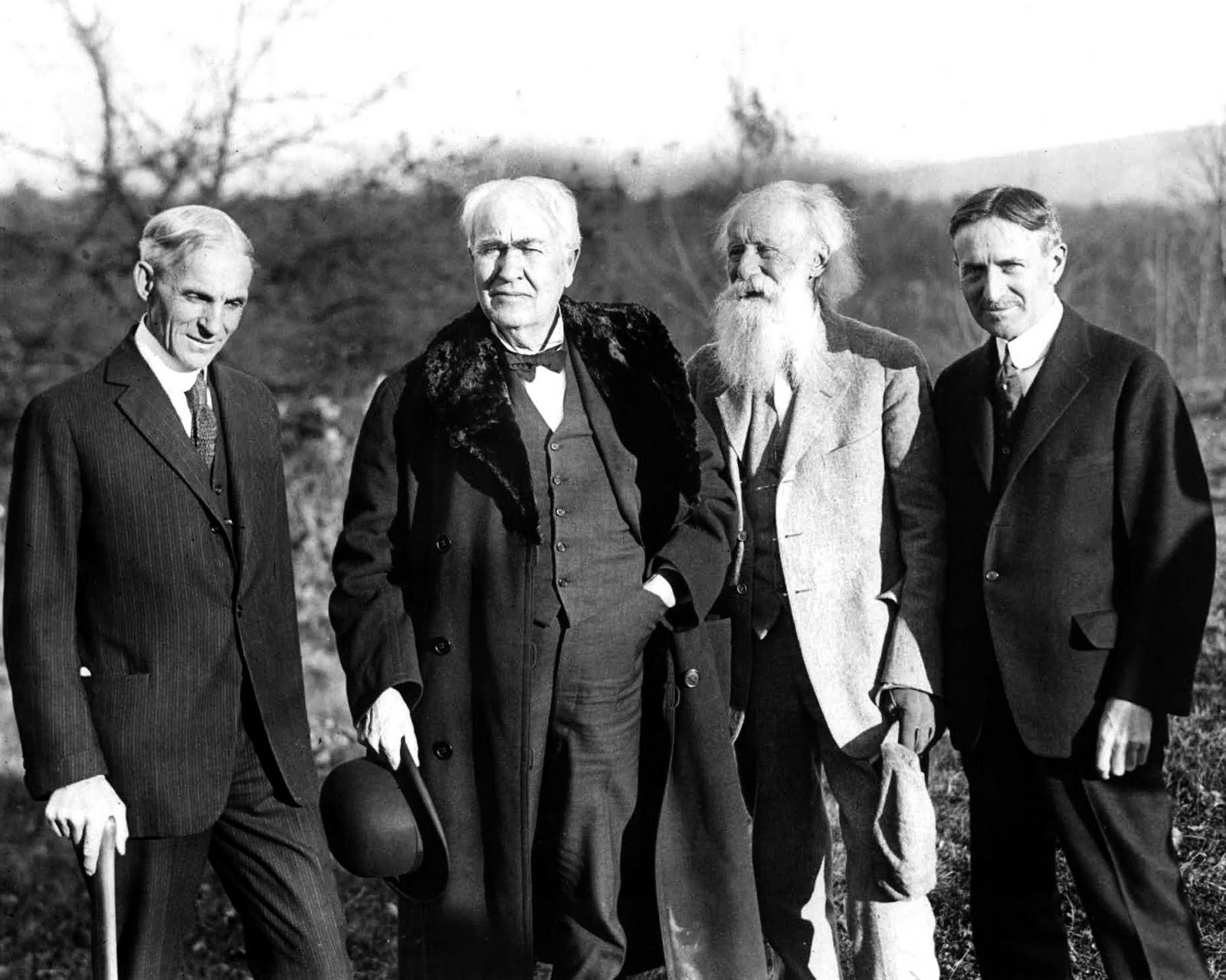
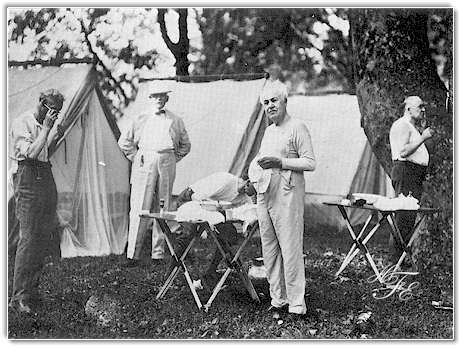
The most famous autocamper was Henry Ford. Every summer Ford undertook a camping tour with his friend Harvey Firestone, of Firestone tyres, and his mentor, Thomas Edison, the bringer of electric light. The fourth member of the party was the antithesis of the modern industrialist, the ageing writer John Burroughs, disciple of Walt Whitman and friend of Theodore Roosevelt.
Burroughs was a critic of the era of mass production, of which Ford’s cars and Edison’s light bulbs were potent symbols, but he had been courted by Ford, and his presence on the trips was a symbol of two American centuries meeting around the campfire.
Henry Ford was a farm boy who couldn’t read a blueprint. He was nervous and energetic, emotionally immature, and puritan in matters of intoxication. A genius with his hands rather than his head, he did not read many books, but he did read the works of John Burroughs, due to his interest in birdspotting. In December 1912, Ford wrote to Burroughs telling him that few persons in the world had given him as much pleasure as he had. In return, he wanted to do something for Burroughs. He wanted to give him a car. He assured Burroughs that it was not a publicity stunt, and the car could be there by January.
Burroughs had misgivings. He was seventy-five years old, an advanced aged for a learner driver. Friends persuaded him to accept the gift and the old man spent the winter attempting to master it, with comically haphazard results. Behind the wheel, he was easily distracted by rare birds or plants, and would take his eyes off the road to follow its flight, his white bushy head rattling as the car bumped over the farm track. Driving scared him. He was not the master of the car. This technology was an unbroken horse with a will of its own.
The gift achieved Ford’s intended aim, which was to meet his hero. In June, Burroughs travelled to Detroit to visit Henry Ford. The two men got on. After a tour of the Ford factory, Burroughs described the manufacturing process with the eyes of a nature writer; it was a “wilderness of men and machinery covering over forty acres. The Ford cars grow before your eyes, and every day a thousand of them issue from the rear.” After returning home to Roxbury, Burroughs went to park his car in the barn but “it run wild”, bursting through the side of the building and rattling on to a drop of fifteen feet. The forward axle went out over the edge but the wheels caught enough purchase to prevent the car landing at the foot of the steep hill. He regarded the accident with shame. The old fool should not have dabbled with technology.
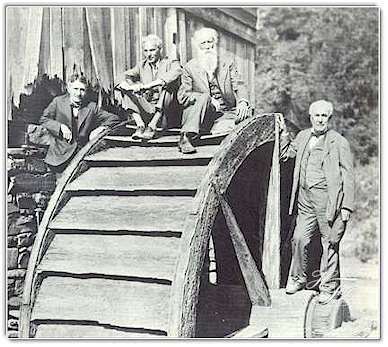
Ford’s courting of Burroughs continued. In September, Henry Ford undertook a pilgrimage in Burroughs’ company to Concord to visit Thoreau’s pond at Walden and the house of Ralph Waldo Emerson, the central figure of The Philosophers’ Camp of 1850. The camping trips that Ford, Burroughs, Thomas Edison and Harvey Firestone undertook echoed the transcendentalist gathering in their assertion that camp is a fitting place to thrash out solutions to the issues of the day. Only at camp, removed from the demands and pressures of daily life, could great men discern the greater good.
Ford and Burroughs’ visited Thomas Edison’s home in Fort Meyer in Florida. Edison was a decade younger than Burroughs, and sixteen years older than Ford, or as Burroughs put it, “Mr Edison and Mr Ford are as young as I am, but no younger.” The public images of all three men relied upon their physical vigour. Burroughs was uncommonly fit for a man in his seventies. When dallying at a cliff edge, it was suggested to him that he show caution and step back. In defiance, the old man sprang onto this hands, his feet in the air, to prove there was no danger. In his early fifties, Henry Ford could run like a deer, and prided himself upon his high kicks and leaps. Edison had many famous pronouncements concerning diet and sleep, claiming that he subsisted on four or five hours rest a night and ate a sparing diet of toast and hot milk. Their camping trips saw the suspension of Edison’s frugal regime; as Burroughs’ diary of his first visit to Florida relates, “We begin the day so late here… Edison sleeps ten to twelve hours in the twenty-four; says he can store up enough sleep to last him two years.”
Edison suggested that the men and their wives should take a break from Fort Meyer and go down to the Everglades and revert back to nature. “We will get away from fictitious civilisation,” said Edison to a reporter, “and we expect to be happy and learn much.” In early March, the party slipped away for two days camping, with two guides and a cook. The trip was a success. More ambitious camping trips were to follow, billed by The Washington Times as “Edison and Ford to go back to nature”.
Taken from The Art of Camping: The History and Practice of Sleeping Under the Stars by Matthew De Abaitua and published by Penguin
Du Pont’s Camping Auto
Colonel T Coleman Du Pont was an arms dealer, an elected senator and, in the words of President Taft, “as slippery as an eel and crooked as a ram’s horn.” He was also the inventor of the “Camping Car”.

T Coleman Du Pont had a 1911 Stoddard-Dayton “Camping Car” built to his specifications so that he could live in it for long stretches with all the comforts of home. The interior accommodated a six foot hair mattress, the exterior had racks and packs for supplies, lockers for carrying stoves and a long box on each running board in which the tent was kept.
The tent was made of balloon waterproof silk and supported by six tent poles, each six feet high. When the car tent was pitched, it consisted of three compartments, with the interior of the car acting as a bedroom, abutted by two boxy tent rooms. T Coleman Du Pont’s camping car also came with electric light, powered by one of Thomas Edison’s storage batteries constantly charged by a dynamo powered by the engine.

T Coleman Du Pont required a camping car to monitor the progress of a road he wanted built across Delaware, a one million and three hundred thousand dollar, ninety-six mile long monument to himself. The construction workers also camped, even through the snow, when they were mainly preoccupied with keeping warm, playing cards, drinking and fighting.

Trangia gas burner
Cooking our last meal of the camping season at a festival in West Dean, the gas on our crappy cooker ran out. We couldn’t get a replacement canister and so had to eat vile claggy pasta cooked in lukewarm water. Enough, I thought. Enough of this stove; The Camping Gaz Camp Bistro.
 It comes in a plastic briefcase that falls apart, it collects grease and gunk and because it has no shelter from the wind, it burns through fuel at an indecent rate. We do most of our cooking over the campfire so I had picked this up for the odd morning brew. But campfires are not always practical and quickly I began to resent the awfulness of this piece of kit.
I have always owned a Trangia but found the meths burner pretty unpleasant to use. Looking around for decent camping cookers, they all looked pretty rubbish. And then I spotted the Trangia gas burner.

It’s a bit pricey but it fitted inside my existing Trangia which protects it from the wind. The burner gives off a brisk, intense heat. After a weekend using it to cook on the midge-infested grounds of Wales, I am a convert. Sometimes I wonder why it takes me so long to get around to the bloody obvious.
Four campsites in fiction
Four favourite camping spots in fiction

‘Picnic Point’ in ‘Three Men in a Boat’ by Jerome K Jerome
A trio of liverish young men and their dog float up the Thames in a camping skiff. They finally pitch their tent at a spot called Picnic Point, near Runnymede, a very pleasant nook under a great elm tree. Yanking the hooped canvas over the boat almost defeats them, but the effort of camping is rewarded; they wake to a soft morning, the river in sunlight, and a view of timeless Englishness.
Mesquite country, Southwest Texas in ‘Freedom’ by Jonathan Franzen
Walter Berglund rejects the corporate way, and takes his young lover Lalitha camping. It’s been a hell of ride for Walter. This camp, filled with birdsong and empty of people, is a blissful interval between crisis and tragedy. Jonathan Franzen recently wrote of his own experiences camping alone on Selkirk Island (reputedly Crusoe’s island) to commemorate his friend and writer, David Foster Wallace.
Jackson’s Island, ‘The Adventures of Huckleberry Finn’ by Mark Twain
The densely wooded Jackson’s Island stands in the middle of the Mississippi River. Huck sets up camp here for three nights. He picks strawberries and green summer grapes, lands catfish and roasts them over a campfire. Islands are lonesome places; Huck smokes, counts the stars, and inspires generations of boys to follow him outdoors.
Swallowdale valley in ‘Swallowdale’ by Arthur Ransome
With their raft shipwrecked, the Swallows climb over a waterfall and discover the perfect valley campsite. With steep sheltering sides, a stream running through it, a pool for the washing up and a secret cave, the craggy landscape of Arthur Ransome’s Swallowdale offers handholds for the imagination of children and adults alike.