
The new issue of The Chap contains my article on the Edwardian camping scene and includes invaluable advice as to how a chap should camp (in tweed, a Gentleman’s Kevlar), coinciding with the forthcoming publication of The Art of Camping.

The Chap also includes a brilliant article describing how to use the remnants of a hearty dinner to re-enact key battles in British history; in this issue, the Battle of Waterloo.
Author: Math
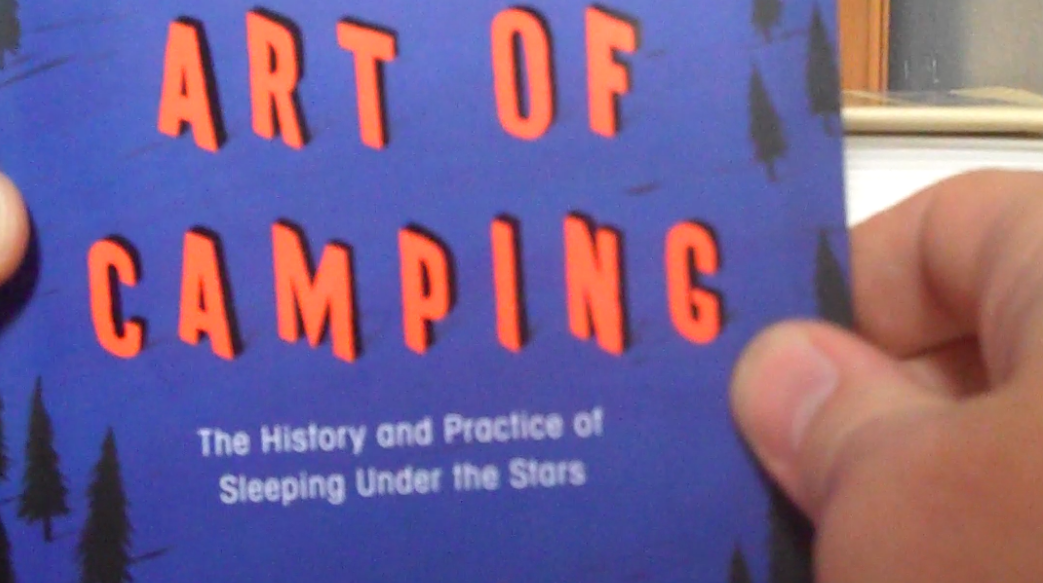
The Art of Camping is nearly here
A finished copy arrived today. On sale in July.
Welsummer campsite
When Thomas Hiram Holding, the gentleman tailor who founded the Camping Club, wanted to camp, he knocked on a farmer’s door and agreed a price for a pitch. The Edwardian camper ranged far and wide and free over the land. That freedom was eroded as the state grew anxious about the impact of camping upon the English countryside. The 1936 Public Health Act contained the first national measures for the control of camping. Only one moveable dwelling – tent – was permitted per acre. Landowners required a licence from the local authority. Large licensed campsites contained the problem of mass tourism in the British countryside. This was the kind of camping I knew as a child, a tent pitched in a manicured internment camp, a suburb under canvas.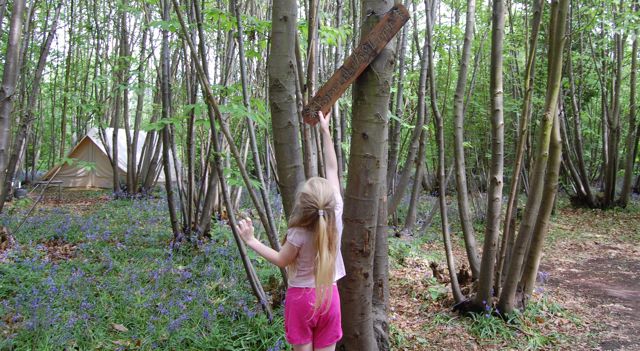
The beginning of this century has seen a rehabilitation of the reputation of camping. There are demographic reasons for this – the rise of a new generation of campers with peak outdoors experiences at festivals – and economic reasons – a middle class adjusting to a decline in income by embracing the simple, cheap pleasure of sleeping under the stars. The culture wants an alternative to screen-based lives of work and play, and camping is one option. But not camping as it used to be.
[ad#Google Adsense-solid bar]
The tiny Welsummer campsite in Kent shows us how much camping has benefitted from shrinkage. It is a small site of twenty pitches set over two cosy meadows and a handful of rugged pitches in a dense wood. An hour and half’s cross-country drive from our home in Lewes, and within reach of a late evening dash from London, Welsummer campsite is run by Med and Laura Benaggoune, a couple in the early forties who lived together in France before returning to Laura’s home in Kent. 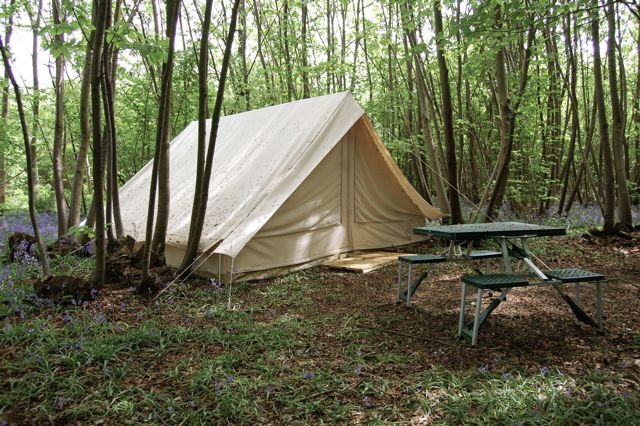
Med and I share a cup of tea. “Where else in Europe you would encounter a site like Welsummer?” I ask. Italy? the Czech republic? The Netherlands? Certainly not in France. “This is not how the French camp,” says Med. “The campfires would be impossible” – dry Southern France is a tinderbox – “ and French campers expect a bar, a disco, a playground.” In other words, everything that the modern British camper eschews. But why have we turned our back on such facilities?
The formula is simple: the smaller the site, the fewer the rules, the greater the freedom. Welsummer has a minimum of signage: in a small site, a friendly word from the owner replaces a blizzard of forbidding notices. Cars must be parked in an adjacent field, which always makes a site more child-friendly and less like a car park. There is a family bathroom, a blessing for anyone who has ever tried to shower three small children in a cubicle, and pre-erected bell tents for metropolitan glampers, keen to dip a Converse galousher in the camping lifestyle. Everyone’s children glom together into a tribe and disappear into the woods. That’s all we ask of camping: freedom for the children, from the children.
Book Welsummer.
Matthew De Abaitua’s book The Art of Camping: The History and Practice of Sleeping Under the Stars is published by Hamish Hamilton in July. Order this new camping book from Amazon.
Forgewood campsite
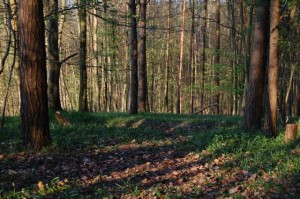
To Forgewood campsite on the Eridge Park estate for our first camp of the year. We pitched in a small clearing within the borders of a wood. The tree surgeon had clipped back ominous overhead branches or ‘widowmakers’ as they are called by old woodsmen. Dappled light spread over bluebells and caterpillars; the woodland management is as much for the benefit of butterflies as it is for campers.
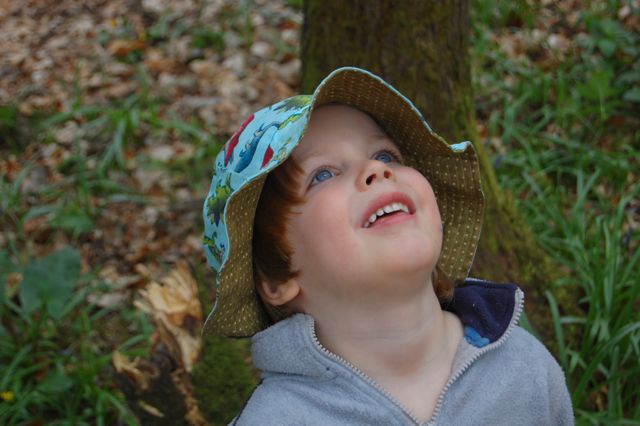
Thomas Hiram Holding, author of The Camper’s Handbook, warned campers away from woods and forests as, if overgrown, they can be damp, dark and infested places. None of these complaints apply to Forgewood. The wood insulated our camp from the pre-Easter chill, not a spot of rain fell over the long weekend, and when we struck camp the groundsheet was unexpectedly dry. The advantage of camping in a wood is a sense of privacy and enclosure, and a contemplative atmosphere.
A wood is also a church. A pagan church. The tall pines and beech make a vaulted ceiling, the light scattered by the leaves resembles the coloured patterns thrown by a stained glass window, and there is serenity standing amongst the cool indifference of trees. In this church, the campfire is the altar, the heart of our veneration.
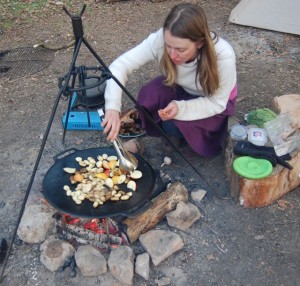
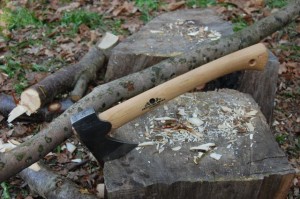
Over the winter, I had acquired more woodcraft gear with which to perfect my campfire craft: a Gränsfors Bruks hatchet, Opinel pocket saw and a Finnish muurikka. The hatchet and saw turned deadwood into kindling, and the campfire turned the muurikka into a sizzling skillet, a cross between a wok and a large frying pan set on three short legs providing maximum cooking area for minimum fuel to feed a hungry family.
Over the weekend, Cath cooked bacon and pancakes, pork chops, apples and gnocchi, and fried breakfast for five. Pancakes cooked in pork fat over the campfire then drizzled with maple syrup is a classic American dish that derives from the epicures of the American wilderness – the camp cookery of Horace Kephart of the Smoky Mountains or Nessmuk of the Adirondacks.
We did not explore much at Forgewood; rumours of ice caves and a ruined castle went unconfirmed. We took the two small children out for a woodland stroll and surprised a deer that bolted away with a flash of a white tail. Over three days, we barely left camp. Camp is a place of minor tasks, with wood to chop, food to prepare, children to dust down and local venison to stew. Rather than explore the woods, I appreciated them with a cup of tea in my hand: the birdsong that always sounds to me like a data stream; the fat atoms of blossom tumbling idly through the spokes of a pine tree; a game of rounders in the adjacent meadow, and boyish shouts of ‘out’, ‘out, ‘out’; a robin impudent on a branch; the distant rifle shots of a deer hunt: and then dusk; the tea in my mug replaced with beer; the meadow passive and misty as the sun set over it with such anger I was concerned for its blood pressure; in its place, an enormous yellow moon rose between coppiced trunks and spread reassuring bands of light across the meadow; estranged owls hooted late night booty calls and dark trees twitched their fibres – the wood seethed like a nervous system and I was drunk and alive – and then, at last, I called it a night, doused the campfire, and instantly vanished in a blow-out of steam, the clean scent of water vapour rushing around my face and into my nostrils like dry ice in a nightclub.
At Forgewood, woodland solitude is offset by a more sociable camp atmosphere in the meadows. A commitment to ‘real camping’ means no caravans and no electric hook ups, and adequate facilities. Forgewood is situated on part of the estate of the Marquess of Abergavenny. The question that I have been puzzling over – how could England offer more of the wild camping that Scotland enjoys by law – could find an answer in the aristocracy and other major landowners. The new generation of real campers are prepared to pay more for a nightly pitch than previous ones, yet expect less in the way of facilities. What we are looking for and paying for is a raw experience with campfires and clean running water. Some landowners and aristocrats have experimented with festivals as a way of making their land pay – but it takes considerable experience and patience to build a successful festival, as Peregrine and Catherine St Germans have proved at Port Eliot. The investment into a large woodland campsite seems less risky than the one big outlay of a festival; now that campers do not demand electrification and tarmac roads to all their pitches, is there an emerging business model in the cultural shift to campfire camping for big landowners?
For the rest of us, it’s unlikely that we could ever afford the sheer expanse of land required for a more solitary camping experience. The need to maximise the return on every mortgaged acre leads to the depressing car park campsite that is all too familiar in the UK. For landowners seeking to balance financial return with the status of a custodian of the countryside, the likes of Forgewood promise financial return without excessive development. Protecting the forests requires managed access: when people have the opportunity to experience these places, they become advocates for their preservation. As camping returns to the spirit of its origins, the camper – historically treated as a nuisance – could be the solution to investing in and protecting the nation’s woodland.
The Bookseller recommends
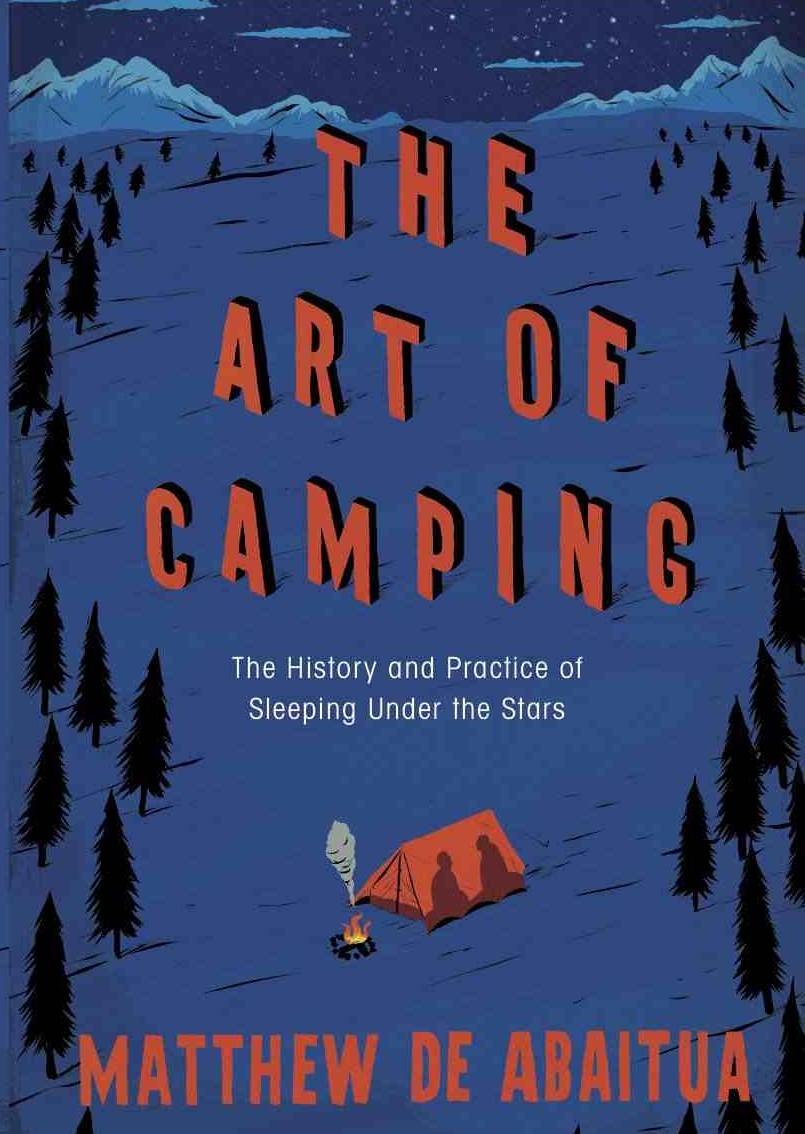
The Bookseller has recommended my forthcoming camping book The Art of Camping: The History and Practice of Sleeping Under the Stars as one to watch for July. Top news.


Is it too early to camp?
Is it Spring yet?  The sun has broken through a long and cold winter and campers are asking themselves, is it time for us to take the tent out of storage? Last year Cath and I camped with our family thirteen times. I intend to match that this year, but to do so we’ll have to start early. That means reading sleeping bag reviews to ensure our kit can take the Spring temperature drop so that we will not be shivering in our tents, and making new gear for the season.
[ad#Google Adsense-solid bar]
Cath has been hard at work on the long dark nights sowing fleecy covers for hot water bottles, and making camping blankets for the children. I spent the winter entirely holed up in my study writing The Art of Camping. I will be giving talks and readings from the book at various festivals this summer, including Camp Bestival, Port Eliot, Glastonbury and a few others are in the pipeline. Hope to see you there. Slowly we are coming out of hibernation.
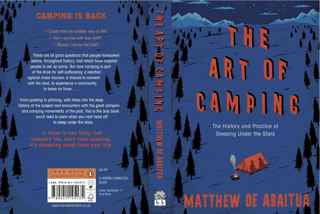
The Art of Camping
The manuscript for The Art of Camping: The History and Practice of Sleeping Under the Stars is with the proofreaders and publisher Hamish Hamilton has set 7 July 2011 as publication date. The camping book can be pre-ordered from Amazon.

Gwalia Farm campsite
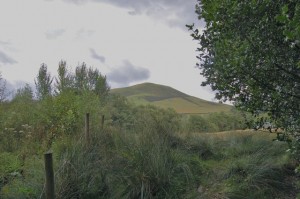
I discovered Gwalia Farm, a small campsite in Wales, through Tiny Campsites, Dixie Willis’ selection of campsites that are an acre or under in size. The farm is tucked away amongst the lower ranges of the eastern side of Snowdonia, not too far from Machynlleth, a Welsh market town with a progressive stripe. Cath and I grew up in Liverpool, and North Wales is the city’s psychedelic and spiritual retreat. Often, we would hear stories of an auntie or uncle who set the controls for the heart of the sun only to crashland on a welsh croft. The Centre for Alternative Technology, nine miles away from the farm, and its small community of sustainable living, crystallises the spirit of numerous experiments in living that have been conducted over the centuries in the Welsh valleys.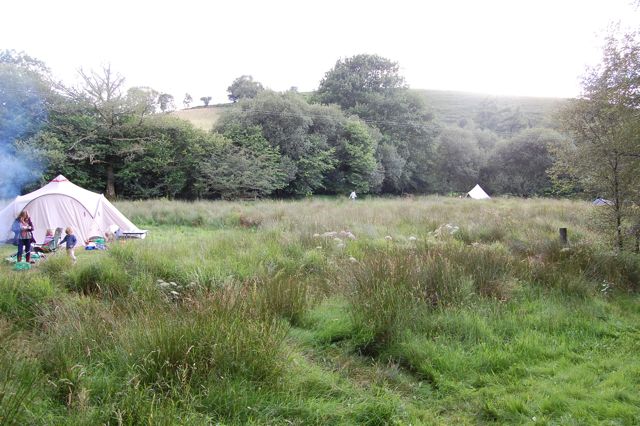
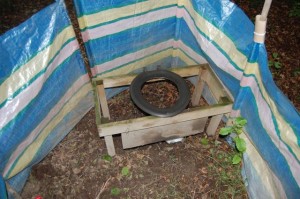
Gwalia Farm is a field around the back of a vegetarian bed and breakfast. Beside a narrow road, there is a rough shoulder where you park up and then trot a dozen yards down to a gate. Beyond the gate there is an overgrown field with half a dozen or so large pitches cut out of the long grass. There is gulley running across the field, a rivulet trickling through it, and after a quick scramble to the woods, there are the latrines – or “lats” as rough campers call them. Holes in the ground. There is a proper WC back at the bed and breakfast. Just past the wood, on the other side of a fence, a pond where some young lads foolishly camped.
I watched the gang of young men set their camp. They were no different than we had been all those years ago, compelled to come out into the country for some freedom and fire. Upon arriving, they discovered that the thirty-five-hour-a-week shifts they put in consuming entertainment media had in no way equipped them for camp. Never before had I witnessed an attempt to pitch a tent in a bog. Beside a wild pond surrounded by tall grass, they gallumphed around for fire wood, bringing back the greenest, dampest looking branches; I suspect they tried to light the wood directly with a zippo. A couple of hours later, they came to visit our camp, lured in by the smell of wood smoke and the leg of lamb roasting over the campfire.
“I don’t think we should have camped in a bog,” said one lad, shirtless and tattooed.
“The campfire’s not…” his friend hesitated.
“It’s not working.”
“You will need a campfire to keep away the insects,” Cath observed. “Because you’ll get a lot of midges and mosquitos near that pond.”
Their disconsolate scratching was eloquent on this matter, even if they were not. Still, I understood how difficult it was to ask for help in setting a campfire, (not that they asked directly for help; the lads presented their wounds like a dog with an injured paw, and hoped that I would infer what was required.) It is embarrassing to admit that you cannot make fire, that the basic technology of humanity eludes you. I gave them a couple of firelighters, some dry wood and a smouldering log. As they loped back to their sinking, midge-ridden camp, I briefly entertained the fantasy of a network of sites like Gwalia Farm spread across the country, rough and ready glades where young people could learn to build Indian shelters, and set campfires, get out of bedrooms and the forecourts of late-night supermarkets to take risks in nature rather than the plastic risks of video games, a fantasy in which camping in Britain is dedicated to the call of the campfire.
View Campsites, campfires, UK in a larger map

The Sex, Drugs and Rock ‘N’ Roll Were Incidental
The festival issue of Five Dials (number 13) included my story The Sex, Drugs and Rock ‘N’ Roll Were Incidental, which is a review of the Woodstock music festival as a failed camping holiday.
The story is reproduced here.
 Five Dials is an online literary magazine from my publishers Hamish Hamilton, and it is free. With an impressive roster of contributors (who I am honoured to join), Five Dials can be downloaded here.

The Art of Camping: The History and Practice of Sleeping Under the Stars
I am pleased to announce that my book The Art of Camping: The History and Practice of Sleeping Under the Stars will be published next year July 2011 by Hamish Hamilton, as reported in the Bookseller.

The last year has been largely spent researching and preparing a proposal for the book, which I am currently deep in the throes of writing. The book will include American characters such as Ernest Thompson Seton, Nessmuk and Horace Kephart alongside the eccentric, progressive British camping movements of The Kindred of the Kibbo Kift and The Order of Woodcraft Chivalry. Thomas Hiram Holding will stand beside Edward Whymper, American Indian beside Romany Gypsy, Buckminster Fuller beside Stewart Brand, on a campsite where Glastonbury, Woodstock, neolithic hunters, and the Boston Methodist camp meetings of the nineteenth century are all taking place simultaneously.
So, I’ve got my work cut out. Wish me luck
Matthew De Abaitua
Cath is also contributing to the book. She is currently setting down her thoughts on taking babies camping; the first woman to join the Camping Club, Mrs F. Horsefield, took her boys of twelve years and her baby of twelve months camping, and we have just returned from the festival where there was a baby of about a month old. It can be done.