
Because sometimes screaming “no” over and again in a tent is fun.
Because sometimes screaming “no” over and again in a tent is fun.

Britain Goes Camping is a new BBC documentary from Brian Henry Martin and Doubleband Films, showing on the BBC iPlayer now.
After a successful premiere on BBC4, Britain Goes Camping will be shown on BBC2 at 10pm on Sunday 8th August, a sign of both the documentary’s and the subject’s appeal.
Earlier this year, Cath and myself spent a day filming with Brian and his small crew, and some of that interview footage is included in the programme. This is my favourite section as it includes a close-up of my Dad as a young man
The crew accompanied us on an early Spring camp in March. The ground was hard with frost and the trees were bare. The first camp of the year is invariably disorganised and fretful, but in this particular case, circumstances were against us; Cath seemed shivery and weak and I was aware of a sickness creeping upon me. But Brian and his crew had travelled from Ireland for the filming and there was no way I would disappoint them so we pressed on, prepping and packing for a cold night outdoors.
“Had the TV crew stuck around, they would have witnessed horrors”
The crew put us at our ease, thanks to Brian’s careful and friendly manner. But due to our growing illness, any hope we might have entertained as to putting on good front was quashed; we undertook our child and tent tasks with our characteristic stoicism, but we lacked the energy to brush our hair and scrub the crayon from the walls for their arrival. After a brief interview at our flat, we headed into the outdoors.
At the campsite, we erected the tent and then conducted separate interviews with Brian. Once filming was done, the crew departed for their bed and breakfast. The night fell quickly, and the land grew cold. Cath shivered. I broke out in a sweat. In any other circumstances, I would have broken camp and headed for home. But I couldn’t. The scandal about television fakery was uppermost on my mind, of people pretending to do things and then not. I would not go on camera eulogising camping and then break for home at the first sign of trouble.
Had the TV crew stuck around, they would have witnessed horrors.
“No, I would not be a TV faker. We would stick it out”
I lit a fire and the barbecue but was unprepared for the overwhelming blackness of the night. The barbecue has a lid and so was effectively invisible to the small children swarming around me. The fire made no inroads into the dark. For safety’s sake, I decided to tip the barbecue into the fire, burning my fingertips in the process. Agony! I ran around in the blackness wailing my lot, cursing my condition, chased by hungry screaming children. A handful of sausages survived the crisis. The two toddlers wolfed them down. Neither Cath nor myself felt like eating, and our eldest child was swaying and sickening.
Surely I should drive us home.
No, I would not be a TV faker. I would not join the ranks of the pampered presenters who had cut and run. The honour of camping was at stake.
In retrospect, I was far too mad at this point to drive. Mad with the night, and the sickness. We attempted bedtime. A fitful hour of sleep was had, and then the vomiting began.
We had swine flu.
One unexpected consequence of inoculating the toddlers against swine flu was that they were bursting with energy and wanting attention and activity at the same time as Cath, myself and our eldest daughter, Alice, were crawling around the groundsheet in a hallucinatory condition of perpetual evacuation.
At four in the morning, the only one of our party still awake, I spent a tense five minutes thinking I was about to die. Ever considerate, I did not wake Cath to inform her of this, reasoning that it would be better for everyone if they slept through my death, and then cleared up after me in the morning.
Could I drive home now, I wondered? Waking the children and loading them into the car was easy. Driving along dark field and the night lanes less so. And there was the risk, what with my impending death, that driving might be beyond me.
No, I would not be a TV faker. We would stick it out. The swine flu wrung me out like a wet cloth, then dawn arrived with its meagre gifts, a weak grey haze and two spoonfuls of warmth.
The sickness abated. I took the family to a National Trust cafe. The toddlers fell ravenously upon the cakes while their filthy stinking parents ignored the quizzical looks from the other families, so immaculate in their unstained skiing jackets.
I look forward to watching Britain Goes Camping, and to discovering what Brian and his team have unearthed concerning the history of camping; Hopefully, in my brief appearance, I do not come across as unduly deranged.
Go back to 10 tips for camping with kids (part 1)

6. Transport
With one baby and one toddler, one of my big questions was how to lug the kids around while we were out and about. The buggy takes up most of our boot space and can be a pain at Glastonbury or other festivals, with the mud and the crowds. We take two Bushbaby backpacks, one like this and a larger one like this, which are more flexible when it comes to rural walks and use up less space in the car. Before we had the car, the buggy was essential for balancing the tent or the cool bag upon; in fact the buggies used to take so much punishment, the axle snapped on one in Cornwall.
7. Which campsite?
I’ve done the full range: festivals, campsites with launderettes and shower rooms and ones with composting toilets and a single cold tap. If you know what to expect then you can plan ahead. Sites with shops mean you can always get snacks and fresh milk, which is convenient, but you may be sacrificing other things like having an open fire. Festivals sell lots of gloopy food and beer but are shy of grocery shops and so you will have to take supplies, at least for baba.
[ad#Google Adsense-solid bar]
8. Hygiene
Babies don’t like showers, nor do toddlers. Little babies can be bathed in sinks if there are plugs; otherwise a collapsible bucket filled with warm water and a sponge is your best bet. If you take your toddler into the shower don’t expect it to be a refreshing, relaxing experience. It won’t be for you, your child or any other campers in the shower block. A couple of days without a bath won’t do them any harm.
9. Illness
Always unfortunate in a tent, one holiday resulted in Matthew losing a filling on some Spaghetti Vongole and Alice, then 18 months old getting conjunctivitis. A basic first aid kit along with Calpol, ibuprofen for kids and adults, a light burns kit and insect repellent is a must.
[ad#Google Adsense-solid bar]
10. Nappies
I have always worked on needing an average of four per day per child and a few extra on top. Sites vary and some will expect you to take your rubbish home with you; come prepared with nappy sacks and bin liners.
I was woken by the intricate melodies of the song thrush marking its territory. The dawn chorus was astonishingly loud through the thin walls of a tent. Nature called. I unzipped the door and clambered out onto the long dewy meadow grass.
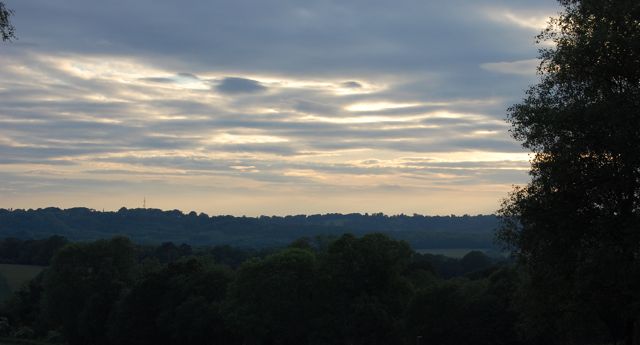
The cold waters of night lay over the land. First light pulsed in the East. In the West, the crescent moon and its court of stars were still up. North into the valley, first light drew the pitch out of the black; the lower fields lurked through thick grainy bands of blue. In the towns and cities the day is either on or off; you miss the long in-between of dawn and dusk, the magically prolonged moment in which the sun rises to challenge the nocturnal supremacy of the moon.
I feel most alive when I am camping. My first response, on finding myself jobless in late Spring, was that my family should spend the summer camping
The moon is taken seriously at Plaw Hatch Farm, a small two hundred acre biodynamic farm near Ashdown Forest in East Sussex. Biodynamic agriculture was devised by Rudolf Steiner, the founder of Anthroposophy and a respectable figure in the progressive underground that flourished in the late nineteenth century and the first decades of the twentieth century. Steiner’s thought is broadly categorised as spiritual science; he sought to unify science’s exacting practicality with mankind’s mystical yearnings. Biodynamic farming belongs to the later practical phase of Steiner’s philosophy, bringing together sound practices we now recognise as mainstream due to the organic food movement, with a touch of the occult: preparations made from cow horn and crystals infuse the soil with cosmic forces, while the respective rhythms of the earth, the moon and the cosmos influence the planting calendar.
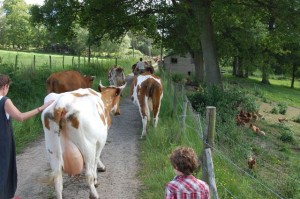
The biodynamic farm aspires to a closed system: the animals are born and reared on the farm, and their manure fertilises the grass that feeds the animals which in turn produces more manure. At Plaw Hatch Farm, the cycle encompasses lambs, sheep and pigs, chickens and ducks, a rabbit field, cows, a milking shed and polytunnels of vegetables. And two beehives. New inputs into the system – such as campers – are taken in reluctantly.
I have long felt that camping could hold the key to a new way of life, and there was certainly an appetite for a new way of life in the economic wreckage
I feel most alive when I am camping. My first response, on finding myself jobless in late Spring, was that my family should spend the summer camping. After two rainy summers of commuting and childcare, the long-term weather forecast predicted a barbecue British summer. More prosaically, the pound was weak against the euro and the British public were pulling their horns in as the economy collapsed. So economically and meteorologically, the summer of camping seemed the fit response to unemployment. More than that, I have long felt that camping could hold the key to a new way of life, and there was certainly an appetite for a new way of life in the economic wreckage. The summer was my chance to explore the meaning and history of camping and how it related to a new view of society, our approach to parenting, even my manhood. The long boom was the era of Big Tent politics, in which our leaders drew together disparate factions under the promise of endless economic growth, a promise that seemed free of ideology. That era was over, and it was time to discover what Little Tent politics might bring. Instead of house prices, I would think only of tents and where to pitch them. As an article in the LA Times on music festivals noted, there was a “growing prominence of temporary structures in a world suddenly drained of capital.” Camping seemed a fit response to the failed property cult.
Continue reading The Sexually Repressed Bees
of Plaw Hatch Farm
Tom’s Field is a popular campsite on the Southern end of the Isle of Purbeck, which is not really an island so much as a hearty peninsula situated on a turn-off from the holiday traffic crawling West through Dorset.
Like so many of the Cool Camping selections, Tom’s Field struggles to maintain its allure now that the secret is out.
We booked well in advance as Tom’s Field is relatively small, being a collection of fields divided by dry stone walls and covering four and a half acres. There is a renowned walk from the site down to a dancing ledge, a flat area of rock with a man-made rock pool at the foot of Jurassic cliffs. Unfortunately our children were too small to manage the descent.
We found Tom’s Field friendly but uninspiring. Campers are encouraged to park their cars in the field outside the site, which is a positive, as nothing spoils a camp like traffic. But fires are forbidden, so the nights we spent there felt suburban. A strict lights-out policy and allocated pitches contributed to the boredom.
The site in Langton Matravers is near to the popular National Trust destination of Corfe Castle; an iconographic ruin, beautiful from a distance but meaningless up close. On a rainy day, campers flee to Dorchester, which becomes crammed with soaked families seeking any distraction from the unrelenting rain, and some risible museums have sprung up to serve this need. The nearby town of Swanage is a dispiriting, down-at-heel seaside town.
[ad#Google Adsense-solid bar]
I judge camping trips by the moments of intensity they deliver, and on that gauge, the best reason to visit Tom’s Field is as a base from which to explore the nearby deserted village of Tyneham. Dorset has strong literary connections: Lyme Regis was the location for John Fowles’ The French Lieutenant’s Woman and Ian McEwan saw in the tightly packed pebbles of Chesil Beach a suitable backdrop for a novel of sexual repression and misunderstanding. Unlike these well-visited places, Tyneham, the subject of Patrick Wright’s digressive history The Village That Died For England, retains an aura of poetic intensity.
Tyneham was a small village cleared by the army during the Second World War so that the area could be used as an artillery and tank firing range. The villagers were promised that they would be able to return once the war was over, but the military reneged on this promise. Today, access to Tyneham is intermittent (check here before heading out), which makes a trip there all the more meaningful; the drive down into the village seems to take much longer than the map indicates, suggesting a topography warped by military intelligence.
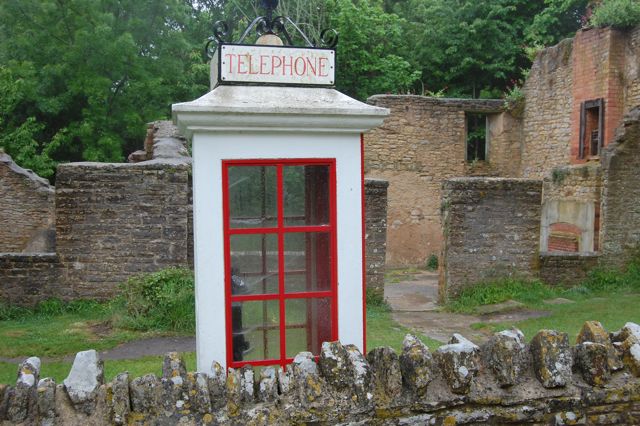
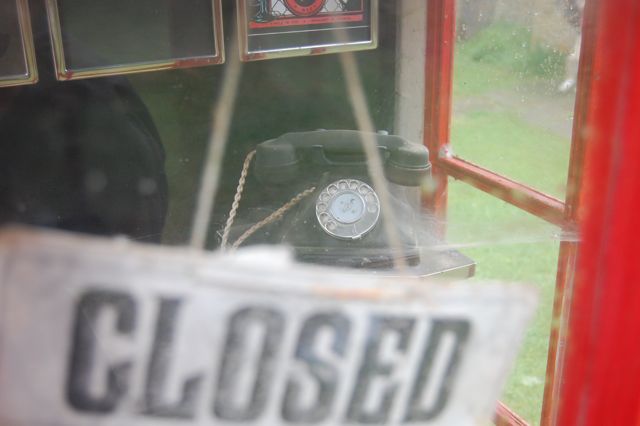
“To drive down into the Tyneham valley is to sink into a zone where even the sharpest of actualities seems overtaken by myth,” observes Patrick Wright. The birdsong is rich and multi-layered, as if the birds have expanded and deepened their repertoire free of the distracting presence of mankind. The graveyard and restored schoolyard – both scrupulously maintained by the Army – are poignant reminders of the temporariness of our places. The small Elizabethan mansion, unstable and gutted, speaks of wayward shelling.
Deserted places exert a particular pull. If Nature abhors a vacuum, the imagination adores one, drawn in by the possibility and promise of an empty lost place.
We went for a stroll around a camping fair held in a field at the back of Middle Farm, near Lewes. Dozens of tents were pitched for the inspection of prospective buyers, from the Vango Dart 200 – a pop-up festival tent – to the enormous Wolf Lake 7, a grand’s worth of polycotton aircraft hanger.
Pitched on long grass, the zipped-in groundsheets were swampy underfoot, and the bigger the tent, the looser and sloppier they felt. I don’t like tents that pretend to be houses. They remind me of vegetarian sausages. Why pretend to be something you are not?
Thirty-three years after Bob Gillis revolutionised the industry by inventing the first geodesic backpacking tent, the Oval Intention, this camping fair seemed intent on taking a big step backward, being more in the spirit of those despised tan-and-orange monsters of Vintage Camping. The Oval Intention used tension to provide integrity to its structure, following the geodesic dome popularised by Buckminster Fuller. Here the design of large tunnel tents like the Outwell Florida 6 owed more to Wisteria Lane – superfluous weight added to make a tent that looks like a suburban terrace, pitched with a rotary clothes drier in the yard to add to the air of domesticity.
I have a strong aversion to tents with windows. A tent is not a house.  You should not be sitting in your tent peering out at your neighbours through a thick sheet of plastic. I don’t want a tent with a wardrobe either. Or a carpet. Outwell’s wall-to-wall carpet comes in a box illustrated with a picture of a happy couple laughing sensuously. Because that’s how in-tent wall-to-wall carpet makes you feel. This is campsite as temporary suburb.
We wandered into the camping shop. We are in the market for a table but none of the tables on show survived five minutes with the boy toddler. We are also in the market for less stuff. That’s what camping teaches you – that you don’t need all that stuff. After an hour, I bought a five quid foot pump, ignoring the motorised ones. Let my children inflate an airbed. Let them know what that feels like.
 The highlight of the fair was Outwell’s Indian Lake tent, a teepee with a porch, erected around a thick central pole. I would have liked to have a crack at pitching it, to test the promise of it being “easy to pitch and pack”. Like the little conical hat atop the Vaude Badawi II, the peak is meant to aid ventilation, although the design of the Indian Lake felt like a pretentious hotch-potch where the Vaude Badawi II is a more elegant evocation of the nomad. Of the others on show, we like the Vango Tigris 800 and 600 tunnels, cheap and very easy to pitch for a family tent, although the extension looked like a right dog’s dinner slung onto the back. How long before some enterprising firm decides to cash-in on the British habit of suburbanising everything they touch by manufacturing a conservatory that attaches to the side of your tent?
It’s the beginning of Bank Holiday weekend and the traffic into Dorset crawls past accident after accident. On the verge and in the central reservation, the beautiful dandy faces of cars faces have been bashed ugly, as if set upon by jealous brutes. The unlucky participants stand around dazed, compressing bumps and scrapes with wet clothes and staring at the ongoing traffic with disbelief – how can you lot continue blithely on your journeys when this terrible thing has just happened? But it’s nothing, we reply. The damage is purely cosmetic. 
On the return journey we pull up behind something far more serious and recent. Just over there, a driver – thoughtfully, mercifully – holds up a blanket behind which a man is dying. A motorcycle lies burnt out. The police move with a terrible and disturbing urgency. Witnesses leave their cars and walk through the traffic. I turn the music down and wait to be told what to do.
I have never driven on a Bank Holiday before. The anger involved is new to me. Anger is the energy men use to force their way through the crowd and up onto the promised freedom of a holiday. Even packing feels angry, stuffing and stuffing the gear into the back of the car and dismissing the bags deemed to be inessential. Later, we hear about an incident at a neighbouring site when a man driving a caravan completely loses himself to anger, screaming and swearing and demanding everyone got out of his effing way. Statistics tells us that Bank Holidays are always rife with accidents but I wonder if the anger is worse this year. Recession anger. Expenses anger. Hapless-sap-in-a-corrupt-sham-of-a-democracy anger. Or perhaps that man was angry because he was driving a caravan in Bank Holiday traffic, which is like trying to put out a fire with petrol.
Cath and I look at one another and wonder if we have made a terrible mistake
The angry head stays with me when it comes to pitching the tent. Anger makes it feel like I am staking and marking out territory. The nearby ball games make me seethe, none more so that when a tennis ball bounces off my head and onto the Trangia so that the boiling water lists. Now a football strikes the barbecue sending hot coals onto the dry grass. The fire attracts the baby’s interest. I burn my fingers flicking the embers away from the galloping approach of my concerned infants. The transition from angry driving into the community spirit of camping is almost too much for me, a gear change from fifth to first and the revs are roaring. Cath and I look at one another and wonder if we have made a terrible mistake.
We didn’t. The rest of the week camping was glorious. Our eldest thrived in the responsibility and freedom of running errands, making friends, building dens. The brains of the two infants lit up with being outdoors all day. Sure, at one point, in the precious hour between finally getting them all to sleep and taking to bed ourselves, Cath asked me if there would come a point in the holiday when we got to enjoy ourselves, but that was just the black parental humour talking.
Time passes, we adjust to tent life. The angry head becomes outdoor head, the expansive inner clarity that comes with spending all day on the land and under the sky. And that’s why we camp: for the perspective.
My rucksack contained three beds, two sleeping bags, a small ration of underwear, a shirt, a pair of shorts, Birkenstocks sandals, a stove, methlylated spirits, some of the shoe overflow from Cath’s rucksack, an Opinel knife, two torches, a rubber mallet, a notebook, a bottle of Talisker single malt, a pair of speakers, an iPod, a sheepskin rug, a baby doll, and its sleeping bag, and indeed all of its baby camping equipment, none of which looked particularly practical to my eye.
Margaret Thatcher is often attributed as saying, “If a man finds himself a passenger on a bus having attained the age of twenty-six, he can account himself a failure in life.” So how should I account of myself as a man past the age of thirty, who has turned his beautiful young wife into a pack horse and commandeered his toddler’s buggy into this Dunkirk of a holiday?
The other passengers on the bus did the accounting for me. The Hackney buses are renowned for the eccentricities of their passengers. For many weeks, the bus carried a sign reading “Please do not transport your fish on this bus,” in honour of the Vietnamese man who used it to transport polystyrene crates of tilapia between Billingsgate and the Dalston restaurants: he disturbed the implaccable sang froid of London commuters by splashing icy fishwater over their trouser suits at 8am. So when Cath whispered to me, as we jostled around one another like tortoises on their hind legs, “Oh my god. We’re the fish man,” I knew exactly what she meant. And the shame of being the fish man was keen. So keen that I could take it no longer, and decided to tromp up to the second deck.
Downstairs, the passengers were mainly older black British citizens. Cath fielded concerned inquiries from a kindly member of the Windrush generation. What were we doing? Going camping. That was insufficient explanation. Cath knew from her conversations with colleagues at Waltham Forest council that, in the words of Ralph, the leisure officer, “Black British people don’t do camping.” Ralph, of Caribbean descent himself, took his children camping every year for two weeks in the classic ‘A’ frame tent – but he had never managed to persuade any of his friends or family to join him. When the office talk turned to holidays, Cath would mention our plans to camp around Ireland or Cornwall and her enthusiasm would meet a dead bat.
Cath did her best to explain to the doubting passengers the method in our seeming madness. Cath is always quick to shoot me down if I make it sound as if these camping trips were all my idea, as if this was some mad man project to which the family was in thrall. No, she was as much the architect of this activity as I.
Camping and parenting are two activities that, from the outside, appear to be a perverse and wilful abandonment of ease.
There are very good reasons for going camping. Even if you’ve got small children? Especially if you’ve got small children. The decision to have children, to embark upon such a messy and demanding adventure as parenthood, is analogous to the decision to go camping, heedless of the weather forecast, with limited resources to hand, a hazy idea of the destination, and most importantly with no certainty of what the future will bring. Camping is unpredictable, and that is why it is superior to two weeks in a Spanish resort, or a month in a Tuscan villa, or any other home-from-home respite from work.
The same desire for unpredictability lay behind my advocacy of having children. As ridiculous as it seems in retrospect, I grew bored of the twentysomething life of parties and drunken angsty conversations and dithering around with committment, and saw parenting as an adventure with an uncertain outcome.
Camping is one of the defining decisions Cath and I have taken as parents, even if we have no idea how that decision will turn out, at least it has been made and life moves on.
These are different arguments than the ones Cath would have essayed on the bus that rainy Friday morning.
Cath let the facts speak for themselves.
“We like camping.”
“But what about the child?” asked the passenger.
“She likes it too.”
“You must get very cold.”
“We take jumpers.”
“Why don’t you have a car?”
Now that was a good question. The fact is that Hackney has the lowest ratio of car owners per head in the UK. For the decade we had lived in Hackney, a car was unnecessary. Where would you park it? How could you leave anything of any value out on these streets? Tesco was five minutes from our house. My Dad tried to drive there once, through Saturday’s traffic, a tiresome stalled argument of cars that stretched from Dalston Junction to Mare Street; it took him an hour, and he was a wreck by the end of it. Cath and I were defined by our walking, our bus-bothering and our dashes to the station. The money I could have blown on car insurance and petrol went on taxis and train tickets. All very reasonable until you start camping.
I look back on my years of carless camping with admiration. The difficulty of travelling to remote rural Britain using only public transport contributed to the vital sense of defamiliarisation that a good camping trip requires; a campsite should not be a home-from-home, rather it should be a place where you shake off the mental habits of domesticity and renew your connection to the ever-unfolding reality of your existence. In 2009, we went camping with a car for the first time, as we now have three children, and even King Kong’s Valet cannot carry all their gear on his back. An intensity was missing from our trips, the urgency of the timetable, the adrenalin of chasing a bus while you are wearing a backpack.
But it was nice to have chairs, for once.
The people at the back of the bus stared at us with mild scrutiny. Some of their faces showed a less inhibited setting, somewhere between Appalled Fascination and Frankly Aghast.
What on earth were a couple in their early thirties doing on the 242 bus that runs between Hackney and the City carrying enormous ruck sacks and a tent on a trolley?
Wait. No! They’ve got a child with them as well. I bowed my head with shame at the situation into which I had placed my family.
We were going camping, despite not having a car, despite living in the inner city. We were going camping using only public transport. With my enormous rucksack, I looked like King Kong’s valet.

Cathy’s rucksack was also outsized, hung off her five-foot tall, blonde, petite frame. My mother describes my wife as a trooper, and this trip resembled a kind of troop training exercise for a young mother. Cath’s rucksack contained two weeks worth of clothes – hers and our daughter’s – packed into water-proof sacks, a sleeping bag, three sections of plastic origami that unfolded into seats, a bag of tea candles and flame-retardant paper lanterns, various soft toys and various thin and flat works of children’s literature, a tupperware box of ground spices, shoes and more shoes and wellies, toilet rolls, bin bags, warm jumpers, waterproofs and sunglasses. Ready for anything. The tent was lashed to a small trolley, mere hand luggage. Balanced on top of the baby buggy, a blue cool bag containing frozen litres of milk, baby bottles, fruit, snacks, sausages.
The bus juddered to a halt and as one over-laden four-legged beast we stumbled back and forth.
Cath and I used to go camping without a car.
The absolute minimum gear while still packing a kid.
I wrote this for The Guardian on the subject.
Now I can drive. But I’ll never forget heaving all that kit around the public transport system.