
Looking for the best campsites in the UK? I’ve plotted a selection of recommendations from our own experiences on one big Google UK camping map, including campsites in England, Scotland and Wales. The flame symbol denotes UK campsites that allow campfires.
Tag: cool camping
Gwalia Farm campsite
I discovered Gwalia Farm, a small campsite in Wales, through Tiny Campsites, Dixie Willis’ selection of campsites that are an acre or under in size. The farm is tucked away amongst the lower ranges of the eastern side of Snowdonia, not too far from Machynlleth, a Welsh market town with a progressive stripe. Cath and I grew up in Liverpool, and North Wales is the city’s psychedelic and spiritual retreat. Often, we would hear stories of an auntie or uncle who set the controls for the heart of the sun only to crashland on a welsh croft. The Centre for Alternative Technology, nine miles away from the farm, and its small community of sustainable living, crystallises the spirit of numerous experiments in living that have been conducted over the centuries in the Welsh valleys.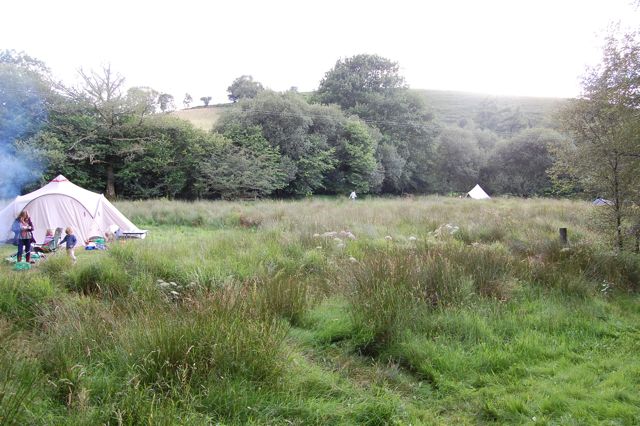
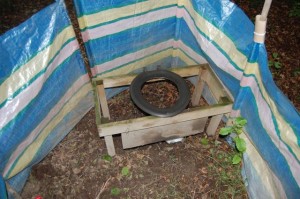
Gwalia Farm is a field around the back of a vegetarian bed and breakfast. Beside a narrow road, there is a rough shoulder where you park up and then trot a dozen yards down to a gate. Beyond the gate there is an overgrown field with half a dozen or so large pitches cut out of the long grass. There is gulley running across the field, a rivulet trickling through it, and after a quick scramble to the woods, there are the latrines – or “lats” as rough campers call them. Holes in the ground. There is a proper WC back at the bed and breakfast. Just past the wood, on the other side of a fence, a pond where some young lads foolishly camped.
I watched the gang of young men set their camp. They were no different than we had been all those years ago, compelled to come out into the country for some freedom and fire. Upon arriving, they discovered that the thirty-five-hour-a-week shifts they put in consuming entertainment media had in no way equipped them for camp. Never before had I witnessed an attempt to pitch a tent in a bog. Beside a wild pond surrounded by tall grass, they gallumphed around for fire wood, bringing back the greenest, dampest looking branches; I suspect they tried to light the wood directly with a zippo. A couple of hours later, they came to visit our camp, lured in by the smell of wood smoke and the leg of lamb roasting over the campfire.
“I don’t think we should have camped in a bog,” said one lad, shirtless and tattooed.
“The campfire’s not…” his friend hesitated.
“It’s not working.”
“You will need a campfire to keep away the insects,” Cath observed. “Because you’ll get a lot of midges and mosquitos near that pond.”
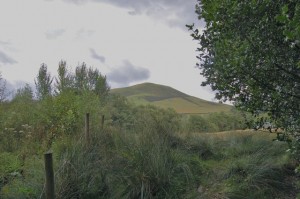
Their disconsolate scratching was eloquent on this matter, even if they were not. Still, I understood how difficult it was to ask for help in setting a campfire, (not that they asked directly for help; the lads presented their wounds like a dog with an injured paw, and hoped that I would infer what was required.) It is embarrassing to admit that you cannot make fire, that the basic technology of humanity eludes you. I gave them a couple of firelighters, some dry wood and a smouldering log. As they loped back to their sinking, midge-ridden camp, I briefly entertained the fantasy of a network of sites like Gwalia Farm spread across the country, rough and ready glades where young people could learn to build Indian shelters, and set campfires, get out of bedrooms and the forecourts of late-night supermarkets to take risks in nature rather than the plastic risks of video games, a fantasy in which camping in Britain is dedicated to the call of the campfire.
View Campsites, campfires, UK in a larger map
Secret campsites – Dernwood Farm
Our second visit to Dernwood Farm in the heart of the Sussex Weald offered a completely different perspective to this wild campsite from our first; at the Lovewood festival we pitched beneath a pylon at the wrong end of the field. On our return, we pitched at the entrance of a glade, a patch of the wood which the dozen children in our party quickly turned into a secret world, building dens, climbing trees and putting on a show.

The campsite is at the end of a winding woodland path, necessitating a twenty minute trek pushing your kit in a wheelbarrow. I have no wheelbarrow skills, never having worked on a building site, and it was only last weekend when I barrowed my kit across the entire length of Glastonbury that I discovered the trick of tying all your gear together and then securing the heaped bundle to the barrow with an X of rope. So I made more of a meal of this task at Dernwood than was necessary.
The allure of wild camping is freedom. Freedom to have a campfire, freedom to arrange your camp as you see fit. And there is plenty of freedom at Dernwood. Our party consisted of a dozen adults and a dozen children, so the pitch-where-you-like system meant we could circle our wagons as we pleased.
My campfire skills are basic. I set bricks around a shallow fire pit, and sparked up the logs. The job of building and maintaining this fire was quickly taken up by two more experienced firebugs, and soon they were prepping wood, and erecting an ad-hoc cooking tripod from cast-iron lantern stands. The sight of iron and fire made my heart leap, and the boys crowded around the men, fascinated by this primal display.
Wild camping demands responsibility, especially when it comes to waste. At Dernwood Farm, I barrowed everyone’s rubbish back to the recycling bins at the entrance. When you spend the best part of an hour “putting the bins out” you are confronted with the fact of your own consumption. All that thoughtlessly acquired packaging at the supermarket comes back to haunt you. Most wild camping sites make no provision for rubbish. You are expected to take it away with you, and this is something to consider when you are loading up.
The facilities at Dernwood Farm stretch to a single WC toilet and water pipe. Check in at the farm on your way in to pay for your pitch and firewood. They also have freezers of their meat for sale.
Cloud Farm campsite
For me, North Devon means idleness. On the edge of Exmoor lies the farmhouse rented by my friends Tom Hodgkinson, editor of The Idler, and his girlfriend Victoria. We decided to visit them during a camping tour of the area. Bearing in mind the maxim that house guests, like fish, go off after three days, Cath and I decide to camp near a few miles south of the Idler farmhouse at Cloud Farm, a campsite in the “Doone Valley”, off the coastal road between Lynton and Minehead.

Of all the places we camped that rainy August, Cloud Farm was my favourite, and I will return. Like all good sites, you are encouraged to park away from the tents, only driving down to pitch or pack up. There was a good shop stocked with real ale and a cafe that the locals spoke warmly about. We wandered down to a pair of small fields and pitched beside a river, which was fenced off from our inquiring toddlers. Snug between the flanks of the valley, I set a fire. The last time I saw Tom, he demonstrated his device for checking the moisture level in logs; the Cloud Farm shop sold some wickedly dry wood, and soon I was roasting marshmellows over its uninhibited dancing flames.
I spent most of my twenties working and writing for The Idler. As Deputy Editor, I was part of a trio consisting of Tom, myself and art director and co-founder, Gavin Pretor-Pinney.

Situated in Clerkenwell in the 1990s and the fun bit of the new millennium, we took full advantage of the city. Since those happy carefree days, each of us has sought out an individual vision of the English pastoral: while I beaver away on a book about camping, Tom’s bestseller How To Be Free posits a way of life that draws on medievalism and rural self-sufficiency; Gavin has enjoyed such international success with his Cloudspotting books that I can no longer gaze up at the clouds without thinking of him. My daughter even calls clouds “Gavs”.

At sunset, Cloud Farm staged a spectacular display of Gavs: a low mauve cloudscape gathered underneath a spectrum of purples enlivened with a streak of red. Purple is the colour of inbetween, the veil between reality and imagination, day and night. For a moment, I was transported out of my immediate responsibilities, that carousel of Dad Tasks, and experienced a sense of well-being that lasted until the sun went down; the silent knowing wisdom of idleness about which we had spent our hectic twenties extolling, but rarely experiencing.
View Campsites, campfires, UK in a larger map
Doone Valley
Oare, Lynton, EX35 6NU
01598 741 234
We Are Camping at Port Eliot
I unveiled my We Are Camping project at Port Eliot festival this year, 23rd-25 July. The event took place on Sunday 25 July in the camping field at 2pm.
I am a big fan of the Port Eliot festival, being their very first paid customer way back when. I have been researching We Are Camping for a year now. For the event, I lead festival goers through the campsite while talking about the meaning and history of camping.

Tom’s Field campsite
Tom’s Field is a popular campsite on the Southern end of the Isle of Purbeck, which is not really an island so much as a hearty peninsula situated on a turn-off from the holiday traffic crawling West through Dorset.
Like so many of the Cool Camping selections, Tom’s Field struggles to maintain its allure now that the secret is out.

We booked well in advance as Tom’s Field is relatively small, being a collection of fields divided by dry stone walls and covering four and a half acres. There is a renowned walk from the site down to a dancing ledge, a flat area of rock with a man-made rock pool at the foot of Jurassic cliffs. Unfortunately our children were too small to manage the descent.
We found Tom’s Field friendly but uninspiring. Campers are encouraged to park their cars in the field outside the site, which is a positive, as nothing spoils a camp like traffic. But fires are forbidden, so the nights we spent there felt suburban. A strict lights-out policy and allocated pitches contributed to the boredom.
The site in Langton Matravers is near to the popular National Trust destination of Corfe Castle; an iconographic ruin, beautiful from a distance but meaningless up close. On a rainy day, campers flee to Dorchester, which becomes crammed with soaked families seeking any distraction from the unrelenting rain, and some risible museums have sprung up to serve this need. The nearby town of Swanage is a dispiriting, down-at-heel seaside town.
[ad#Google Adsense-solid bar]
I judge camping trips by the moments of intensity they deliver, and on that gauge, the best reason to visit Tom’s Field is as a base from which to explore the nearby deserted village of Tyneham. Dorset has strong literary connections: Lyme Regis was the location for John Fowles’ The French Lieutenant’s Woman and Ian McEwan saw in the tightly packed pebbles of Chesil Beach a suitable backdrop for a novel of sexual repression and misunderstanding. Unlike these well-visited places, Tyneham, the subject of Patrick Wright’s digressive history The Village That Died For England, retains an aura of poetic intensity.
Tyneham was a small village cleared by the army during the Second World War so that the area could be used as an artillery and tank firing range. The villagers were promised that they would be able to return once the war was over, but the military reneged on this promise. Today, access to Tyneham is intermittent (check here before heading out), which makes a trip there all the more meaningful; the drive down into the village seems to take much longer than the map indicates, suggesting a topography warped by military intelligence.
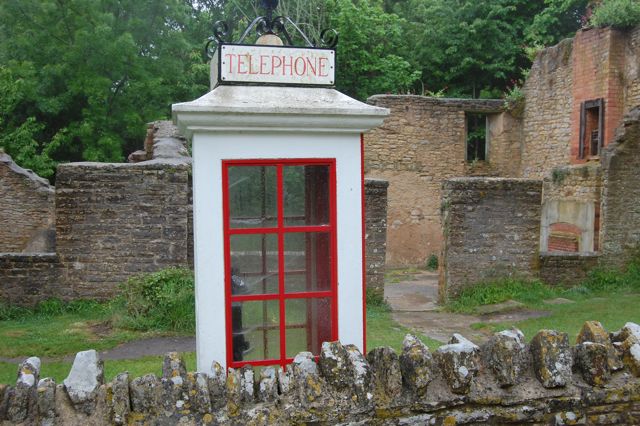
“To drive down into the Tyneham valley is to sink into a zone where even the sharpest of actualities seems overtaken by myth,” observes Patrick Wright. The birdsong is rich and multi-layered, as if the birds have expanded and deepened their repertoire free of the distracting presence of mankind. The graveyard and restored schoolyard – both scrupulously maintained by the Army – are poignant reminders of the temporariness of our places. The small Elizabethan mansion, unstable and gutted, speaks of wayward shelling.
Deserted places exert a particular pull. If Nature abhors a vacuum, the imagination adores one, drawn in by the possibility and promise of an empty lost place.
Tent reviews
We went for a stroll around a camping fair held in a field at the back of Middle Farm, near Lewes. Dozens of tents were pitched for the inspection of prospective buyers, from the Vango Dart 200 – a pop-up festival tent – to the enormous Wolf Lake 7, a grand’s worth of polycotton aircraft hanger.
Pitched on long grass, the zipped-in groundsheets were swampy underfoot, and the bigger the tent, the looser and sloppier they felt. I don’t like tents that pretend to be houses. They remind me of vegetarian sausages. Why pretend to be something you are not?
Thirty-three years after Bob Gillis revolutionised the industry by inventing the first geodesic backpacking tent, the Oval Intention, this camping fair seemed intent on taking a big step backward, being more in the spirit of those despised tan-and-orange monsters of Vintage Camping. The Oval Intention used tension to provide integrity to its structure, following the geodesic dome popularised by Buckminster Fuller. Here the design of large tunnel tents like the Outwell Florida 6 owed more to Wisteria Lane – superfluous weight added to make a tent that looks like a suburban terrace, pitched with a rotary clothes drier in the yard to add to the air of domesticity.
I have a strong aversion to tents with windows. A tent is not a house.  You should not be sitting in your tent peering out at your neighbours through a thick sheet of plastic. I don’t want a tent with a wardrobe either. Or a carpet. Outwell’s wall-to-wall carpet comes in a box illustrated with a picture of a happy couple laughing sensuously. Because that’s how in-tent wall-to-wall carpet makes you feel. This is campsite as temporary suburb.
We wandered into the camping shop. We are in the market for a table but none of the tables on show survived five minutes with the boy toddler. We are also in the market for less stuff. That’s what camping teaches you – that you don’t need all that stuff. After an hour, I bought a five quid foot pump, ignoring the motorised ones. Let my children inflate an airbed. Let them know what that feels like.
 The highlight of the fair was Outwell’s Indian Lake tent, a teepee with a porch, erected around a thick central pole. I would have liked to have a crack at pitching it, to test the promise of it being “easy to pitch and pack”. Like the little conical hat atop the Vaude Badawi II, the peak is meant to aid ventilation, although the design of the Indian Lake felt like a pretentious hotch-potch where the Vaude Badawi II is a more elegant evocation of the nomad. Of the others on show, we like the Vango Tigris 800 and 600 tunnels, cheap and very easy to pitch for a family tent, although the extension looked like a right dog’s dinner slung onto the back. How long before some enterprising firm decides to cash-in on the British habit of suburbanising everything they touch by manufacturing a conservatory that attaches to the side of your tent?